
Last updated: November 9, 2026 – By Eddie Brennan
November 2026 update: reconfirmed recharge, condenser, evaporator, and compressor cost ranges.
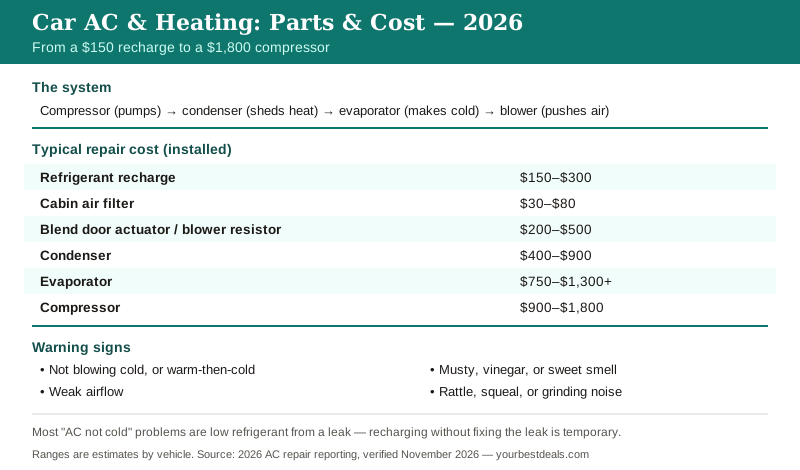
Your car’s AC costs anywhere from a $150 recharge to a $1,800 compressor, depending on what’s wrong – and the good news is that the most common complaint, weak or warm air, is usually one of the cheaper problems. The system works by moving refrigerant through a loop: the compressor pumps it, the condenser sheds heat up front, the evaporator behind the dash makes the cold air, and the blower pushes it into the cabin. When it stops blowing cold, the usual culprit is low refrigerant from a slow leak, which is cheap to recharge but needs the leak fixed to last. These are estimated ranges that vary by vehicle, so confirm your car locally.
AC work picks up every summer, and the thing I most want drivers to know is the cost ladder: a recharge and a cabin filter are cheap, the compressor and evaporator are the pricey end, and a simple recharge that skips the leak is money down the drain. This guide covers what each part does, the warning signs, and what the common repairs cost, with links to detailed diagnostic pages.
How the AC and heat work
The AC is a closed loop that moves heat out of the cabin. The compressor, driven by the engine, pressurizes the refrigerant and pushes it to the condenser at the front of the car, which sheds that heat to the outside air. The refrigerant then expands and cools as it passes through the evaporator behind your dashboard, and the blower motor blows cabin air across that cold evaporator to give you cold air. Refrigerant is the working fluid, and the whole system depends on it being sealed and full.
Heating is simpler and separate: it uses hot engine coolant routed through a small radiator-like heater core behind the dash, with the blower pushing air across it. That’s why “no heat” often ties back to the cooling system or a stuck blend door rather than the AC. Both heat and AC share the blower and the blend doors that direct airflow, which is why one failed part – a blend door actuator or a blower resistor – can affect both. Understanding the loop helps you place where a symptom is coming from.
Repair costs, cheapest to most expensive
Here’s the rough installed cost for common AC and heating repairs, cheapest first. Treat these as estimated ranges, since access and parts vary a lot by vehicle.
| Repair | Typical installed cost | Notes |
|---|---|---|
| Refrigerant recharge | $150–$300 | Fix the leak too, or it won’t last |
| Cabin air filter | $30–$80 | Fixes weak airflow and odors |
| Blend door actuator / blower resistor | $200–$500 | Temperature or fan-speed problems |
| Condenser | $400–$900 | Part $150–$400 |
| Evaporator | $750–$1,300+ | High labor – dash removal |
| Compressor | $900–$1,800 | The big one |
| Full system replacement | $1,500–$3,000 | Compressor, condenser, evaporator, lines |
The evaporator is the sleeper cost: the part isn’t always expensive, but it’s buried behind the dashboard, so the labor to reach it can dominate the bill. The compressor is the headline expense. Everything above the condenser row is relatively affordable, which is why a proper diagnosis that lands you on a recharge, filter, or actuator instead of a compressor makes a big difference.
Straight From the Invoice: the cheap fix and the expensive one
These are jobs I either did myself or watched come through the bay – a recharge done right, a cheap airflow fix, and a compressor.
Invoice #1 – 2016 Honda Civic, recharge with leak fix, Columbus OH
AC blowing warm from low refrigerant; we found a leaking O-ring, fixed it, and recharged. Total landed a bit above a bare recharge because of the leak repair, but it actually lasted. Lesson: a recharge alone on a leaking system is a temporary fix – pay a little more to fix the leak and it holds.
Invoice #2 – 2015 Ford F-150, weak airflow, cabin filter, Ohio
Owner thought the AC was failing; the air was cold but barely moving. It was a filthy, clogged cabin air filter – a sub-$80 fix. Lesson: weak airflow with cold air is often just a clogged cabin filter, not a system failure. Check the cheap thing first.
Invoice #3 – 2013 Subaru Outback, failed compressor, Ohio
Grinding noise and no cold air; the compressor had seized and shed debris into the system, so it needed the compressor plus a flush and drier. Well over a thousand. Lesson: a failing compressor caught early is one job; a seized one that contaminates the system is a bigger, pricier repair.
Warning signs and what they point to
The most common complaint is AC that isn’t blowing cold, or that blows cold then warm – usually low refrigerant from a leak, sometimes a compressor or electrical issue. Weak airflow, where the air is cold but barely moving, is often a clogged cabin air filter or a blower problem. Air that comes out the wrong vents or at the wrong temperature points at a blend door actuator. And smells tell their own story: musty or vinegar smells usually mean mold on a damp evaporator, while a sweet smell can mean a coolant leak from the heater core.
Noises matter too. A rattle, squeal, or grinding when the AC kicks on points at the compressor or its clutch and shouldn’t be ignored, because a failing compressor that seizes can contaminate the whole system and turn a moderate repair into an expensive one. If your AC isn’t blowing cold, start with the refrigerant and leak check; if you hear compressor noise, see our signs of a failing compressor guide. Catching compressor trouble early is the difference between a repair and a bigger repair.
Shop Talk
Be careful with those cheap “AC recharge in a can” kits from the parts store. They’ll get you cold air for a while, but they don’t fix the leak that let the refrigerant out, and the ones with sealer or dye in them can gum up a shop’s expensive recovery equipment and complicate a proper repair later – some shops charge extra to clean it out. If your AC is low, it’s low because it leaked, and refrigerant doesn’t get used up in a sealed system. The smart move is to have the leak found and fixed, then recharge. A recharge that lasts a week just tells you the leak is big.
What Gets Misdiagnosed
The most common AC misdiagnosis is treating low refrigerant as the problem instead of the symptom. The system is sealed, so if it’s low, it leaked – recharging without finding the leak gets you cold air that fades in weeks or months, and you’re back paying for another recharge. A proper AC service includes leak detection, often with dye or an electronic sniffer, so the recharge actually lasts. Chasing recharges is how people spend more over a summer than one proper repair would have cost.
The second is mistaking a cheap airflow problem for an expensive system failure. Weak air is often just a clogged cabin filter or a blower issue, and wrong-temperature air is frequently a blend door actuator – none of which is a compressor. People fear the worst and get quoted the worst when the real fix is under $500. So before accepting a big AC quote, make sure someone has checked the cheap causes: filter, actuator, and refrigerant with a leak search. Matching the symptom to the actual failed part is what keeps an AC repair from ballooning.
The Real Number
Car AC repairs run cheap to expensive: a recharge is $150 to $300, a cabin filter $30 to $80, a blend door actuator or blower resistor $200 to $500, a condenser $400 to $900, an evaporator $750 to $1,300-plus, and a compressor $900 to $1,800 – all estimated ranges. Most “not cold” complaints are low refrigerant from a leak, so fix the leak, don’t just recharge, or you’ll be back. Check the cheap causes – cabin filter, actuator, refrigerant – before accepting a big quote, and don’t ignore compressor noise, because a seized compressor contaminates the system and turns a repair into a bigger one.
Frequently Asked Questions
How much does car AC repair cost?
It depends on the part. A refrigerant recharge runs $150 to $300, a cabin air filter $30 to $80, and a blend door actuator or blower resistor $200 to $500. Bigger jobs include a condenser at $400 to $900, an evaporator at $750 to $1,300 or more, and a compressor at $900 to $1,800, with a full system replacement $1,500 to $3,000. These are estimated ranges that vary by vehicle. Because the cheap fixes are so much less than the compressor or evaporator, a proper diagnosis matters – many “AC failures” turn out to be a recharge, filter, or actuator rather than a major component.
Why is my car AC not blowing cold air?
The most common reason is low refrigerant from a slow leak, since the system is sealed and refrigerant doesn’t get consumed – if it’s low, it leaked out. Other causes include a failing compressor, a clogged condenser, an electrical fault, or a stuck blend door sending warm air. Because low refrigerant is both common and cheap to recharge, that’s the first thing to check, but the leak must be found and fixed or the recharge won’t last. If a recharge holds only briefly, the leak is significant. See our AC not blowing cold guide for the full diagnosis.
How long does an AC recharge last?
In a properly sealed system, a recharge should last for years, because refrigerant isn’t consumed – it just circulates. So if your AC needed a recharge, it means refrigerant leaked out, and how long the recharge lasts tells you how big the leak is. A recharge that fades in weeks means a significant leak; one that lasts a year or two might be a tiny seep. Either way, the lasting fix is to find and repair the leak rather than repeatedly recharging. A shop can add dye or use an electronic detector to locate it, so the next recharge actually holds.
Is it cheaper to fix the AC or just recharge it?
It depends on why it’s low, but repeatedly recharging a leaking system usually costs more over time than fixing the leak once. A single recharge is $150 to $300, but if the leak is significant you’ll be back every few weeks or months, and those add up fast. Finding and fixing the leak – often a cheap O-ring or a moderate condenser or hose repair – makes the recharge last. The exception is a very slow seep that only needs topping up every couple of years, where recharging can be the pragmatic choice. A leak search tells you which situation you’re in.
Why does my AC smell bad?
A musty or mildew smell usually means mold and bacteria growing on the damp evaporator behind your dash, which is common and often fixed with an evaporator cleaner or by running the fan without AC to dry it out. A vinegar smell is a similar microbial issue. A sweet, syrupy smell is different and more concerning – it often means coolant leaking from the heater core, which is a repair worth diagnosing. And a rotten smell can be debris like leaves in the intake or a very clogged cabin air filter. Matching the smell to the cause points you at the right, usually inexpensive, fix.
Can I drive with a broken AC compressor?
You can usually drive with a bad AC compressor, but with caveats. If the compressor has seized, it can affect the serpentine belt that also drives other components, so a seized compressor should be addressed before it strands you or damages the belt. If it’s just not engaging, you’ll have no cold air but the car runs fine otherwise. The bigger issue is that a failing compressor which sheds metal debris can contaminate the whole AC system, turning a compressor job into a compressor-plus-flush-and-drier job. So driving on a noisy or failing compressor risks a larger repair – get it checked promptly.
Why does my car overheat when the AC is on?
Running the AC adds load and heat: the condenser sits in front of the radiator, and the compressor draws engine power, so a marginal cooling system can tip into overheating with the AC on. Common causes are a failing radiator cooling fan or condenser fan, a low or old coolant system, a clogged radiator, or a weak water pump. Since the AC condenser and the radiator share airflow, a fan that isn’t pulling enough air affects both. If your car only overheats with the AC on, have the cooling fans and the overall cooling system checked. Our overheating guide covers the causes.
Sources
Car AC and heating repair cost ranges verified against 2026 industry cost reporting on November 9, 2026. Figures are estimated ranges that vary widely by vehicle; confirm with a shop for your specific car.
- ConsumerAffairs – cost of car AC repair, 2026
- K&K Richardson – car AC recharge cost, 2026
- UseCalcPro – car AC repair cost calculator, 2026
Related Guides
- Why is my car AC not blowing cold air?
- 6 signs of a failing AC compressor
- 9 reasons your engine is overheating
- What does a check engine light mean?

Eddie Brennan spent 11 years as an ASE Master Certified technician at an independent shop in Columbus, OH, where AC work spiked every summer and the fix was usually cheaper than the customer feared. His A6 electrical/electronic certification covers the compressor clutch and blower diagnostics behind these repairs. He takes no referral fees and drives a 250,000-mile 2015 Subaru Outback and a 2020 Ford F-150.