
Last updated: November 6, 2026 – By Eddie Brennan
November 2026 update: refreshed the five starter-failure signs, the battery-first rule, and the starter replacement cost.
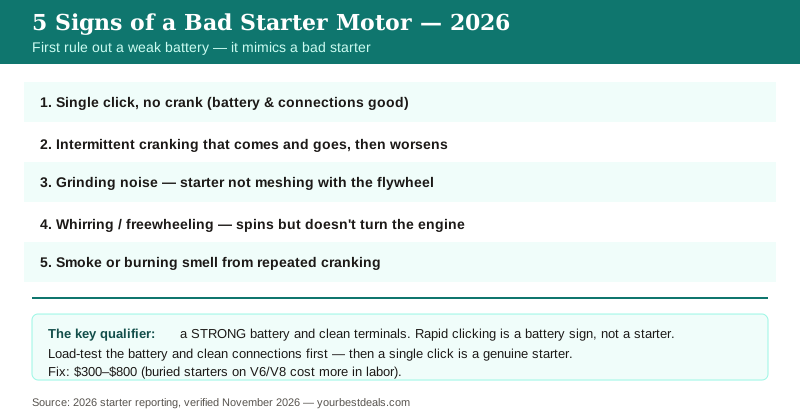
A failing starter motor shows five signs – but only once you’ve ruled out the battery, because a weak battery mimics a bad starter and is the far more common culprit. The five: a single click with no crank when the battery is strong, intermittent cranking that comes and goes and gets worse, a grinding noise as the starter fails to mesh with the flywheel, a whirring or freewheeling sound where the starter spins but doesn’t turn the engine, and smoke or a burning smell from repeated cranking. Replacement runs $300 to $800.
The most important thing on this page is the qualifier “with a good battery.” I saw countless starters replaced that were fine – the battery was weak or a terminal was corroded, and nobody checked. So before you read a single click as a starter, load-test the battery and clean the connections. With those ruled out, these five signs point really to the starter. For the full cost breakdown, see our starter replacement cost guide.
Rule out the battery first
This step saves the most money, so it comes before the signs. A weak or dying battery, or a corroded battery terminal, produces symptoms nearly identical to a bad starter – and it’s a $150 battery or a free terminal cleaning instead of a $400 starter. The clearest tell: rapid clicking when you turn the key is a battery symptom, not a starter one, caused by the solenoid trying and failing because there isn’t enough current. So load-test the battery and clean and tighten the terminals first. Only once the battery is confirmed strong and the connections clean do the following signs actually point to the starter.
The 5 signs (with a good battery)
1. A single click with no crank
You turn the key, the dash lights and headlights stay strong, and you get a single loud click but the engine doesn’t turn over. With a confirmed-good battery, that single click is the starter solenoid engaging but the motor failing to spin – a classic dying-starter sign. The strong lights are the key detail: if the lights dim or you hear rapid clicking, that’s the battery instead. A single, solid click with healthy electrics points at the starter.
2. Intermittent cranking that worsens
The car cranks and starts fine sometimes, and other times just clicks or does nothing, with the failures becoming more frequent over days or weeks. This intermittent, worsening pattern – again, with a good battery – is a very common way a starter dies, as worn brushes or a failing solenoid make contact inconsistently. It’s a warning with a deadline: the starter will eventually fail completely, so it’s a repair to do on your schedule before it strands you.
3. A grinding noise when starting
A grinding sound as you start, similar to the noise of accidentally turning the key when the engine’s already running, means the starter’s gear isn’t meshing cleanly with the engine’s flywheel ring gear. This comes from a worn starter drive gear or worn flywheel teeth. Grinding is worth acting on promptly, because a starter that grinds can chew up the flywheel ring gear, turning a starter job into a much bigger flywheel repair. Don’t keep cranking through a grind.
4. A whirring or freewheeling sound
You turn the key and hear the starter spin up with a high-pitched whir, but the engine doesn’t crank – the starter motor is running but not engaging the flywheel. This “freewheeling” means the starter’s gear isn’t extending to mesh, from a worn drive or solenoid. The motor spins freely without doing its job. Like the other signs, it points to a starter that’s failing mechanically and needs replacing before it stops engaging entirely.
5. Smoke or a burning smell
Smoke or a burning-electrical smell, usually after repeated cranking attempts, means the starter is drawing too much current and overheating, often from an internal short or from being run too long trying to start a car that won’t. This is a sign to stop cranking – continued attempts can damage the starter further or the wiring. A starter that smokes or smells hot is failing electrically and needs attention, not another round of key-turning.
Straight From the Invoice: starter calls
These are jobs I either did myself or watched come through the bay – a battery mistaken for a starter, a real starter, and a grind that took the flywheel.
Invoice #1 – 2012 Nissan Altima, “starter” that was a battery, Columbus
Rapid clicking on a cold morning, owner sure it was the starter. The battery load-tested weak and a terminal was corroded. A $150 battery and a clean terminal, no starter. Lesson: rapid clicking is the battery – ruling it out first saved a needless $400 starter.
Invoice #2 – 2014 Honda Civic, real starter, independent, Ohio
Strong battery, single click, intermittent no-crank that got worse – a genuine dying starter. Reman unit, about $360. Confirmed by a good battery and clean connections. Lesson: a healthy battery with a single click and intermittent cranking is a real starter, and $300-$450 is fair on a compact.
Invoice #3 – 2013 truck, grind that took the flywheel, Texas
A grinding start the owner cranked through for weeks. The starter drive chewed the flywheel ring gear, adding a flywheel job to the starter. Lesson: don’t keep cranking through a grind; a starter that grinds can damage the flywheel and double the repair.
Shop Talk
Before you spend a dime on a starter, do the free battery check: load-test it and clean the terminals. If the battery’s strong and clean and you still get a single click, intermittent cranking, or a whir with no crank, then it’s a genuine starter. But if it’s rapid clicking or the lights dim, that’s the battery, and a starter won’t fix it. One more thing: if you hear grinding, stop cranking and get it in, because a grinding starter can chew up the flywheel and turn a $400 starter into a much bigger job.
What it costs and why access matters
A starter replacement runs $300 to $800 on most cars, with the part $150 to $400 and the rest labor. The big swing is access: on many four-cylinder engines the starter is easy to reach and it’s a quick job, but on plenty of V6 and V8 engines, especially trucks, the starter sits buried under the intake manifold, and reaching it means hours of labor. That’s why a truck starter can cost double a compact’s for the same basic part. See our starter cost guide for the full breakdown, and ask the shop whether your engine has an exposed or buried starter before authorizing the work.
A quality remanufactured starter is usually the value pick, rebuilt with new internals and carrying a warranty for less than new. Avoid the cheapest no-name reman, which can fail early and strand you again. Between confirming the battery is good, catching the failure on the first intermittent signs rather than after a grind ruins the flywheel, and choosing a quality reman part, a starter stays a manageable repair.
The Real Number
The five starter signs – a single click with strong lights, intermittent cranking, grinding, whirring, and a burning smell – only point to the starter once you’ve ruled out the battery, since rapid clicking and dim lights are the battery instead. Load-test the battery and clean the terminals first, free. Then a genuine starter is a $300-to-$800 job, more on a buried truck starter. Catch it on the first intermittent signs, don’t crank through a grind that can ruin the flywheel, and choose a quality reman part.
Frequently Asked Questions
What are the signs of a bad starter?
With a confirmed-good battery: a single loud click and no crank while the lights stay strong, intermittent cranking that comes and goes and worsens, a grinding noise as the starter fails to mesh with the flywheel, a whirring or freewheeling sound where the starter spins but doesn’t turn the engine, and smoke or a burning smell from repeated cranking. The critical qualifier is a healthy battery and clean connections, because a weak battery and rapid clicking mimic a bad starter. Rule out the battery first, then these signs point truly to the starter.
How do I know if it’s the starter or the battery?
The sound and the lights tell you. Rapid clicking, or a single click with the dash and headlights dimming, points to a weak battery or a bad connection. A single solid click with the lights staying strong, or intermittent cranking with a good battery, points to the starter. Nothing at all can be either, plus the ignition. The sure way is to load-test the battery and clean the terminals first, both free at a parts store – if the battery is strong and clean and the car still won’t crank, it’s the starter.
Can I still drive with a bad starter?
Not reliably. A failing starter often works intermittently at first, so you might get a few more starts, but you’re gambling on being stranded wherever you park next, since once it fully fails the car won’t crank until it’s replaced. If your starter shows intermittent symptoms, handle it before it leaves you stuck, and meanwhile park where you can get a jump or a tow. Unlike some slow-wear parts, a starter tends to fail suddenly after the warning signs, so don’t push your luck once it’s acting up.
What does a bad starter sound like?
Most often a single loud click when you turn the key, with the engine not cranking and the lights staying strong. It can also be a grinding noise, meaning the starter gear isn’t meshing cleanly with the flywheel, or a high-pitched whir or freewheeling sound, meaning the motor spins but doesn’t engage the engine. What it usually is not is rapid clicking, which is a weak-battery sound. So a single click, a grind, or a whir with a good battery points to the starter, while chatter-chatter clicking points to the battery.
Why is a starter more expensive on some cars?
Almost entirely because of access. On many four-cylinder engines the starter is easy to reach and the job is quick, but on plenty of V6 and V8 engines, especially trucks, the starter is tucked under the intake manifold, so reaching it means removing parts and booking three to four hours of labor instead of one. The starter part might be under $250, but the access turns the total into $600 to $800 or more. That’s why a truck starter can cost double a compact’s. Ask whether your engine’s starter is exposed or buried.
Should I replace my starter with a reman or a new one?
For most cars, a quality remanufactured starter is the right call – it’s rebuilt with new brushes, bearings, and a fresh solenoid, carries a warranty, and costs well under new. Avoid the cheapest no-name reman units, which can fail early and strand you again, but a reputable brand’s reman is a sound, cost-effective repair. Consider new OEM mainly for luxury or European cars, or when the starter is buried and the labor is high enough that you never want to do the job twice. See our starter cost guide.
Is a grinding starter urgent?
Yes, more than the other signs, because a grinding starter can damage the flywheel. The grinding means the starter’s drive gear isn’t meshing cleanly with the engine’s flywheel ring gear, and continued cranking through the grind can chew up the flywheel teeth. That turns a $300-to-$800 starter job into a much bigger flywheel repair. So if your starter grinds, stop cranking and get it in promptly rather than forcing more starts. Catching a grind early keeps the damage to the starter alone instead of spreading to the flywheel.
Sources
Starter failure signs and cost figures verified against 2026 reporting on November 6, 2026. Costs vary by vehicle and access; rule out the battery and connections before replacing the starter.
- RepairPal – starter replacement cost estimate
- ConsumerAffairs – starter replacement cost, 2026
- CarParts.com – starter replacement cost breakdown
Related Guides
- Starter replacement cost
- Car electrical system guide
- Why won’t my car battery hold a charge?
- Alternator replacement cost

Eddie Brennan is an ASE Master Certified technician (including A6, Electrical/Electronic Systems) who spent 11 years at an independent shop in Columbus, OH, and saved plenty of customers from a needless starter by load-testing the battery first. He writes the repair and diagnostic guides on Your Best Deals and takes no referral fees. He drives a 250,000-mile 2015 Subaru Outback and a 2020 Ford F-150.