
Last updated: November 8, 2026 – By Diane Holcomb
November 2026 update: reconfirmed the date-code formats and the free-test option.
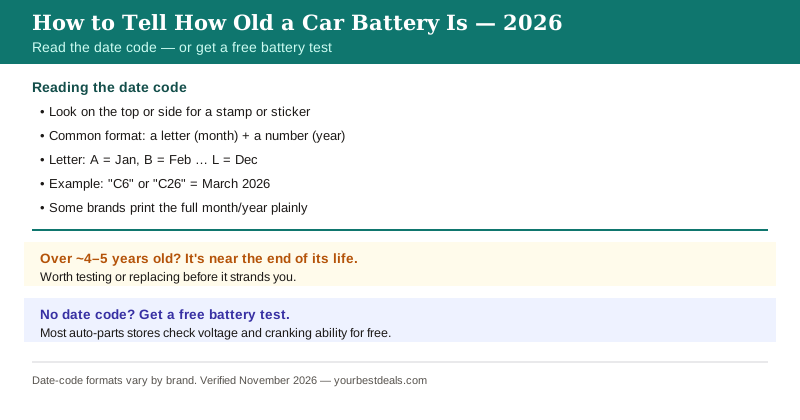
To tell how old your car battery is, find its date code – a stamp or sticker usually on the top or side of the battery. The most common format is a letter and a number: the letter is the month (A = January, B = February, on through L = December) and the number is the year, so a code like “C6” or “C26” means March 2026. Some brands skip the code and just print the full month and year. Once you know the date, the rule of thumb is simple: a battery more than about 4 to 5 years old is near the end of its typical life and worth testing or replacing before it leaves you stranded. And if you can’t find or read a date code, any auto-parts store can test the battery for free and tell you where it stands.
Customers asked me this all the time when buying a used car or wondering if their current battery was living on borrowed time. Knowing the age turns “should I worry?” into a clear answer, and it takes about thirty seconds once you know where to look. Let me show you how to find and read the code, and what to do with the number.
Finding and reading the date code
Look on the top of the battery first, then the sides, for either a raised stamp in the plastic case or a small sticker. You’re looking for a short code, commonly two characters. In the standard format, the first character is a letter for the month and the second is a number for the year:
| Code element | Meaning | Example |
|---|---|---|
| Letter (1st) | Month: A=Jan, B=Feb … L=Dec | C = March |
| Number (2nd) | Year | 6 or 26 = 2026 |
| Full code | Month + year | C6 / C26 = March 2026 |
So “C6” reads as March 2026. Formats do vary by brand – some print the month and year in plain text (like “03/26” or “MAR 26”), some put the code on a round sticker with a punched or written month and year, and a few use their own scheme. If the code is ambiguous, the manufacturer’s name is on the battery and you can look up their specific date-code format, or just have it tested. The date tells you when the battery was made, which for a battery installed new is close enough to its in-service age.
Shop Talk
This trick is most valuable in two moments. First, when buying a used car: pop the hood and read the battery’s date code before you buy. If it’s a 5-year-old battery, that’s a $150-to-$300 replacement coming soon that you can factor into your offer – and a swollen case or heavy terminal corrosion is a bargaining chip. Second, when you buy a new battery: check its date code before you leave the store. Batteries lose some charge sitting on a shelf, so you want one that was made recently, ideally within the last few months, not one that’s been sitting in the back for a year. A reputable store will swap a stale one for fresh stock if you ask. And a practical habit: when you do install a new battery, write the install date on it with a paint pen or a sticker, so in a few years there’s no guessing – you’ll know exactly how old it is and can plan the replacement before a cold morning plans it for you.
Where Drivers Overpay
The overpay this prevents is getting stranded and paying emergency prices – a tow, a roadside jump, or a rushed battery bought at whatever’s nearby – because you didn’t know the battery was old. A thirty-second date-code check tells you when a battery is entering its risky years (4 to 5-plus), so you can replace it on your schedule at a store with free install rather than at the worst possible moment. See our battery cost guide for what to budget.
The reverse waste is replacing a battery just because it “seems old” without confirming it’s actually weak. Age is a guide, not a verdict – a well-maintained 4-year-old battery may still test strong, while a poorly-charged 3-year-old may be failing. So pair the date code with a free battery test (which checks voltage and cranking ability) before deciding: the code tells you when to start watching, and the test tells you when to actually replace. Together they keep you from both getting stranded and from tossing a good battery early.
The Real Number
Find the date code on the battery’s top or side: a letter for the month (A=Jan … L=Dec) plus a number for the year, so “C6” or “C26” means March 2026. Over about 4 to 5 years old, it’s near the end and worth testing or replacing before it strands you. Can’t find or read the code? Get a free battery test at any parts store. Check the date when buying a used car (and when buying a new battery – you want fresh stock), and write the install date on any battery you put in.
Frequently Asked Questions
How do I read a car battery date code?
The most common format is a letter and a number: the letter is the month (A = January, B = February, through L = December) and the number is the year, so “C6” or “C26” means March 2026. Look for it stamped in the plastic or on a sticker on the top or side of the battery. Some brands instead print the full month and year plainly (like “03/26” or “MAR 26”), or use a round sticker with a punched date. Formats vary by manufacturer, so if it’s unclear, look up that brand’s date-code key or have the battery tested.
Where is the date code on a car battery?
Usually on the top of the battery or on one of the sides, as either a raised stamp molded into the plastic case or a small sticker. Check the top first, then the sides, and look for a short code of a couple of characters or a printed month and year. On some batteries it’s near the brand label or the handle. If you can’t locate any code, the manufacturer’s name is on the battery so you can look up where they place it, or simply take it to a parts store, which can test it and often identify the age.
How old is too old for a car battery?
A battery more than about 4 to 5 years old is near the end of its typical 3-to-5-year life and should be tested regularly and replaced before it fails. Age alone isn’t a death sentence – a well-maintained battery may test fine at 4 years, while a mistreated one fails at 3 – but once you’re past that window, the risk of being stranded climbs. Use the date code to know when you’ve entered the risky years, then let a free battery test decide the exact replacement timing. Replacing proactively beats an emergency.
Can I tell a battery’s age without the date code?
Yes – if the date code is missing or unreadable, take the battery (or the car) to an auto-parts store for a free battery test, which checks voltage and cranking ability and effectively tells you whether it’s healthy or worn out regardless of age. That test is arguably more useful than the date anyway, since it measures actual condition. You can also check for physical signs of an old, failing battery: slow cranking, needing jumps, corrosion on the terminals, or a swollen case. When in doubt, the free test settles it.
Why should I check a battery’s date when buying a new one?
Because batteries slowly lose charge and age while sitting on a shelf, so you want one manufactured recently – ideally within the last few months – rather than one that’s been in storage for a year. A stale battery may have a shorter usable life and start out partially discharged. Check the date code before you leave the store, and if the one you’re handed is old, ask for fresher stock; a reputable retailer will swap it. This small check helps you get the full life you’re paying for.
Does the date code tell me when the battery was installed?
It tells you when the battery was manufactured, not installed, but for a battery bought and installed new the two are usually close, so it’s a good proxy for in-service age. The gap matters mainly if a battery sat in storage a long time before installation, or in a used car where you don’t know the history. That’s why writing the actual install date on the battery (with a paint pen or sticker) when you replace it is a smart habit – it removes any guesswork about age later. For most cars, the date code is close enough.
What are the physical signs of an old car battery?
Beyond the date, watch for slow cranking when you start the car, needing jump-starts, dimming lights at idle, a check of the battery warning, corrosion buildup on the terminals, or a visibly swollen or bulging case (a sign of heat damage and a reason to replace promptly). A rotten-egg smell can indicate a leaking or overcharged battery. Any of these on a battery that’s also 4 to 5-plus years old strongly suggests it’s time to replace it. Confirm with a free battery test, which measures whether it can still deliver proper cranking power.
Sources
Date-code formats and age guidance reflect standard battery-industry practice, reviewed November 2026. Specific codes vary by manufacturer.
- Interstate Batteries – battery date codes and support
- AAA – car battery basics
- NAPA – battery care resources
Related Guides
- Car Battery Replacement Cost
- How Long Does a Car Battery Last?
- What Does the Battery Light Mean?
- Signs of a Failing Alternator
- Electrical System Guide

Diane Holcomb spent seven years as a service advisor at multi-brand dealerships in Charlotte, NC, where reading a battery’s date code was step one on any used-car inspection or “is my battery about to die” question. She drives a 2019 Honda CR-V and a hand-me-down 2007 Toyota Camry, and takes no referral fees or advertising money from any shop or chain.