
Last updated: November 9, 2026 – By Eddie Brennan
November 2026 update: refreshed the voltage reference numbers and the load-test guidance.
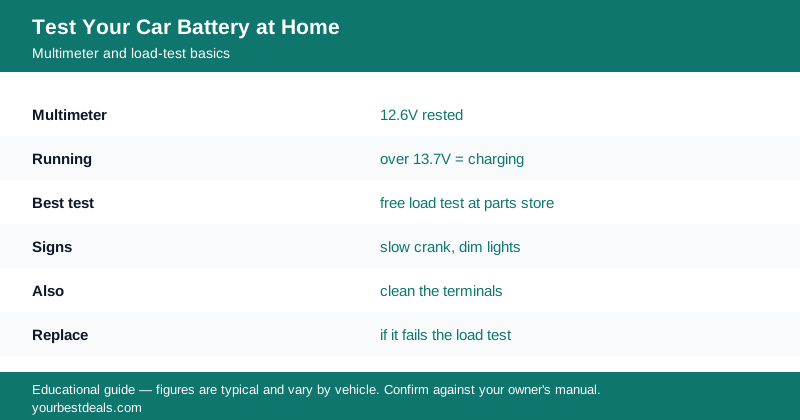
You can check your car battery at home with a cheap multimeter in a few minutes. Three numbers tell most of the story. Resting voltage (engine off, ideally sat a few hours): about 12.6V means fully charged, 12.4V roughly 75%, 12.2V about 50%, and 12.0V or below is discharged. Cranking voltage (while someone starts the engine): it should dip but stay above roughly 9.6V – a plunge well below that points to a weak battery. Charging voltage (engine running): the alternator should bring it up to about 13.7–14.7V; much lower means the battery isn’t being charged, much higher means an overcharge problem. A multimeter shows voltage, but true capacity needs a load test – which most auto parts stores do free.
The battery and charging system are the first thing I check on any no-start or hard-start, because people blame the battery when it’s the alternator, and the alternator when it’s a corroded cable. Three voltage readings sort out which it is in about five minutes.
What you need and the resting-voltage test
A basic digital multimeter (inexpensive) is all you need for the voltage checks. Set it to DC volts (the 20V range). For the resting-voltage test, the car should have sat without running for a few hours ideally (a freshly driven battery reads high from the surface charge and overstates its state). Touch the red probe to the positive terminal, black to the negative, and read: ~12.6V fully charged, ~12.4V about 75%, ~12.2V about 50%, 12.0V or below discharged. A battery resting at 12.4V or lower is worth charging and retesting; one that won’t hold above ~12.4V after a full charge is likely failing.
The cranking and charging tests
For the cranking test, leave the meter connected and have someone start the engine while you watch the reading. The voltage will drop momentarily as the starter draws current – that’s normal – but a healthy battery should hold above roughly 9.6V during cranking. A drop well below that (into the 8s or lower) suggests the battery can’t deliver current under load, i.e., it’s weak even if resting voltage looked okay.
For the charging test, with the engine running, read the voltage at the battery again: it should rise to about 13.7–14.7V as the alternator charges. If it stays near resting voltage (barely above 12.6V) with the engine running, the charging system isn’t doing its job – a bad alternator, belt, or connection. If it climbs well above ~15V, that’s an overcharge condition (often a voltage regulator fault) that can cook a battery. For more on charging-system diagnosis, see our alternator replacement guide.
Shop Talk
A multimeter tells you voltage, but voltage alone can fool you – a battery can read a healthy 12.6V at rest and still fail under the load of starting, because what’s dying is its capacity, not its voltage. That’s why the cranking test (watching the voltage hold up while the engine starts) matters more than the resting number, and why a real load test is the gold standard. The good news: almost every auto parts store will test your battery and charging system for free, using a proper load tester that reports the battery’s actual cranking amps against its rating and tells you pass/fail. So the smart move is to do the quick multimeter checks at home to get a sense of things, then, if the battery is marginal or you’re chasing a no-start, take it (or drive the car) to a parts store for the free load test before buying anything. The other field tip: before condemning a battery, check the terminals and cable connections – corrosion (the white or greenish fuzz) or a loose clamp causes a huge number of “dead battery” and hard-start complaints, and cleaning the terminals is free. A lot of batteries get replaced when the real problem was a dirty connection. Clean the terminals, test the voltage, confirm with a free load test, then decide.
What Gets Misdiagnosed
The most common electrical mix-up is battery versus alternator versus connection. A battery that keeps going dead might be a bad battery – or a bad alternator not charging it, or a parasitic drain, or just corroded terminals. Resting voltage, cranking voltage, and charging voltage together separate these: good resting voltage but a crank-voltage plunge points to the battery; good battery but low charging voltage points to the alternator; good everything but it still dies overnight points to a parasitic drain.
The other is condemning a battery on resting voltage alone. A battery can read 12.6V and still fail under load because its capacity is gone – so a resting number that looks fine doesn’t clear the battery. The cranking test and a proper load test are what actually confirm capacity.
The Real Number
Three multimeter readings tell most of the story: resting voltage (~12.6V full, 12.0V or below discharged), cranking voltage (should hold above ~9.6V while starting), and charging voltage (~13.7–14.7V with the engine running). Resting voltage alone can fool you – a battery can read fine and still fail under load – so check the crank test and clean the terminals before condemning anything. Then confirm with the free load test almost any auto parts store offers. For charging-system repair cost, see our alternator guide.
Frequently Asked Questions
What voltage should a healthy car battery read?
A healthy 12-volt car battery should read about 12.6 volts at rest (engine off, after sitting a few hours), which indicates a full charge; lower resting readings indicate a lower state of charge – roughly 12.4V is about 75% charged, 12.2V about 50%, and 12.0V or below is essentially discharged. The “at rest” part matters: measure after the car has sat without running for a few hours if possible, because a battery just charged by driving carries a surface charge that reads artificially high (often 12.8V or more) and overstates the true state of charge. With the engine running, the reading should be higher – about 13.7 to 14.7 volts – because the alternator is actively charging; that’s a different measurement (charging voltage) and shouldn’t be confused with resting voltage. So the quick interpretation: ~12.6V resting is good, 12.4V or below means the battery is partly discharged and worth charging and retesting, and a battery that won’t hold above roughly 12.4V even after a full charge is likely failing. Keep in mind that resting voltage measures state of charge, not capacity – a battery can show 12.6V and still be unable to deliver enough current to start the car, which is why the cranking test and a load test matter. Use the resting voltage as a first screen, then confirm health under load. For charging issues, see our alternator replacement guide.
How do I test a car battery with a multimeter?
To test a car battery with a multimeter, set the meter to DC volts (the 20V range on most meters), then touch the red probe to the battery’s positive terminal and the black probe to the negative terminal, and read the voltage – doing this in three scenarios gives you the full picture. First, the resting test: with the engine off (ideally after the car has sat a few hours), read the voltage; about 12.6V means fully charged, and 12.0V or below means discharged. Second, the cranking test: leave the probes connected and have someone start the engine while you watch the meter; the voltage will dip as the starter draws power, but it should stay above roughly 9.6V – a drop well below that signals a weak battery that can’t hold up under load. Third, the charging test: with the engine running, read again; it should rise to about 13.7–14.7V, confirming the alternator is charging (if it stays near 12.6V, the charging system has a problem; if it climbs above ~15V, it’s overcharging). Make sure your connections are clean and the probes are making solid contact for accurate readings, and observe safety around the battery (no sparks near it, as batteries can vent flammable gas). These three readings – resting, cranking, charging – let you distinguish a bad battery from a charging-system problem. For capacity, a load test (free at most parts stores) is the confirmation. For charging repairs, see our alternator replacement guide.
Can a battery read good voltage but still be bad?
Yes – a car battery can read a healthy resting voltage (around 12.6V) and still be bad, because resting voltage measures the battery’s state of charge, not its capacity to deliver current under load, and a battery with degraded internal plates can show full voltage while being unable to supply the amps needed to crank the engine. This is one of the most important things to understand about battery testing: voltage and capacity are different properties. An aging battery, or one with sulfated or shorted cells, may hold a normal-looking 12.6V at rest but collapse the moment it has to deliver the high current the starter demands – which is why a car can start fine one day and fail the next, or why a battery passes a quick voltage check but still leaves you stranded. The way to catch this is to test under load: the cranking test with a multimeter (watching whether the voltage holds above ~9.6V while starting) gives a hint, and a proper load test (which most auto parts stores perform free) is the definitive check, because it draws a heavy current from the battery and measures whether it can maintain voltage, revealing lost capacity that resting voltage hides. So never clear a battery on resting voltage alone, especially if you’re chasing an intermittent no-start or the battery is several years old. If the resting voltage is fine but you’re having starting trouble, get a load test before assuming the battery is okay. For related charging diagnosis, see our alternator replacement guide.
How can I tell if it’s the battery or the alternator?
You can distinguish a bad battery from a bad alternator with the charging-voltage test: with the engine running, a healthy charging system should bring the battery voltage up to about 13.7–14.7V, so if it reads in that range the alternator is charging (pointing to the battery as the problem), while if it stays near resting voltage (barely above 12.6V) with the engine running, the alternator isn’t charging and is the likely culprit. Here’s the logic: the battery’s job is to start the car, and the alternator’s job is to recharge the battery and power the car while running. If the battery keeps dying, it’s either a bad battery (can’t hold a charge), a bad alternator (not recharging it), or something draining it. The charging test separates the first two: good charging voltage (13.7–14.7V running) plus a battery that still goes dead points to the battery or a drain; low charging voltage (staying near 12.6V running) points to the alternator or its belt/wiring. Other alternator clues include a battery warning light, dimming headlights at idle that brighten when you rev, or the car dying shortly after a jump-start (meaning the alternator isn’t keeping it alive). If the car runs after a jump but dies soon, suspect the alternator; if it needs a jump after sitting but then runs fine, suspect the battery or a drain. The free parts-store test checks both. For alternator repair cost, see our alternator replacement guide.
How long does a car battery last?
Most car batteries last somewhere around 3 to 5 years, though the range is wide – some fail in 2 to 3 years in hot climates, while others last 6 years or more in milder conditions and with good charging and usage – so battery age is one of the first things to consider when you’re having starting trouble. The biggest factor in battery life is heat: contrary to what many assume, hot climates are harder on batteries than cold ones (heat accelerates the internal chemical breakdown and fluid loss), so batteries in southern, hot regions often live at the shorter end of the range while those in moderate climates last longer. Other factors include how the car is used (lots of short trips that never fully recharge the battery shorten its life, as does letting it sit discharged), the charging system’s health (an overcharging or undercharging alternator stresses the battery), vibration (a poorly secured battery wears faster), and simply the battery’s quality. Cold weather doesn’t kill batteries so much as expose already-weak ones – a battery weakened by age or heat often fails on the first cold morning because cold reduces its available power and thickens the oil the starter has to turn, so winter is when borderline batteries give up. The practical takeaway: if your battery is 4+ years old and you’re seeing slow cranking or needing jumps, its age alone makes it a prime suspect, and a load test will confirm. Testing it before winter is smart insurance. For a replacement cost estimate, see our car battery replacement guide.
Why does my battery keep dying overnight?
If your battery keeps dying overnight despite being in good condition, the likely cause is a parasitic drain – something in the car continuing to draw power after it’s shut off and the key is out – rather than the battery itself, especially if the battery tests healthy and the charging system is working. Normally a car draws a tiny amount of current with everything off (to keep memory in modules, clocks, alarms), but a fault can cause an excessive draw that flattens the battery over hours: a stuck relay, a glovebox or trunk light that stays on, an aftermarket accessory (dash cam, stereo, alarm) wired incorrectly, or a failing module that doesn’t “sleep.” The way to diagnose a parasitic drain is to measure the current draw with the car off (using a multimeter set to measure amps, in series with the battery, after the car’s modules have gone to sleep), then pull fuses one at a time to find which circuit the excess draw is on – this narrows it to the system at fault. If your battery is healthy (tests good, charges fine) but still dies when the car sits, a parasitic drain is the prime suspect and worth diagnosing rather than just replacing the battery, which won’t fix the underlying draw. Of course, first rule out the simple things: a battery that’s simply old and failing, a charging system not fully recharging it, or corroded connections. But a good battery that dies overnight points to a drain. A shop can perform a parasitic draw test to pin it down. For battery replacement cost, see our car battery replacement guide.
Is it safe to test a car battery myself?
Testing a car battery’s voltage with a multimeter is safe to do yourself as long as you follow basic precautions, because the voltage measurement itself is low-risk – a 12V automotive battery won’t shock you through dry skin – but car batteries do carry two real hazards to respect: they can deliver very high current (a short across the terminals can cause sparks, burns, or damage) and they can vent flammable hydrogen gas, so you avoid sparks near the battery. The practical safety steps: make sure your multimeter probes only touch the intended terminals and don’t bridge both terminals with a tool or jewelry (remove rings and watches), keep sparks and flames away (especially important if the battery has been charging or is gassing), wear eye protection as a sensible precaution since batteries contain acid, and if you’re doing the cranking test, keep hands and the meter leads clear of moving engine parts and the belt when the engine starts. For the amperage/parasitic-draw test (measuring current in series), take extra care, as connecting a meter set to amps incorrectly can blow its fuse or create a spark, so that test is a bit more advanced. For most people, the voltage tests (resting, cranking, charging) are simple and safe with a basic meter and these precautions. If you’re uncomfortable, the free test at an auto parts store removes any risk and uses professional equipment. So yes, it’s a reasonable DIY check – just respect the high-current and flammable-gas hazards, avoid shorting the terminals, and keep sparks away.
Sources
Battery-testing voltage references and procedures verified against standard automotive electrical practice in November 2026. Confirm capacity with a professional load test before replacing.
- ASE – National Institute for Automotive Service Excellence
- NHTSA – vehicle safety
- Cars.com – maintenance and repair resources
Related Guides
- 8 Reasons Your Car Battery Is Dead
- Car Battery Replacement Cost
- Alternator Replacement Cost
- Starter Replacement Cost
- Electrical Guides

Eddie Brennan is an ASE Master Certified technician (A6 Electrical/Electronic Systems) who spent 11 years in an independent shop in Columbus, OH, before a back injury moved him into writing. The battery and charging system were his first check on any no-start – three voltage readings usually told him whether it was the battery, the alternator, or a dirty cable. He drives a 2015 Subaru Outback with over 250,000 miles and a 2020 Ford F-150, and takes no referral fees or advertising money from any shop or chain.