
Last updated: November 6, 2026 – By Diane Holcomb
November 2026 update: reconfirmed module pricing, the rebuilt-board option, and the confirm-the-cause point.
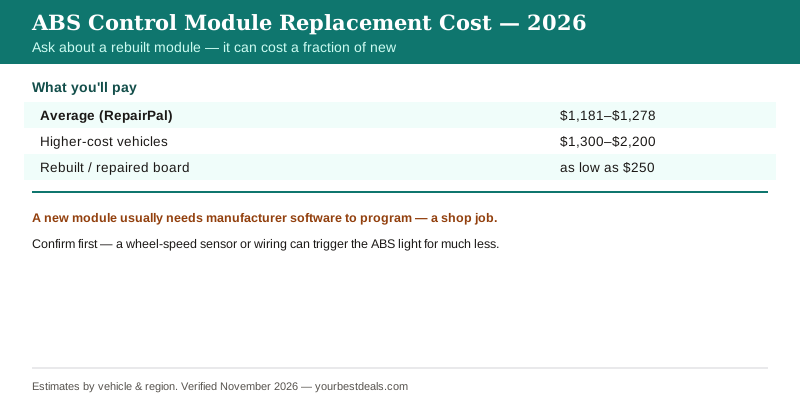
An ABS control module replacement runs about $1,181 to $1,278 on average (per RepairPal), with make-specific jobs ranging higher – roughly $1,300 to $2,200 on some vehicles. But there’s an important cheaper option: a rebuilt or repaired module can cost as little as $250 when only the circuit board is damaged, which is a real money-saver worth asking about. A new module usually has to be programmed with manufacturer software to match your car, so this is generally a shop job rather than a plug-and-play part. Signs of a failing module include the ABS warning light, loss of anti-lock braking function, and sometimes traction or stability control warnings. Before paying for a module, confirm it’s actually the fault – a wheel-speed sensor or wiring problem can trigger the ABS light for far less than a module.
Two things keep this repair from being as expensive as the headline number: the rebuilt-module option and confirming the module is really the culprit. Let me cover the cost, the repair-vs-replace angle, and the cheaper look-alikes.
What you’ll actually pay
Here’s the price picture. These are estimated ranges that vary by vehicle and shop.
| Option | Cost | Notes |
|---|---|---|
| Average (RepairPal) | $1,181–$1,278 | New module, parts + labor |
| Higher-cost vehicles | $1,300–$2,200 | Luxury / European |
| Rebuilt / repaired board | as low as $250 | If only the board is bad |
The ABS module (often part of the hydraulic control unit) manages anti-lock braking and, on many cars, traction and stability control. Because a new one needs programming, it’s generally a dealer or capable-shop job. Our brakes guide covers the ABS system.
Shop Talk
Two things can knock this repair down from the $1,200-plus headline. First, confirm the module is actually bad before buying one. An ABS light does not automatically mean a dead module – the far more common cause is a failed wheel-speed sensor (one at each wheel), and those are much cheaper. Dirty sensor tone rings, wiring or connector corrosion, and low brake fluid can also set the light. So the right first step is a scan: the trouble codes usually point to a specific wheel-speed sensor or circuit, and only when the codes and testing implicate the module itself should you be buying a module. Second, ask about module repair. There are specialist companies that rebuild or repair the ABS module’s circuit board – you (or the shop) send the unit in, they fix the failed component, and it comes back for a fraction of a new module, sometimes around $250. That route takes a little longer (shipping time) and the car’s ABS is down meanwhile, but the savings are large. And remember a new module usually needs programming to your car, so factor that into any quote; a “cheap” module online that can’t be programmed isn’t a deal.
Where Drivers Overpay
The biggest overpay is buying a module when the ABS light was really a wheel-speed sensor – the most common cause – or dirty tone rings, wiring corrosion, or low brake fluid. All of those cost far less than a module, and a scan usually points right at the specific wheel or circuit. Confirming the module is the fault before buying one is the key.
The second is paying full price for a new module without exploring a rebuilt one. Specialist companies repair the module’s circuit board for a fraction of new (sometimes ~$250), at the cost of some downtime. And a cheap online module that can’t be programmed to your car is no bargain. The pattern: scan and confirm the cause, consider a board repair, and account for programming in any new-module quote.
The Real Number
A new ABS module averages $1,181 to $1,278 (up to ~$2,200 on some cars), but confirm it’s really the module first – an ABS light is more often a cheap wheel-speed sensor, dirty tone ring, wiring, or low fluid, and a scan points to the specific wheel. If the module itself is bad, ask about a circuit-board repair, which can run around $250. A new module needs programming to your car, so factor that in – a non-programmable online part isn’t a deal.
Frequently Asked Questions
How much does it cost to replace an ABS control module?
On average about $1,181 to $1,278 per RepairPal, with some vehicles – particularly luxury and European models – running roughly $1,300 to $2,200. A rebuilt or repaired module, where a specialist fixes the circuit board rather than replacing the whole unit, can cost as little as $250 when only the board is damaged. These are estimates that vary by vehicle and shop. A new module usually has to be programmed with manufacturer software to work with your car, so it’s generally a shop job, and that programming should be included in any quote. The wide spread is why confirming the actual cause and exploring a repair are worthwhile.
Does an ABS light always mean a bad module?
No – in fact, the module is one of the less common causes. An ABS warning light is more often triggered by a failed wheel-speed sensor (there’s one at each wheel), and those are much cheaper to replace. Dirty or damaged sensor tone rings, corroded wiring or connectors, and low brake fluid can also set the light. That’s why a diagnostic scan is the right first step: the trouble codes usually point to a specific wheel-speed sensor or circuit. Only when the codes and testing implicate the module itself does replacing it make sense. Assuming the module is bad without a scan risks spending over a thousand dollars on the wrong part.
Can an ABS module be repaired instead of replaced?
Often, yes. Specialist companies rebuild or repair ABS module circuit boards – the unit is removed and sent in, they repair the failed electronic components, and it’s reinstalled, typically for a fraction of a new module (sometimes around $250). This is a legitimate money-saving route when the failure is in the module’s electronics rather than its hydraulic portion. The trade-offs are the turnaround time (shipping the unit out and back, during which the car’s ABS is offline) and finding a reputable rebuilder. For many drivers facing a $1,200-plus new-module quote, asking the shop about a module repair is well worth it before committing to a brand-new unit.
Is it safe to drive with the ABS light on?
Your regular brakes still work with the ABS light on – the car will stop normally under ordinary braking. What you lose is anti-lock function, so in a hard or emergency stop, especially on wet or slippery roads, the wheels could lock up and you’d lose some steering control during that stop. On many cars, an ABS fault also disables traction and stability control. So you can drive carefully to get it diagnosed, but you shouldn’t treat it as nothing, particularly in bad weather. If the regular brake warning light is also on (not just ABS), that’s more serious and suggests a brake-system problem that should be checked right away before driving.
What causes an ABS module to fail?
Genuine module failures usually come from electronic faults – corrosion or moisture intrusion damaging the circuit board, failed solder joints, or internal component wear, often on higher-mileage vehicles. Electrical issues like voltage spikes can also contribute. That said, what gets blamed on the module is frequently something else in the ABS system: a wheel-speed sensor, wiring, or a tone ring. True module failure is confirmed by diagnostic codes and testing that rule out those cheaper causes. Because corrosion is a common culprit, vehicles in wet or salted climates can be more prone to module problems, but proper diagnosis is still what separates an actual module failure from a look-alike.
Why does a new ABS module need programming?
Because modern ABS modules are computers that must be configured to your specific vehicle – its ABS, traction, and stability-control parameters – and integrated with the car’s other systems. A new module typically comes blank or generic and has to be programmed (and sometimes calibrated) with manufacturer software so it communicates correctly. This is why it’s generally a dealer or well-equipped shop job, and why a cheap module bought online that can’t be programmed to your car isn’t actually usable as a bargain. When comparing quotes, make sure programming is included; a part price alone can be misleading if the programming is a significant separate charge or isn’t available outside the dealer.
Should I go to a dealer or an independent shop?
Either can work, depending on capability. The main requirement is that the shop can program the new module to your vehicle, which the dealer can always do and many well-equipped independents can too. Independents are often less expensive on labor, and some will also handle the send-out module-repair route that can save a lot over a new unit. A dealer may be the simpler choice on newer or luxury vehicles with proprietary programming. Whichever you choose, confirm they’ve properly diagnosed the fault (so you’re not replacing a module when a sensor was the problem) and that programming is included in the quote. Getting a couple of estimates helps on a repair this costly.
Sources
Price ranges verified against 2026 ABS control module pricing in November 2026. Dollar amounts are estimates that vary by vehicle and shop.
- RepairPal – ABS control module replacement cost
- Rick’s Free Auto Repair Advice – ABS module failures and costs
- ASE – National Institute for Automotive Service Excellence
Related Guides

Diane Holcomb spent seven years as a service advisor at multi-brand dealerships in Charlotte, NC, where an ABS light on the estimate meant “scan it first” – because it was usually a wheel-speed sensor, not the pricey module. She drives a 2019 Honda CR-V and a hand-me-down 2007 Toyota Camry, and takes no referral fees or advertising money from any shop or chain.