
Last updated: November 8, 2026 – By Diane Holcomb
November 2026 update: reconfirmed fan pricing and the check-the-relay-first point.
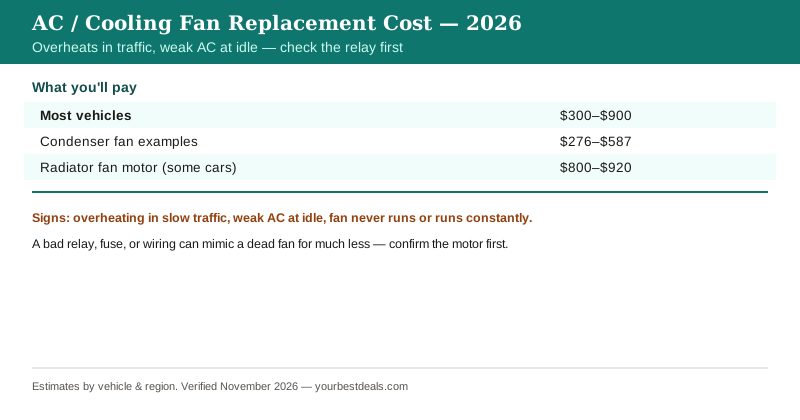
An AC condenser fan or radiator cooling fan replacement runs roughly $300 to $900 for most vehicles. Examples: a Nissan Frontier condenser fan lands around $294 to $364, a Hyundai Sonata condenser fan motor around $276 to $587, and a radiator fan motor around $800 to $920 on some cars. Cost rises when the fan sits behind the condenser or needs the radiator removed to reach it. The cooling fan (or fans) pulls air through the radiator and the AC condenser, so a failed one shows up as overheating in slow traffic or at idle, weak AC when you’re stopped or crawling, and sometimes a fan that never runs – or runs constantly. One money-saver up front: a bad fan relay, fuse, or wiring can mimic a failed fan for much less, so confirm the fan motor itself is the fault before replacing it.
The giveaway with a cooling fan is that problems show up when you’re stopped or slow – exactly when the fan has to do the airflow the moving car normally provides. Let me cover the cost, the symptoms, and the cheaper look-alikes to rule out.
What you’ll actually pay
Here’s the price picture. These are estimated ranges that vary by vehicle and shop.
| Item | Cost | Notes |
|---|---|---|
| Most vehicles | $300–$900 | Fan motor or assembly |
| Condenser fan examples | $276–$587 | Common cars |
| Radiator fan motor (some cars) | $800–$920 | Behind the radiator |
Access drives the labor – a fan in front of the condenser is easier than one that needs the radiator or other parts removed. Our cooling system guide and AC repair guide cover how the fan serves both cooling and AC.
Shop Talk
The cooling fan earns its keep when the car isn’t moving. At speed, air rushes through the radiator and condenser on its own; at idle or in stop-and-go traffic, the fan is what keeps that air flowing. So the classic signs of a dead fan are temperature creeping up in slow traffic but settling once you’re moving, and AC that blows cold on the highway but goes weak at a long red light. Before you buy a fan motor, though, have the actual cause confirmed, because the fan not spinning doesn’t always mean the fan is bad. A blown fuse, a failed fan relay, a bad temperature sensor telling the fan when to run, or corroded wiring can all leave a perfectly good fan sitting still – and those are far cheaper fixes. A good tech checks whether the fan gets power and ground when it should before condemning the motor. Also, many cars have two fans (or a dual-fan assembly), so sometimes only one motor has failed; and if the fan is behind the radiator, the labor is higher because of what has to come out. Don’t ignore a non-working fan, though: repeated overheating in traffic can cause real engine damage, so it’s worth fixing promptly once the cause is pinned down.
Where Drivers Overpay
The main overpay is replacing the fan motor when the fan wasn’t actually the failed part. A fan sitting still can be a blown fuse, a bad relay, a faulty temperature sensor, or corroded wiring – all cheaper than a motor. A tech verifying the fan gets power and ground when it should is what separates a dead motor from a dead circuit.
The other consideration is access and count: some cars have two fans and only one failed, and a fan behind the radiator costs more in labor than one in front. The pattern: confirm the motor itself is bad (not the relay, fuse, sensor, or wiring), check whether one or both fans failed, and fix it promptly, since repeated overheating in traffic can damage the engine.
The Real Number
An AC or cooling fan is $300 to $900 (more if it’s behind the radiator). The tells are overheating in slow traffic and weak AC at idle – problems that ease once you’re moving. But confirm the fan motor is actually bad first: a blown fuse, bad relay, faulty temperature sensor, or corroded wiring can stop a good fan for far less. Fix it promptly, because repeated overheating in traffic can damage the engine.
Frequently Asked Questions
How much does it cost to replace an AC or cooling fan?
Roughly $300 to $900 for most vehicles. Condenser fan examples run around $276 to $587 (a Nissan Frontier about $294 to $364, a Hyundai Sonata fan motor $276 to $587), while a radiator fan motor can run about $800 to $920 on some cars. Cost rises when the fan sits behind the condenser or requires removing the radiator or other parts to access it. These are estimates that vary by vehicle and shop. Because many cars have a dual-fan assembly, whether one or both fan motors need replacing – and whether the whole assembly is sold as a unit – affects the price. A model-specific quote is most accurate.
What are the signs of a bad cooling fan?
The clearest signs appear when the car isn’t moving: the engine temperature climbing in slow or stop-and-go traffic but settling once you’re moving again, and AC that blows cold at speed but goes weak at idle or a long red light. That’s because the fan provides the airflow the moving car normally supplies. You might also notice the fan never running when it should, running constantly, or being unusually loud. Overheating warnings are a serious version of this. Because these same symptoms can come from a relay, fuse, sensor, or wiring problem rather than the fan motor itself, the actual cause should be confirmed before replacing the fan.
Does a cooling fan affect the AC?
Yes. In most cars the same fan (or fans) that cools the radiator also pulls air through the AC condenser mounted at the front. When you’re stopped or moving slowly, the AC condenser relies on the fan to move air across it and shed heat; if the fan isn’t working, AC performance drops at idle and low speed even though it may be fine at highway speed. So weak AC specifically when parked or in slow traffic, combined with the engine running hot in the same conditions, points toward a fan problem. This dual role is why a failed cooling fan shows up as both an overheating issue and an AC issue at low speeds.
Is it always the fan motor, or could it be something cheaper?
Often it’s something cheaper, which is why confirming the cause matters. A fan that isn’t spinning can be caused by a blown fuse, a failed fan relay, a faulty coolant-temperature or other sensor that tells the fan when to run, a bad fan control module, or corroded wiring and connectors – all less expensive than a new fan motor. A good technician checks whether the fan is receiving power and ground when it should before condemning the motor. So if you’re quoted a fan replacement, it’s reasonable to ask whether the relay, fuse, sensor, and wiring were checked first. Replacing the motor when the real fault is a $20 relay is a common avoidable overpay.
Can I drive with a bad cooling fan?
Only cautiously, and not for long. On the highway, airflow from motion may keep the engine cool enough, but in slow traffic, at idle, or in hot weather, a non-working fan can let the engine overheat – and repeated or sustained overheating can cause serious, expensive engine damage like a warped head or blown head gasket. You’ll also have poor AC at low speeds. So while you might make a short trip keeping an eye on the temperature gauge and avoiding traffic, a failed cooling fan should be fixed promptly. If the temperature climbs into the red, stop and let it cool rather than risk the engine.
Why do cooling fans fail?
The electric fan motor wears out over time – brushes and bearings degrade, and the motor can seize or weaken. Heat, moisture, and road debris contribute, and corrosion can affect the motor or its wiring and connectors. Sometimes the fan blade is damaged by debris, or the fan clutch (on older or some truck setups with mechanical fans) fails. Related electrical parts – the relay, fuse, sensor, or control module – also fail and stop the fan without the motor being bad. High mileage and years of heat cycling are the usual backdrop. Because both the motor and its supporting electronics can cause a no-spin fan, pinpointing which one failed is the key to the right repair.
Should I replace both fans if my car has two?
Not automatically – it depends on their condition. Many vehicles have two cooling fans or a dual-fan assembly, and sometimes only one motor has failed. If the other fan is working well and isn’t the same age-related failure risk, replacing just the bad one is reasonable. However, if both are high-mileage and the assembly is sold as a single unit, or the second fan is also showing signs of wear, doing both can save a repeat visit. Ask the shop whether your car has separate replaceable fans or a combined assembly, and about the condition of the second fan, then decide. There’s no need to replace a good fan just because its partner failed.
Sources
Price ranges verified against 2026 cooling and condenser fan repair pricing in November 2026. Dollar amounts are estimates that vary by vehicle and shop.
- RepairPal – condenser/cooling fan replacement estimates
- ASE – National Institute for Automotive Service Excellence
- AAA – auto repair resources
Related Guides
- Coolant & Cooling System Guide
- 9 Reasons Your Engine Is Overheating
- Car AC Repair Cost
- Radiator Replacement Cost
- Car Repair Cost Estimator

Diane Holcomb spent seven years as a service advisor at multi-brand dealerships in Charlotte, NC, where a “weak AC at the drive-thru, fine on the highway” complaint was the tell for a cooling fan – but she always had the relay checked before quoting a motor. She drives a 2019 Honda CR-V and a hand-me-down 2007 Toyota Camry, and takes no referral fees or advertising money from any shop or chain.