
Last updated: November 8, 2026 – By Diane Holcomb
November 2026 update: reconfirmed leak-source pricing and the diagnose-first point.
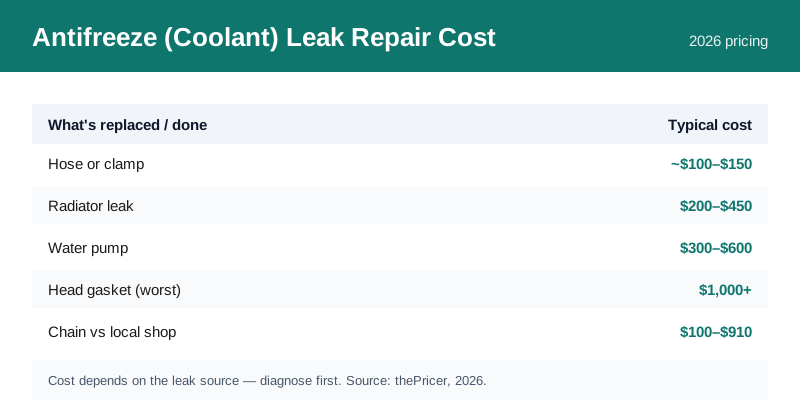
An antifreeze (coolant) leak repair isn’t one price – it’s whatever the leaking part costs, and that ranges from about $100 to $150 for a hose or clamp, $200 to $450 for a radiator leak, $300 to $600 for a water pump, up to $1,000 or more for a head gasket. Overall, chain auto centers run about $100 to $835 and local mechanics $165 to $910, depending on the source. Antifreeze is the coolant that circulates through the engine and radiator to keep it from overheating in summer and freezing in winter. A leak shows up as a puddle of sweet-smelling green, orange, yellow, or pink fluid under the car, a dropping coolant level, white steam, or the temperature gauge climbing. Because the cost depends entirely on where it’s leaking, the first step is a diagnosis – usually a pressure test – to find the source before anyone quotes a repair.
“Coolant leak” could be a $100 hose or a $1,000 head gasket, so finding the source is everything. Let me break it down.
What you’ll actually pay
Here’s the range by leak source. These are estimates that vary by vehicle and shop.
| Leak source | Cost | Notes |
|---|---|---|
| Hose or clamp | ~$100–$150 | Cheapest |
| Radiator | $200–$450 | Common |
| Water pump | $300–$600 | Moderate |
| Head gasket | $1,000+ | Worst case |
A coolant leak can come from many parts; our coolant leak guide, radiator hose guide, and water pump guide cover the specific sources.
Shop Talk
“Antifreeze” and “coolant” are the same thing, and a leak can come from a lot of places – a hose or clamp, the radiator, the water pump, the thermostat housing, the heater core (inside the car), the coolant reservoir, a freeze plug, or, worst case, the head gasket or engine itself. That’s why the price swings so wildly, and why the smart first move is a proper diagnosis. A shop pressure-tests the cooling system (and may add UV dye) to find exactly where it’s escaping, so you fix the one part that’s leaking instead of guessing. Two things to watch. One, the sweet smell and the fluid color: coolant is sweet-smelling and usually green, orange, yellow, or pink – a puddle of that under the front of the car is the tell. (It’s also toxic to pets, so clean it up.) Two, the real danger isn’t the leak itself, it’s running the engine low on coolant and overheating, which can warp the head or blow the head gasket – turning a cheap hose leak into a $1,000-plus engine repair. So if your temperature gauge climbs, pull over and shut it off. Keep the coolant topped up with the correct type while you get it diagnosed. And catch leaks early: a $100 hose fixed now beats the overheating damage a neglected leak causes.
Where Drivers Overpay
The waste here is skipping the pressure-test diagnosis and throwing parts at a leak – replacing a water pump when a $100 hose was the source. Since the cost swings from $100 to $1,000+ by part, a proper diagnosis that pinpoints the leak is the save.
The bigger cost is ignoring the leak until it overheats the engine: a cheap hose leak left to run low can warp the head or blow the head gasket, a four-figure repair. The pattern: diagnose the source with a pressure test, fix the one leaking part, keep coolant topped up meanwhile, and never drive on an overheating engine.
The Real Number
An antifreeze leak is a hose at ~$100–$150, a radiator at $200–$450, a water pump at $300–$600, or a head gasket at $1,000+ – the source decides the price, so get a pressure-test diagnosis first. A sweet smell and green/orange/pink fluid under the car are the signs. The real risk is overheating: a cheap hose leak ignored until the engine runs low can warp the head, so never drive on a hot gauge.
Frequently Asked Questions
How much does it cost to fix an antifreeze leak?
It depends entirely on where the leak is. A leaking hose or clamp is about $100 to $150, a radiator leak $200 to $450, a water pump $300 to $600, and a head gasket (the worst case) $1,000 or more. Overall, chain auto centers run about $100 to $835 and local mechanics $165 to $910 depending on the source and vehicle. These are estimates that vary by vehicle and shop. Because the cost range is so wide – a cheap hose versus a major engine repair – a proper diagnosis (usually a pressure test, sometimes with UV dye) to find the exact leak source is the essential first step before any quote. Fixing the specific leaking part, rather than guessing, is what keeps you from overpaying. Catching a leak early, before it causes overheating, also keeps the cost down.
What is antifreeze and what does it do?
Antifreeze (also called coolant) is the fluid that circulates through your engine and radiator to manage temperature. Mixed with water, it absorbs heat from the engine and releases it through the radiator, keeping the engine from overheating. It also lowers the fluid’s freezing point so it won’t freeze and crack the engine in winter, raises the boiling point, and contains additives that prevent corrosion and lubricate the water pump. So “antifreeze” and “coolant” are the same thing – it does both the anti-freeze and the cooling job. It circulates through hoses, the radiator, the water pump, the thermostat, the heater core, and passages inside the engine. Because it’s essential to keeping the engine at a safe temperature, losing it through a leak risks overheating, which is why a coolant leak matters beyond just the puddle on the driveway.
Where does antifreeze usually leak from?
Coolant can leak from many points in the cooling system, which is why diagnosis matters. Common sources include: radiator and heater hoses (and their clamps) – often the cheapest fix; the radiator itself (cracks, especially at the plastic end tanks, or corrosion); the water pump (a failing seal); the thermostat housing (often a cracked plastic housing or its gasket); the coolant reservoir/overflow tank; freeze (core) plugs; and the heater core (which leaks inside the cabin, giving a wet floor and foggy windows). The worst case is internal: a blown head gasket or cracked head/block, which can leak coolant internally or externally and is the expensive repair. A pressure test finds the external source; internal leaks show other signs (white exhaust smoke, coolant loss with no visible leak, milky oil). Identifying which source is leaking is what determines the cost and the fix.
Is it safe to drive with an antifreeze leak?
Only with great caution, and not for long – because the real danger is overheating. As coolant leaks, the level drops, and if the engine runs low or empty, it overheats, which can cause severe, expensive damage: a warped cylinder head, a blown head gasket, or even a seized engine. So a small, slow leak might let you drive briefly while watching the temperature gauge and keeping the coolant topped up with the correct type – but a significant leak should be fixed before driving much, and you should never keep driving if the temperature gauge climbs toward hot. If it overheats, pull over and shut the engine off to avoid damage. In short, a coolant leak itself won’t strand you immediately, but ignoring it and letting the engine overheat turns a cheap repair into a major one. Treat a known leak as a fix-it-soon item and monitor the gauge closely.
Why does the cost vary so much?
Because “antifreeze leak” describes a symptom, not a specific repair – and the cooling system has many parts that can leak, ranging from a $10 hose clamp to a head gasket job. A leaking hose or clamp is cheap and quick ($100 to $150). A radiator, water pump, or thermostat housing is a moderate repair ($200 to $600). But a head gasket, cracked head, or engine block leak is a major, labor-intensive repair costing $1,000 or more. So the same symptom – coolant on the ground – can be a minor or a major fix depending entirely on the source. This is exactly why a diagnosis comes first: pressure-testing the system to pinpoint the leak tells you which repair you’re facing. Without that, you can’t know whether it’s a cheap hose or an expensive gasket, and guessing risks paying for the wrong part. The source, not the symptom, sets the price.
Can I use a stop-leak product instead?
Stop-leak products (additives you pour into the coolant to seal small leaks) exist and can be a temporary stopgap for a very minor leak, but they come with real caveats and aren’t a proper repair. They may temporarily slow or seal a tiny leak, which can help you limp to a shop. However, they can also clog the cooling system’s small passages – the radiator, heater core, and narrow coolant channels – potentially causing bigger problems and complicating a proper repair later. Many mechanics advise against them except as an emergency measure. They also don’t fix the underlying problem (a failing hose, radiator, or gasket), so the leak often returns. For a lasting, reliable fix, finding and repairing the actual leaking part is the right approach. So use stop-leak only as a last-ditch, get-me-home measure if at all, and plan on a proper diagnosis and repair rather than relying on an additive.
How do I know if it’s a head gasket versus a simple leak?
The signs differ, and it’s an important distinction because of the cost gap. A simple external leak (hose, radiator, water pump) shows visible coolant dripping or puddling under the car, and a pressure test reveals where it escapes. A blown head gasket, by contrast, often leaks coolant internally and shows different symptoms: white, sweet-smelling exhaust smoke (coolant burning in the cylinders), coolant disappearing with no visible external leak, a milky/foamy appearance in the oil (coolant mixing with oil), bubbles in the coolant reservoir, overheating, and sometimes rough running. A shop can test for combustion gases in the coolant to confirm a head gasket breach. So if you’re losing coolant but can’t find an external leak, and you see white exhaust smoke or milky oil, that points to the head gasket – the expensive repair. A clearly visible external drip is more likely a cheaper hose, radiator, or pump. Diagnosis confirms which.
Sources
Price ranges verified against 2026 coolant leak repair pricing in November 2026. Dollar amounts are estimates that vary by vehicle and shop.
- thePricer – coolant leak repair cost
- RepairPal – repair cost estimator
- ASE – National Institute for Automotive Service Excellence
Related Guides
- Coolant Leak Repair Cost
- Radiator Hose Replacement Cost
- Water Pump Replacement Cost
- Head Gasket Replacement Cost
- Car Repair Cost Estimator

Diane Holcomb spent seven years as a service advisor at multi-brand dealerships in Charlotte, NC, where a coolant leak always got a pressure test first – because “antifreeze on the driveway” could be a $100 hose or a $1,000 head gasket. She drives a 2019 Honda CR-V and a hand-me-down 2007 Toyota Camry, and takes no referral fees or advertising money from any shop or chain.