
Last updated: November 10, 2026 – By Diane Holcomb
November 2026 update: reconfirmed drum pricing and the pair/per-axle convention.
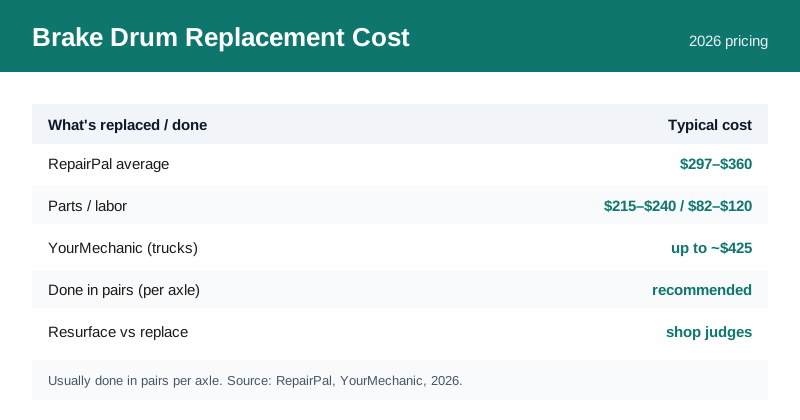
Replacing the brake drums runs about $300 to $425 per axle, with the drum parts roughly $215 to $240 and labor $82 to $120. Heavier trucks and SUVs sit toward the top. Drums are normally replaced in pairs across an axle so both wheels brake evenly. These are estimates that vary by vehicle and shop. The brake drum is the spinning metal housing the brake shoes press against on drum-brake vehicles – usually the rear axle, with disc brakes up front. A worn drum can sometimes be resurfaced (machined smooth) if there’s enough metal left, which is cheaper than replacing; but a drum worn past its limit or badly scored must be replaced. Signs of bad drums include scraping or grinding, a pulsing brake pedal, and weaker braking.
Most cars only have drums on the rear, and they tend to last a long time. When they do need work, the resurface-or-replace call drives the cost. Let me break it down.
What you’ll actually pay
Here’s the picture. These are estimates that vary by vehicle and shop.
| Item | Cost | Notes |
|---|---|---|
| Drum replacement (per axle) | $300–$425 | Pair |
| Drum parts | $215–$240 | Two drums |
| Labor | $82–$120 | Per axle |
| Resurface (per drum) | $10–$30 | If enough metal |
Drums work with shoes and other rear-brake hardware; our drum brake replacement guide covers the full service.
Shop Talk
Here’s what saves you money on drums: they often don’t need replacing at all. Unlike brake pads, which wear out regularly, drums are thick and last a long time – frequently through several sets of shoes. When you do a rear brake job, the shop measures the drum’s inside diameter against the “max” number stamped right on the drum. If there’s enough metal and the surface isn’t badly scored, the drum can be resurfaced (machined smooth on a lathe) for just $10 to $30 each, or sometimes left alone – no new drum needed. Only if the drum is at or past its max diameter, cracked, or too scored does it need replacing. So when a shop quotes you new drums, it’s fair to ask whether they measured them and whether resurfacing is an option. One caveat: drums are replaced (or resurfaced) in pairs per axle so both sides grip evenly – never just one. And if you’re replacing drums, do the shoes and springs at the same time, since the labor to get in there is shared. A good tell that the drums themselves are the problem (not just the shoes): a pulsing brake pedal or a rhythmic noise, which points to an out-of-round or warped drum.
Where Drivers Overpay
The classic overpay is buying new drums when the old ones still had plenty of metal and could have been resurfaced ($10 to $30) or reused. Drums last far longer than pads or shoes, so a measurement should come before any replacement quote.
The value move is bundling: since the labor to pull the drum is the same whether you resurface it or replace it, doing the shoes, springs, and any drum work together in one rear-brake visit spreads that labor. The pattern: ask whether the drums were measured, resurface when there’s metal left, replace in pairs, and do the shoes at the same time.
The Real Number
Brake drum replacement is about $300 to $425 per axle (drums $215 to $240, labor $82 to $120), done in pairs so both sides brake evenly, with trucks at the top. But drums last a long time and often just need resurfacing ($10 to $30 each) or nothing at all – so ask whether the shop measured them before quoting new ones. If you’re replacing drums, do the shoes and hardware at the same time to share the labor.
Frequently Asked Questions
How much does it cost to replace brake drums?
Brake drum replacement runs about $300 to $425 per axle. That covers the drum parts (roughly $215 to $240 for the pair) plus labor of about $82 to $120. Heavier trucks and SUVs tend toward the top of the range because their drums are larger and pricier. These are estimates that vary by vehicle and shop. Keep in mind drums are replaced in pairs across an axle, not one at a time, so both wheels brake evenly. Also, drums often don’t need full replacement – if there’s enough metal, they can be resurfaced for just $10 to $30 each, so ask whether that’s an option before paying for new ones. Since most vehicles only have drums on the rear axle (discs up front), this is usually a rear-brake item. A complete rear drum-brake service also includes checking the shoes and hardware.
Do I need to replace both drums at once?
Yes – like most brake components, drums should be done in pairs across an axle, not one side at a time. The reason is braking balance: if one drum is fresh and the other is worn (different diameter, different surface, different grip), the car can pull to one side under braking, which is unsafe and uneven. Replacing or resurfacing both rear drums together keeps braking even and predictable. The same logic applies to the shoes inside them – do both sides. The good news is that the labor to access the rear brakes covers both wheels in one visit, so doing the pair isn’t double the labor. If a shop offers to replace just one drum, that’s a red flag; ask them to address both sides. Pairing is standard, safe practice and the small extra part cost is worth the even, reliable braking. This is the same pair-per-axle rule that applies to rotors and pads up front.
Can brake drums be resurfaced instead of replaced?
Often, yes – and it’s much cheaper, which is why it’s worth asking about. Resurfacing means machining the drum’s inner surface smooth on a lathe to remove scoring and restore a flat braking surface, typically for just $10 to $30 per drum. It can be done as long as the drum has enough metal left: every drum has a maximum inside-diameter limit stamped on it, and as the surface wears (and gets machined), the diameter grows. If resurfacing would push the drum past that max, or if it’s cracked, deeply scored, or heat-damaged, it must be replaced instead. Because drums are thick and wear slowly, there’s frequently enough metal to resurface or even reuse them during a routine shoe change. So when you’re quoted new drums, a fair question is whether they measured the drums and whether resurfacing is viable. That said, if drums are cheap for your vehicle and the old ones are marginal, some shops just replace them – ask which makes sense for your situation and budget.
What are the symptoms of bad brake drums?
A worn or damaged drum usually announces itself through braking feel and noise. A pulsing or vibrating brake pedal – especially a rhythmic pulse as the wheels turn – often means an out-of-round or warped drum (the shoes grip an uneven surface). Scraping, grinding, or scoring noises can mean the shoes have worn down into the drum or the drum surface is badly scored. You might also notice reduced braking power, the car pulling to one side when braking (uneven drum wear side to side), or a rhythmic noise from the rear that rises with speed. Sometimes the parking brake (which often uses the rear drums) feels weak or doesn’t hold well. Because these symptoms overlap with worn shoes and hardware, a proper rear-brake inspection – pulling the drum and measuring it – is how a shop sorts drum problems from shoe problems. Any grinding or a pulsing pedal is worth getting checked promptly, since rear brakes still do real work and the parking brake depends on them.
How long do brake drums last?
Brake drums are built to last a long time – often well over 100,000 miles, and frequently through two or more sets of brake shoes. They’re thick, solid castings that wear far more slowly than the shoes rubbing against them, which is why they’re commonly resurfaced or simply reused during a shoe change rather than replaced. Their lifespan depends on driving conditions: lots of stop-and-go driving, towing, heavy loads, or mountainous terrain wears them faster, while gentle highway use is easy on them. Rust can also be a factor in wet or salted climates, sometimes pitting the surface. Because rear drum brakes do less of the total braking work than the front discs on most cars, they tend to last longer than front rotors and pads. So for many drivers, the drums themselves may never need replacing over the life of the car – the shoes and hardware inside wear out first. When you do a rear brake service, that’s the moment to have the drums measured and decide whether they’re good to reuse, need resurfacing, or finally need replacing.
Should I replace the shoes at the same time as the drums?
Yes – if you’re in there replacing drums, it almost always makes sense to do the brake shoes (and ideally the springs and hardware) at the same time, because the labor is shared. Getting to the drum means removing it, which exposes the shoes right behind it; replacing the shoes at that point adds the part cost but little extra labor, versus paying the full teardown again later when the shoes wear out. It’s the same logic as doing pads with rotors up front. In fact it’s more common to go the other way – you replace worn shoes and, while you’re there, measure the drums and resurface or reuse them if they’re fine. Either way, the shoes, drums, and hardware are a system that’s best serviced together. A good shop will inspect all of it when the drum is off and tell you what’s worn. Doing the related parts in one visit avoids repeat labor and keeps the rear brakes working as a matched set. For the complete picture of a rear job, see our drum brake guide.
Are drum brakes worse than disc brakes?
For most everyday driving, rear drum brakes work fine – they’re not “worse” so much as a different, older design used on the rear of many economy and midsize cars because the rear brakes do less work. Disc brakes (standard on the front of virtually all cars, and all four corners of many) dissipate heat better, resist brake fade under hard or repeated braking, and perform better when wet, which is why they’re used up front where most braking happens and on performance vehicles. Drums are cheaper to make and conveniently integrate the parking brake, which is why automakers keep them on the rear of budget-friendly models. In normal driving you likely won’t notice a downside to rear drums. The practical differences for an owner are mostly about service: drums are a bit more involved to inspect (the drum must come off), but they often last longer and the parts can be cheaper. If your car has rear drums, there’s no need to worry – just service them on schedule like any brake component. Their long life is actually a cost advantage.
Sources
Price ranges verified against 2026 brake drum pricing in November 2026. Dollar amounts are estimates that vary by vehicle and shop.
- RepairPal – brake drum replacement cost
- Jerry – brake drum replacement cost
- ASE – National Institute for Automotive Service Excellence
Related Guides

Diane Holcomb spent seven years as a service advisor at multi-brand dealerships in Charlotte, NC, where she learned that rear drums usually outlive several sets of shoes – and that the honest move was measuring them before ever quoting a customer new ones. She drives a 2019 Honda CR-V and a hand-me-down 2007 Toyota Camry, and takes no referral fees or advertising money from any shop or chain.