
Last updated: November 4, 2026 – By Diane Holcomb
November 2026 update: refreshed pads-and-rotors per-axle and all-four ranges against 2026 brake-cost reporting and current labor rates.
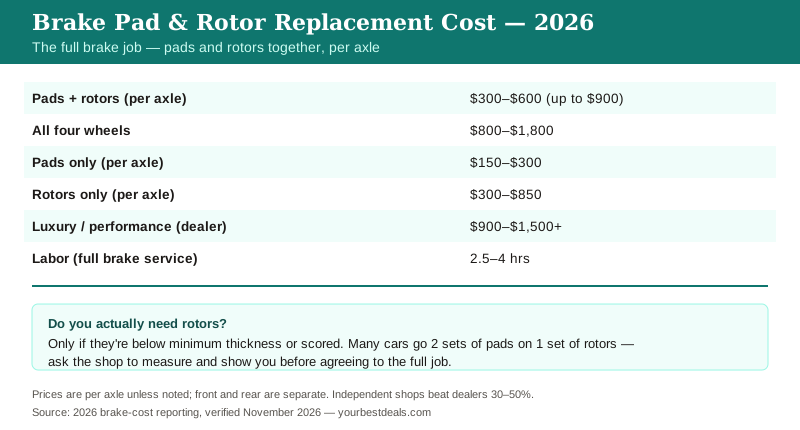
Replacing brake pads and rotors together costs $300 to $600 per axle for most cars in 2026, climbing to $900 on pricier vehicles and $900 to $1,500-plus for luxury or performance cars at a dealer. Doing all four wheels runs roughly $800 to $1,800. The big question this page answers isn’t just the price – it’s whether you actually need rotors at all, because that’s the difference between a $200 pad job and a $600 pads-and-rotors job per axle.
This is the brake quote that makes people flinch, and half the time the flinch is justified and half the time it isn’t. When I wrote these tickets, the honest ones had a rotor measurement behind them and the questionable ones didn’t. So this guide gives you the real ranges and, more importantly, how to tell whether the rotors on your car really need to come off. For the pads-only breakdown, see the brake pad cost guide; for the mechanical side of how rotors wear, that’s covered in our technical brake guides.
Pads and rotors cost breakdown
These are per-axle figures on a standard car, since front and rear are separate jobs. Pads and rotors together is the full brake service most people picture when they say “brake job.”
| Service | Cost per axle | Notes |
|---|---|---|
| Pads + rotors | $300–$600 (up to $900) | The full brake job |
| Pads only | $150–$300 | If rotors still measure good |
| Rotors only | $300–$850 | Rare on its own |
| All four wheels (pads + rotors) | $800–$1,800 | Front and rear together |
| Luxury / performance (dealer) | $900–$1,500+ | Pricier parts and labor |
A full brake service books 2.5 to 4 hours of labor, at rates that top $180 an hour in major markets, which is why the labor half of a pads-and-rotors job is substantial. The parts half depends on rotor quality and your vehicle. As with any brake work, a reputable independent runs 30 to 50 percent below a dealer for identical quality.
Do you actually need rotors?
This is the whole game. Rotors need replacing only when they’re below the manufacturer’s minimum thickness or badly scored or warped – and many cars go through two sets of pads on one set of rotors. So being told you need rotors at your first pad change is worth questioning, while being told at your second or third is often legitimate. The rotor has a minimum thickness stamped right on it, and a shop can measure the actual thickness with a micrometer and show you the two numbers.
Insist on that. An honest shop will happily show you the measurement or point out the deep scoring or the warping you can feel as a pulsing brake pedal. A shop that says “we always do rotors with pads” as a blanket policy is either being lazy or padding the bill, and that’s your cue for a second opinion. Sometimes rotors can even be resurfaced rather than replaced, though many modern rotors are too thin to machine and are cheaper to just replace – a fair shop will tell you which applies.
Straight From the Invoice: pads-and-rotors jobs
I pulled these from actual repair orders I either wrote or reviewed – one where rotors were needed, one where they weren’t, one all-four job.
Invoice #1 – 2014 Honda Accord, front pads + rotors, independent, Ohio
Second brake job on the car; rotors measured below minimum and the shop showed the micrometer reading. $460 front, fair, and the old rotors truly couldn’t take new pads. Lesson: rotors at the second or third pad change, backed by a measurement, are usually the real deal.
Invoice #2 – 2018 Toyota RAV4, quoted pads + rotors, declined rotors, Charlotte NC
A chain quoted $580 for front pads and rotors at the first brake job. The rotors measured fine on request, so the driver got pads only elsewhere for $220. Lesson: “we always replace rotors” isn’t a measurement. Ask for the number, and a $580 job can become a $220 one.
Invoice #3 – 2013 Ford Escape, all four pads + rotors, independent, Texas
Neglected brakes, all four corners real gone – pads and rotors front and rear came to $1,150. Steep, but the car needed every bit of it. Lesson: waiting until all four are shot means an $800-to-$1,800 job instead of catching one axle at a time; brakes are cheaper handled early.
Why the all-four number gets so big
The $800-to-$1,800 all-four figure shocks people, but it’s just two axles of pads-and-rotors plus the labor to do them, and it usually reflects brakes that were let go too long. Fronts wear faster than rears, so if you handle each axle when it’s due, you rarely face all four at once. Letting everything go until the car is grinding on every corner is how a manageable $300-to-$600 axle job becomes a four-figure bill.
The lesson from the shop side is that brakes are cheapest when caught early. A squeal from the wear indicator is your prompt to do one axle of pads before it becomes pads-and-rotors, and before the other axle catches up. Inspect at every oil change, address the front when it squeals, and you’ll almost never see the all-four number.
Shop Talk
When a shop quotes pads and rotors, say one sentence: “Can you measure the rotors and show me the reading against the minimum?” That single question separates the honest quotes from the padded ones. Warped rotors you can often feel yourself – a pulsing or shuddering brake pedal when you slow from highway speed – and really worn ones the micrometer proves. If the shop can show you the number or the scoring, pay for the rotors with confidence. If they can’t or won’t, get pads-only priced somewhere that will measure first.
Where drivers overpay
The number-one overpay on this repair is buying rotors you don’t need. A shop with a “rotors always come with pads” policy will sell you a $600 job when a $220 pad-only job would have done, and the only defense is asking for the measurement. Rotors are legitimately needed sometimes – but “sometimes” is not “every time,” and the micrometer, not the service writer, settles it. The second overpay is the dealer premium on a routine brake job, which runs 30 to 50 percent over an independent for identical quality.
The third is the reverse mistake: waiting so long that a cheap single-axle pad job becomes an all-four pads-and-rotors bill. Neglect turns $300 into $1,500. Catching brakes early – one axle when it squeals, rotors only when they truly measure out – is how you keep this from ever being the four-figure repair. Inspect at oil changes, act on the squeal, and verify the rotors, and brakes stay affordable.
The Real Number
Budget $300 to $600 per axle for pads and rotors, or $800 to $1,800 for all four, with luxury and dealer work higher. The one thing that decides whether you overpay is the rotors: ask the shop to measure them and show you the reading against the stamped minimum, because many cars run two sets of pads on one set of rotors. Use a reputable independent over a dealer to save 30 to 50 percent, catch brakes early so a single-axle pad job never becomes an all-four bill, and never accept “we always do rotors” without a measurement.
Frequently Asked Questions
How much do brake pads and rotors cost in 2026?
Pads and rotors together run $300 to $600 per axle on most cars, up to $900 on pricier vehicles and $900 to $1,500 or more for luxury and performance cars at a dealer. Doing all four wheels totals roughly $800 to $1,800. For comparison, pads alone are $150 to $300 per axle installed, so the rotors are what push the job up. A full brake service books 2.5 to 4 hours of labor. A reputable independent runs 30 to 50 percent below a dealer for the same quality.
Do I really need to replace rotors with my pads?
Only if the rotors are below the minimum thickness stamped on them, or badly scored or warped. Many cars go through two sets of pads on one set of rotors, so being told you need rotors at your first pad change is worth questioning. Ask the shop to measure the rotor thickness with a micrometer and show you the reading against the minimum, or to point out the scoring. An honest shop proves it; a shop with a blanket “always replace rotors” policy is your cue for a second opinion.
Can brake rotors be resurfaced instead of replaced?
Sometimes, but less often than they used to be. Resurfacing machines a thin layer off the rotor to give a fresh surface, which is cheaper than replacing, but it only works if the rotor has enough thickness left to stay above minimum after machining. Many modern rotors are made thin to save weight and are too close to minimum to resurface, so replacing is the only safe option and often costs about the same once you factor in the machining labor. A fair shop will tell you which applies to your rotors.
Why is a four-wheel brake job so expensive?
Because it’s two full axles of pads and rotors plus the labor to do both, and it usually means brakes that were let go too long. At $300 to $600 per axle, all four naturally lands at $800 to $1,800. Fronts wear faster than rears, so handling each axle when it’s actually due keeps you from facing all four at once. The big all-four bill is almost always avoidable by inspecting brakes at each oil change and doing the front axle when it first squeals.
How do I know if my rotors are warped?
The classic sign is a pulsing or shuddering you feel through the brake pedal or steering wheel when slowing from highway speed, as the pad rides the uneven rotor surface. Warping usually comes from heat – hard braking, towing, or riding the brakes downhill. Unlike thickness, which needs a micrometer, warping you can often feel yourself, which makes it one brake symptom you can partly self-diagnose. If your brakes pulse, warped rotors are the likely cause, and that’s a legitimate reason to replace or resurface them.
Is it cheaper to do pads and rotors at the same time?
If the rotors truly need replacing, yes, because the labor overlaps – the caliper and pads have to come off either way, so replacing rotors during a pad job saves paying for that access twice. That’s why a legitimate pads-and-rotors job is efficient. But it’s only a saving if the rotors are actually worn; paying for rotors you don’t need isn’t cheaper, it’s just more. Do them together when the rotors measure out, and do pads alone when the rotors still have life.
Should I get brakes done at a dealer or independent shop?
An independent, for almost every car. Brakes are a routine, well-defined repair, and a reputable independent uses quality pads and rotors for 30 to 50 percent less than a dealer’s pricing. The dealer’s higher labor rate and OEM-only parts rarely buy anything the brakes need, so unless you’re under warranty, the independent is the value choice. The exception is a luxury or performance car with brake components the independent can’t source or service properly, where the dealer or a specialist earns its premium.
Sources
Brake pad and rotor cost ranges verified against 2026 brake-cost reporting on November 4, 2026. Ranges are per axle for a standard vehicle and vary by vehicle, parts, and region; confirm your exact price locally.
- ConsumerAffairs – cost to replace brake pads and rotors, 2026
- Empire Auto Protect – brake rotor replacement cost, 2026
- UseCalcPro – brake replacement cost calculator, 2026
Related Guides
- Brake pad replacement cost (pads only)
- Car repair cost estimator hub
- CV joint replacement cost
- Oil change cost
- About Diane Holcomb

Diane Holcomb spent seven years writing repair estimates at Charlotte dealerships and two at an independent shop, where the “do you need rotors” question came up on nearly every brake ticket. She writes the cost and pricing guides on Your Best Deals and takes no referral fees. She drives a 2019 Honda CR-V and a 2007 Toyota Camry.