
Last updated: November 4, 2026 – By Diane Holcomb
November 2026 update: refreshed door, rear, and quarter-glass ranges and the regulator-vs-glass distinction.
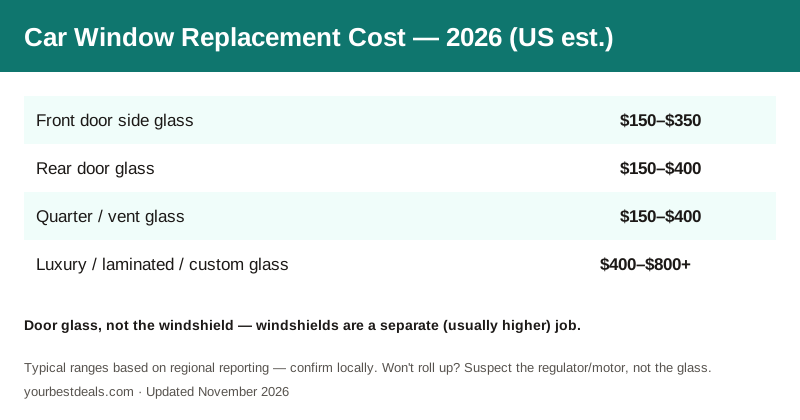
Replacing a car’s side (door) window glass usually costs about $150–$350 for a front door, $150–$400 for a rear door or a quarter/vent window, and $400–$800+ if it’s luxury, laminated, or custom glass – parts and labor included. These are typical ranges based on regional reporting; confirm locally. Two things set the real price: the type of glass (most door windows are tempered and reasonably priced; laminated or acoustic glass and anything on a luxury or EV costs more) and which window it is. One important caution up front: if your window won’t roll up or down but the glass is intact, the problem is usually the regulator or motor, not the glass – a different repair. And side-window replacement is not the same as a windshield, which is a separate (usually higher) job.
Window glass was one of the quotes people found confusing, because they’d lump it in with the windshield or assume a broken window meant the whole mechanism was shot. Most of the time a side window is a modest, self-contained job – but you have to know whether you’re buying glass or buying a regulator, because those are two different repairs.
Straight From the Invoice: What Window Jobs Actually Cost
I pulled these from repair orders I either wrote or reviewed.
Invoice #1 – 2015 Honda Civic, front door glass (break-in), glass shop, NC
Owner braced for a windshield-sized bill. Final: $235 for a new front door window, installed, plus a vacuum of the broken glass from the door and seat tracks. A clean, contained job – door glass is tempered and breaks into pebbles, so most of the labor was cleanup.
Invoice #2 – 2020 Audi A4, rear door acoustic glass, dealer, NC
Quoted $620, landed at $680. The glass was laminated acoustic (not plain tempered), which is why it cost roughly double a standard door window. A reminder that “it’s just a side window” isn’t true on every car – the glass type drives it.
Invoice #3 – 2013 Toyota Camry, “window won’t go up” – NOT glass, independent shop, NC
Owner asked for a new window; the glass was fine. The real fault was a failed window regulator. Final: $265 for a regulator, not a pane of glass. The lesson: a window that won’t move is a mechanism problem, and diagnosing it right saved buying glass that wasn’t broken.
Car Window Replacement Cost by Type (2026, US estimates)
| Window | Typical range (parts + labor) |
|---|---|
| Front door side glass (tempered) | $150–$350 |
| Rear door glass | $150–$400 |
| Quarter / vent glass | $150–$400 |
| Rear/back glass (not hatch liftgate) | $250–$500 |
| Luxury / laminated / acoustic / EV glass | $400–$800+ |
| Window regulator or motor (if glass is intact) | $200–$500 |
Typical ranges based on regional reporting – confirm locally. Windshields are a separate job and usually cost more.
Why Your Quote Looks Different
Side-window quotes vary mostly by glass type and vehicle. Most door windows are tempered safety glass (the kind that shatters into small pebbles), which is relatively inexpensive; but laminated or acoustic glass (increasingly common on quieter and luxury cars) and glass on luxury makes or EVs costs considerably more, and some have tint or defrost features built in. Which window matters too – a common front door glass is cheaper and more available than a quarter or vent window. Parts availability (OEM vs aftermarket, in stock vs ordered) and labor to disassemble the door, fit the glass, and clean up shattered glass from inside the door and interior all factor in. And crucially, if the window won’t move but isn’t broken, you’re looking at a regulator or motor repair instead, which is priced separately.
Shop Talk
Before you pay for new glass, figure out whether you actually need glass or a regulator – because “my window won’t go up” and “my window is broken” are two completely different repairs, and people mix them up constantly. If the glass is intact but the window won’t roll up or down, drops into the door, or moves crookedly, the problem is almost always the window regulator (the mechanism that raises and lowers the glass) or its motor, not the glass itself – so buying a new pane wouldn’t fix it. If the glass is actually shattered or cracked, then you need glass. Telling a shop the right symptom gets you the right quote. Two more field tips. First, check your insurance: comp coverage often covers glass (including side windows) from break-ins or vandalism, sometimes with a deductible, so a $300 window might cost you little out of pocket – worth a call before you pay cash, though weigh it against your deductible and premium. Second, if your window was smashed in a break-in, budget a little extra for cleanup: tempered glass shatters into hundreds of pebbles that get into the door cavity, seat tracks, and carpet, and a good shop vacuums it all out so you’re not finding glass for months. Diagnose glass-versus-regulator first, then get the right quote.
Where Drivers Overpay
The biggest overpay is paying for new glass when the glass was never the problem. A window that won’t roll up is usually a failed regulator or motor – replacing the (intact) glass does nothing, and a shop that quotes glass for a “window won’t move” complaint without checking is selling the wrong fix. Describe the actual symptom so you get the right diagnosis.
The other is skipping the insurance check. Comp coverage frequently covers a side window broken in a break-in or by vandalism, sometimes with a modest deductible, so paying cash for a $300 window when your policy would have covered most of it is money left on the table – weigh it against your deductible and any premium impact, but at least make the call before you pay. And don’t confuse a side window with a windshield; they’re different jobs at different prices.
The Real Number
Budget about $150–$350 for a front door window, $150–$400 for a rear or quarter window, and $400–$800+ for luxury, laminated, or EV glass – parts and labor. First confirm you need glass and not a regulator: a window that won’t move but isn’t broken is a mechanism repair ($200–$500), not glass. Check whether comp insurance covers a break-in before paying cash, and remember a side window is a separate, usually cheaper job than a windshield. Ranges are regional estimates – confirm locally.
Frequently Asked Questions
How much does it cost to replace a car’s side window?
Replacing a car’s side (door) window typically costs about $150–$350 for a front door window and $150–$400 for a rear door or quarter window, parts and labor included, with luxury, laminated, acoustic, or EV glass running $400–$800 or more – so for most mainstream cars a broken side window is a modest, self-contained repair rather than a major expense. Most door windows are made of tempered safety glass, which is relatively inexpensive and shatters into small pebbles when broken (unlike a laminated windshield), and replacing it involves removing the door panel, fitting the new glass into the regulator mechanism, and cleaning up the broken glass from inside the door and the interior. The price climbs when the glass is a more expensive type – laminated or acoustic glass used on quieter and luxury vehicles, or glass with built-in tint, antenna, or defrost elements – or when it’s on a luxury make or an EV where parts cost more. Which window it is also matters: common front door glass is cheaper and more readily available than a quarter or vent window. To get an accurate number, tell the shop your exact vehicle and which window broke. And confirm the glass is actually the problem: if the window won’t move but isn’t broken, that’s a regulator issue, a different repair. These are regional estimates, so confirm locally. For the mechanism side, see our window regulator guide.
Why won’t my window go up, and is that a glass problem?
If your window won’t go up or down but the glass itself is intact, the problem is almost certainly the window regulator or its motor, not the glass – so replacing the glass wouldn’t fix it, and this is one of the most common and costly mix-ups in window repair. The window regulator is the mechanism inside the door that raises and lowers the glass (electrically via a motor on power windows, or by a hand crank on manual ones), and when it or the motor fails, the glass may refuse to move, move slowly or crookedly, make grinding noises, or drop down into the door and not come back up – all while the glass is perfectly fine. Because the symptom (“my window is broken”) sounds like a glass problem, people sometimes ask for new glass when what they actually need is a regulator or motor, which is a separate repair typically running around $200–$500 depending on the vehicle and whether it’s just the motor or the whole regulator assembly. The way to tell the difference is simple: if the glass is cracked or shattered, you need glass; if the glass is whole but won’t move properly, you need the regulator or motor. When you call a shop, describe the actual symptom accurately so you get quoted the right repair. A shop that quotes you new glass for a “window won’t go up” complaint without checking that the glass is the issue may be heading toward the wrong fix. For the mechanism repair, see our window regulator guide.
Is a car window the same as a windshield?
No – a car’s side (door) window is not the same as a windshield, and they’re different repairs at different prices, which matters because people often lump them together and expect windshield-level cost for a side window (or vice versa). Side windows and most rear windows are made of tempered glass, which is heat-treated to shatter into small, relatively harmless pebbles on impact; they’re generally less expensive to replace and are a self-contained door repair. A windshield, by contrast, is laminated glass – two layers of glass bonded to a plastic interlayer so it holds together and stays in place when cracked, for safety – and it’s structurally bonded to the car’s frame, often incorporates sensors or cameras for driver-assistance systems that require recalibration after replacement, and is generally more expensive to replace than a side window. So a broken door window is usually a cheaper, simpler job than a windshield. The rear/back glass is often tempered like side glass (though a rear window with a defroster grid adds some cost). The practical takeaway is to treat them as separate repairs: if it’s a side window, expect side-window pricing (typically $150–$400 for mainstream cars); if it’s the windshield, that’s a different and usually higher cost, especially with driver-assist recalibration. Don’t assume one price applies to the other. For windshield-specific pricing, see our windshield replacement guide.
Does insurance cover a broken car window?
In many cases yes – comp (non-collision) auto insurance coverage typically covers car window glass broken by a break-in, vandalism, theft, or other non-collision events, often subject to your deductible, so it’s worth checking your policy before paying out of pocket, though whether a claim makes sense depends on your deductible and potential premium impact. Comp coverage (the part of a policy that covers damage not from a collision) generally includes glass damage from break-ins, vandalism, falling objects, and similar events, which covers the common scenario of a side window smashed in a break-in. If your deductible is low relative to the repair cost (say a $250 window against a $100 or $250 deductible), a claim may save you money; if your deductible is as high as or higher than the repair, paying cash is simpler and avoids any claim. Some policies and states have specific glass provisions, and a few offer reduced or zero-deductible glass coverage, so the details matter. It’s also worth noting that a comp claim for glass is generally less likely to raise your rates than an at-fault collision claim, but it’s not guaranteed, so you can ask your insurer how a glass claim would affect your premium before filing. The practical step is to call your insurer (or check your policy) before paying for a broken side window, especially from a break-in, to see whether it’s covered and whether a claim beats paying cash given your deductible. For the repair cost itself, see the ranges above. Weigh the claim against your specific deductible and situation.
Can I drive with a broken or missing car window?
You can technically drive with a broken or missing side window, but it’s not advisable for more than getting to a repair, because it leaves the car exposed to weather and theft, can be a safety and visibility concern, and loose or jagged glass can be hazardous – so a temporary cover is wise until it’s fixed. A missing side window lets rain, snow, and debris into the interior (risking water damage to upholstery and electronics), leaves the car and its contents open to theft, and in some areas may draw unwanted attention or even a fix-it citation. If the glass is only partially broken with jagged edges remaining, those can be dangerous. For these reasons, while a short drive to a glass shop is fine, you shouldn’t leave a window broken or open for an extended period. As a temporary measure until the repair, many people cover the opening with heavy plastic sheeting and tape (a clear trash bag or specific window film works), which keeps most weather out and provides a minimal deterrent, though it won’t stop a determined thief and can be noisy at speed. If the window shattered, clear the loose glass from the seat and door before driving, and be cautious of any remaining shards. The best course is to get it replaced promptly, both to secure the car and to stop weather intrusion. If you need to park it before the repair, do so somewhere secure and covered if possible. For replacement cost, see the ranges above, and confirm your options locally.
What’s the difference between tempered and laminated side glass?
The difference is how the glass is made and how it behaves when broken: tempered glass (used for most side and rear windows) is heat-treated so it shatters into many small, relatively blunt pebbles, while laminated glass (always used for windshields and increasingly for side windows on quieter and luxury cars) sandwiches a plastic layer between two glass panes so it holds together when cracked – and laminated side glass costs more to replace. Tempered side glass is designed to break safely into small fragments rather than large sharp shards, which is why a broken side window becomes a pile of pebbles; it’s the standard, less expensive option and is what most mainstream cars use for door windows. Laminated side glass, the same basic construction as a windshield, is used by some manufacturers for side windows to reduce road noise (acoustic glass), improve security (it’s harder to smash through because the plastic layer holds it together), and add UV protection; because it’s more complex and often model-specific, it’s more expensive to replace, which is part of why luxury and newer quiet-cabin cars have higher side-window costs. When you’re getting a quote, the glass type for your specific car and window is a big factor in the price, so a shop pricing your exact vehicle will know whether it’s tempered or laminated. If your car has acoustic or laminated side glass, don’t be surprised the replacement costs more than a basic tempered window. Either way, use glass that matches your car’s original specification. For pricing context, see the ranges above.
How long does it take to replace a car window?
Replacing a car’s side window is usually a relatively quick job, often completed in about one to two hours, though the exact time depends on the vehicle, which window it is, whether the glass shattered (requiring cleanup), and parts availability – making it one of the faster glass repairs, much quicker than some other body work. The basic process involves removing the interior door panel to access the window mechanism, removing any remaining broken glass, fitting the new glass into the regulator, reassembling the door panel, and testing that the window raises and lowers properly. On a simple front door window with the glass in stock, this can be done in an hour or two. Time increases if the window shattered in a break-in, because the shop should vacuum the hundreds of glass pebbles out of the door cavity, seat tracks, and carpet (a worthwhile step so you’re not finding glass for months), or if the specific glass has to be ordered rather than being in stock, which can add a day or more of waiting for the part even though the install itself is quick. Quarter or vent windows and some rear glass can take a bit longer depending on access. If the issue turns out to be the regulator or motor rather than the glass, that’s a somewhat different (and sometimes longer) repair. For most mainstream side-window replacements, plan on the car being at the shop for a couple of hours once the glass is on hand, plus any ordering time. Call ahead to confirm the glass is in stock for your vehicle. For the regulator alternative, see our window regulator guide.
Sources
Window-replacement cost ranges reflect US regional reporting reviewed in November 2026. Figures are estimates; get a quote for your exact vehicle and window.
- J.D. Power – car ownership and repair guides
- Kelley Blue Book – car advice and ownership costs
- Cars.com – maintenance and repair resources
Related Guides
- Window Regulator Repair Cost
- Windshield Replacement Cost
- Car Paint Job Cost
- Car Headliner Repair Cost
- Service Cost Estimator

Diane Holcomb spent seven years as a service advisor at multi-brand dealerships in Charlotte, NC, before moving into writing about real-world service costs in 2023. Window glass was a quote people found confusing, because they’d lump it with the windshield or assume a broken window meant a broken mechanism – so she learned to separate glass from regulator first. She drives a 2019 Honda CR-V EX-L and a 2007 Toyota Camry, and takes no referral fees or advertising money from any shop or chain.