
Last updated: November 2, 2026 – By Diane Holcomb
November 2026 update: reconfirmed external vs. concentric pricing and the do-the-clutch-too point.
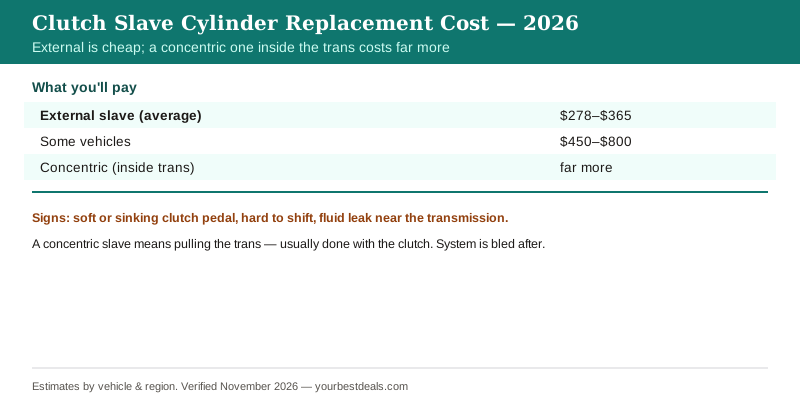
A clutch slave cylinder replacement runs about $278 to $365 on average for an externally mounted one, and $450 to $800 on some vehicles. The big cost swing is the design: many cars use a concentric slave cylinder mounted inside the transmission (around the input shaft), and replacing that type means pulling the transmission – so the labor is much higher and it’s almost always done together with the clutch while everything’s apart. On a manual car, signs of a failing slave cylinder include a clutch pedal that goes soft or sinks to the floor, trouble shifting into or out of gear, and a fluid leak near the transmission. The slave shares hydraulic fluid with the clutch master cylinder, so the two are often replaced together, and the system is bled afterward to remove air.
The whole price story here is external versus concentric – a cheap bolt-on job or a transmission-out job. Let me cover the cost, the two designs, and why the clutch often goes with it.
What you’ll actually pay
Here’s the price picture. These are estimated ranges that vary by vehicle and shop.
| Design | Cost | Notes |
|---|---|---|
| External slave (average) | $278–$365 | Bolt-on, accessible |
| Some vehicles | $450–$800 | Harder access |
| Concentric (inside trans) | far more | Transmission must come out |
This part only applies to manual-transmission cars with a hydraulic clutch. The master and slave cylinders work as a pair, and the system is bled after any opening. Our clutch replacement guide covers the related clutch job often done at the same time.
Shop Talk
The single question that sets your price is where the slave cylinder lives. An externally mounted slave bolts to the outside of the transmission and pushes the clutch fork – it’s accessible, so replacing it is a few hundred dollars and a bleed. A concentric slave cylinder (also called a CSC or hydraulic throw-out bearing) sits inside the bellhousing around the transmission input shaft, so to reach it the transmission has to come out – that’s hours of labor, and it’s the same teardown as a clutch job. So on a concentric-slave car, if the slave has failed and the transmission is already coming out, it almost always makes sense to replace the clutch at the same time (and vice versa – when you do a clutch on these cars, you replace the concentric slave while you’re in there), because you never want to pull the transmission twice. On the symptoms: a clutch pedal that sinks to the floor or feels soft, or trouble getting into gear, points at the hydraulic system – but that could be the slave or the master cylinder, since they share fluid. A shop checks for a leak and tests both. They’re often replaced as a pair, and the system must be bled afterward to get the air out, or the pedal stays soft.
Where Drivers Overpay
The costly scenario isn’t an overpay so much as a design reality: on a concentric-slave car, the transmission has to come out, so the job is expensive – and the mistake is not replacing the clutch at the same time. If the trans is already out for the slave, doing the clutch then avoids ever pulling the transmission twice; the same logic means replacing the concentric slave during any clutch job.
The other consideration is diagnosis: a soft or sinking pedal can be the slave or the master cylinder (they share fluid), so confirming which before replacing avoids fixing the wrong one, and they’re often done as a pair. The pattern: determine external vs. concentric, bundle the clutch and concentric slave when the trans is out, confirm slave vs. master, and bleed the system after.
The Real Number
An external clutch slave cylinder is $278 to $365 (some vehicles $450 to $800). But if yours is a concentric slave inside the transmission, the trans has to come out and it costs far more – in which case replace the clutch at the same time so you never pull the transmission twice. A soft or sinking clutch pedal can be the slave or the master cylinder, so confirm which; they’re often done as a pair, and the system is bled after.
Frequently Asked Questions
How much does it cost to replace a clutch slave cylinder?
For an externally mounted slave cylinder, about $278 to $365 on average, and $450 to $800 on some vehicles. If your car uses a concentric slave cylinder mounted inside the transmission, it costs far more because the transmission must be removed to reach it – that’s a major labor job usually combined with a clutch replacement. These are estimates that vary by vehicle and shop. The slave is often replaced alongside the clutch master cylinder since they share fluid and work as a pair. The design (external versus concentric) is the single biggest cost factor, so knowing which your car has is key to an accurate estimate.
What’s the difference between an external and a concentric slave cylinder?
An external slave cylinder bolts to the outside of the transmission and pushes the clutch release fork – it’s accessible, so replacing it is relatively quick and inexpensive. A concentric slave cylinder (CSC), sometimes called a hydraulic throw-out bearing, sits inside the transmission bellhousing around the input shaft and acts directly on the clutch. Because it’s inside, replacing it requires removing the transmission, which is hours of labor – the same teardown as a clutch job. That’s why the cost difference is so large. On concentric-slave cars, the slave and clutch are typically serviced together since the transmission is already out. Your car’s design determines which you have and drives the repair cost.
What are the signs of a bad clutch slave cylinder?
The main signs are a clutch pedal that feels soft or spongy or sinks to the floor, difficulty shifting into or out of gear, a clutch that doesn’t fully disengage, and low clutch fluid or a fluid leak (often seen near the transmission or at the pedal). Because the slave and master cylinders share the hydraulic fluid, a leak at either can cause these symptoms. A shop inspects for leaks and tests both components to determine which has failed. If your clutch pedal has lost its firm feel or goes to the floor, the hydraulic system (slave or master cylinder) is the likely cause, and it should be addressed since you can lose the ability to shift.
Should I replace the clutch at the same time?
On a concentric-slave car, almost always yes. Because the transmission has to be removed to reach a concentric slave cylinder, and that’s the exact same teardown required to replace the clutch, doing both at once avoids ever pulling the transmission twice – a big labor savings. So if the concentric slave failed and the trans is coming out, replacing the clutch then is the smart move, and conversely, when you do a clutch on these cars you replace the concentric slave at the same time. On an external-slave car, the slave is accessible without pulling the transmission, so you don’t need to touch the clutch just to replace the slave. The design dictates whether bundling makes sense.
Could the problem be the master cylinder instead of the slave?
Yes, and it’s important to check. The clutch hydraulic system has a master cylinder (at the pedal) and a slave cylinder (at the transmission), connected by a line and sharing fluid. A soft or sinking clutch pedal, trouble shifting, or fluid loss can come from either one. A shop diagnoses by inspecting for external leaks, checking the fluid, and testing the system to see which cylinder has failed. Because they’re a matched hydraulic pair and often of similar age, many shops replace both at the same time when one fails, especially if labor overlaps, to avoid a repeat repair. Confirming which cylinder is at fault (or deciding to do both) before the work prevents fixing the wrong part.
Why does the clutch system need bleeding afterward?
Because opening the hydraulic clutch system (to replace the slave or master cylinder) lets air in, and air compresses where fluid doesn’t. If air is left in the system, the clutch pedal stays soft or spongy and won’t fully disengage the clutch, so you can’t shift properly. Bleeding pushes fresh fluid through and forces the air out until the pedal is firm. It’s an essential final step of the repair, not optional. A clutch that still feels soft after a slave cylinder replacement usually just needs a proper bleed. This is the same principle as bleeding brakes – any hydraulic system that’s been opened needs the air removed to work correctly.
Can I drive with a failing clutch slave cylinder?
It’s risky and often impractical. As the slave cylinder fails, the clutch may not fully disengage, making it hard or impossible to shift smoothly, and you can grind gears or get stuck unable to shift – potentially leaving you stranded if the pedal goes fully to the floor. Low fluid from a leak makes it worse over time. So while you might limp a short distance early on, a failing clutch slave cylinder should be repaired promptly, both to avoid being stranded and to prevent damaging the transmission synchros from forced shifting. If the pedal is already sinking to the floor and you can’t get into gear, the car may not be drivable until it’s fixed.
Sources
Price ranges verified against 2026 clutch hydraulic repair pricing in November 2026. Dollar amounts are estimates that vary by vehicle and shop.
- RepairPal – clutch slave cylinder replacement cost
- YourMechanic – clutch slave cylinder replacement
- ASE – National Institute for Automotive Service Excellence
Related Guides

Diane Holcomb spent seven years as a service advisor at multi-brand dealerships in Charlotte, NC, where the first thing she checked on a clutch-hydraulic job was whether the slave was external or inside the bellhousing – it decided everything about the price. She drives a 2019 Honda CR-V and a hand-me-down 2007 Toyota Camry, and takes no referral fees or advertising money from any shop or chain.