
Last updated: November 3, 2026 – By Diane Holcomb
November 2026 update: reconfirmed flush pricing, the interval range by coolant type, and the correct-coolant rule.
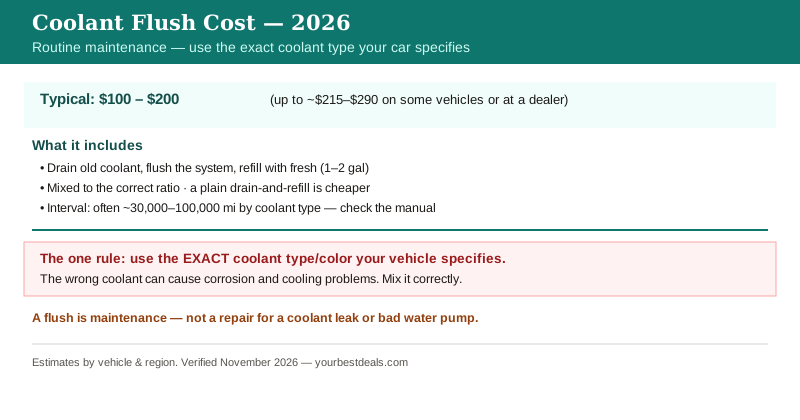
A coolant (antifreeze) flush typically costs about $100 to $200, and can reach $215 to $290 or more on some vehicles or at a dealer. The service drains the old coolant, flushes the system, and refills with fresh coolant mixed to the correct ratio – usually 1 to 2 gallons. A simple drain-and-refill is cheaper than a full machine flush. Like the other fluid services, this is routine maintenance, not a repair for a coolant leak or a bad water pump. Most manufacturers recommend it on a schedule (often somewhere between 30,000 and 100,000 miles depending on the coolant type), so check your owner’s manual. And the single most important rule: use the exact coolant type and color your vehicle specifies.
Coolant is one of those fluids people ignore until something overheats, but flushing it on schedule prevents corrosion and keeps the cooling system healthy. The cost is modest; the mistake that actually causes damage is using the wrong coolant. Let me cover the price, what the service includes, and that critical coolant-type rule.
What you’ll actually pay
Here’s the price picture. These are estimated ranges that vary by vehicle and shop.
| Service | Cost | Notes |
|---|---|---|
| Drain-and-refill | $80–$150 | Simpler, replaces most coolant |
| Full machine flush | $100–$200 | More thorough |
| Some vehicles / dealer | $215–$290+ | More coolant or higher labor |
| Coolant itself | varies | 1–2 gallons, correct type |
A drain-and-refill empties and refills the system, replacing most of the coolant, and is the cheaper option. A full flush runs a machine (or a chemical cleaner) through to clear more of the old coolant and any deposits, and costs a bit more. Vehicles that hold more coolant, or that require a pricier specialty coolant, land at the higher end, and dealers charge more. Our coolant guide covers the cooling system and overheating.
Shop Talk
The one thing that can turn cheap maintenance into an expensive problem is using the wrong coolant, so this is where to pay attention. Modern cars use several different coolant chemistries – the old green stuff (IAT), and various long-life types (OAT, HOAT) that come in orange, yellow, pink, blue, and other colors – and they are not interchangeable. Mixing incompatible coolants, or using the wrong type, can cause corrosion, gel or sludge formation, and cooling-system damage that costs far more than the flush. So insist the shop use the exact coolant your vehicle specifies (it’s in your manual and often on a decal or cap), and if you top off yourself, match what’s already in there or use the correct spec. Color is a rough guide but not a guarantee – go by the specification, not just the color. One more practical note: don’t confuse a flush with a repair. If you’re losing coolant, overheating, or seeing coolant on the ground, that’s a leak or a failing part (hose, water pump, radiator), and a flush won’t fix it – you need the leak diagnosed. A flush is preventive maintenance for healthy coolant, not a cure for a cooling-system fault.
Where Drivers Overpay
The most common overpay is a dealer or premium flush price when a fair-priced shop drain-and-refill would serve for routine maintenance. For a car that’s on schedule and has healthy coolant, a simple drain-and-refill with the correct coolant is often enough and cheaper than an elaborate machine flush. Match the service to the need, and use an independent shop for better value than a dealer on this routine job.
The costlier mistake, though, is the opposite of saving: economizing on coolant type. Using a cheaper or “universal” coolant that isn’t your vehicle’s specification can cause corrosion or gelling and expensive cooling-system damage, wiping out any savings many times over. This is the one place not to cut corners – the fluid must match the spec. And don’t pay for a flush hoping it fixes a leak or overheating; those are repairs that need diagnosis, not maintenance. Follow your manual’s interval, insist on the correct coolant, and keep the flush separate in your mind from an actual cooling-system repair.
The Real Number
A coolant flush is typically $100 to $200 (up to $215 to $290+ on some cars or at a dealer); a simple drain-and-refill is cheaper. Do it on your manufacturer’s schedule (often 30,000 to 100,000 miles by coolant type). The one rule that prevents expensive damage: use the exact coolant type and color your vehicle specifies – the wrong coolant causes corrosion and gelling. And remember a flush is maintenance, not a repair for a leak, overheating, or a bad water pump.
Frequently Asked Questions
How much does a coolant flush cost?
Typically about $100 to $200, and up to $215 to $290 or more on some vehicles or at a dealer. A simple drain-and-refill runs less, around $80 to $150, while a full machine flush costs a bit more for the added thoroughness. Vehicles that hold more coolant or require a pricier specialty coolant land at the higher end. These are estimates that vary by vehicle and shop. As with other fluid services, an independent shop usually offers better value than a dealer for this routine maintenance.
How often should coolant be flushed?
It depends on the coolant type, so check your owner’s manual, but intervals commonly fall somewhere between 30,000 and 100,000 miles or every few years. Older conventional green coolant needs changing more often (often around 30,000 miles or 2 to 3 years), while modern long-life coolants can go much longer (100,000 miles or more). Time matters as well as mileage, since coolant degrades and loses its corrosion protection over years. Follow your manufacturer’s schedule rather than a universal number, and watch for old, discolored, or rusty coolant as a sign it’s due.
What’s the difference between a coolant drain-and-refill and a flush?
A drain-and-refill empties the coolant that drains out and refills with fresh, replacing most of it, and is the simpler, cheaper option. A full flush runs a machine or chemical cleaner through the system to remove more of the old coolant plus deposits and scale, which is more thorough and costs a bit more. For a car maintained on schedule, a drain-and-refill is often sufficient; a flush is better when the system is neglected, dirty, or you’re switching coolant types. Both should refill with the exact coolant your vehicle specifies.
Why does coolant type matter so much?
Because modern vehicles use different coolant chemistries – conventional (IAT) and various long-life types (OAT, HOAT) in colors like orange, yellow, pink, and blue – and they aren’t interchangeable. Using the wrong type or mixing incompatible coolants can cause corrosion, gel or sludge formation, and cooling-system damage that costs far more than the flush. Color is only a rough guide, so go by the specification your manual lists, not just the color. This is the one place not to economize: the coolant must match your vehicle’s spec, whether the shop does it or you top off yourself.
Is a coolant flush the same as fixing an overheating problem?
No. A coolant flush is preventive maintenance for healthy coolant – it doesn’t fix a leak, overheating, or a failing part. If you’re losing coolant, overheating, or seeing coolant on the ground, that’s a cooling-system fault (a bad hose, water pump, radiator, thermostat, or worse) that needs diagnosis and repair, and a flush won’t cure it. Sometimes fresh coolant is part of the fix after a repair, but the flush itself isn’t the repair. So don’t pay for a flush hoping it solves overheating; get the actual cause diagnosed.
Can I do a coolant flush myself?
A basic drain-and-refill is doable for many DIYers – drain the radiator, refill with the correct coolant mixed to the right ratio, and burp the air out of the system. The cautions are working only on a cool engine (hot coolant is under pressure and causes burns), disposing of old coolant properly (it’s toxic to pets and wildlife), using the exact coolant spec, and bleeding the air out correctly so the engine doesn’t overheat from an air pocket. A full machine flush usually requires shop equipment. If you’re comfortable with those steps, a DIY drain-and-refill saves labor; if not, the shop cost is modest.
What happens if I never flush my coolant?
Over time coolant loses its corrosion inhibitors and can become acidic, which promotes rust and scale inside the radiator, water pump, heater core, and engine passages. That corrosion can lead to clogging, reduced cooling efficiency, overheating, and premature failure of expensive parts like the water pump or radiator. Old coolant also offers less freeze and boil protection. So neglecting coolant, while it won’t cause an immediate problem, risks costly cooling-system repairs down the road – which is why the modest, scheduled flush is worthwhile preventive maintenance.
Sources
Price ranges and intervals verified against 2026 cooling-system service pricing in November 2026. Dollar amounts are estimates that vary by vehicle and shop.
- Kelley Blue Book – service & repair guide
- AAA – auto repair resources
- FuelEconomy.gov – maintenance guidance
Related Guides
- Coolant & Cooling System Guide
- Green vs. Orange Coolant
- Transmission Fluid Change Cost
- Brake Fluid Flush Cost
- Car Repair Cost Estimator

Diane Holcomb spent seven years as a service advisor at multi-brand dealerships in Charlotte, NC, where matching the exact coolant type to the vehicle was the detail that separated cheap maintenance from an expensive mistake. She drives a 2019 Honda CR-V and a hand-me-down 2007 Toyota Camry, and takes no referral fees or advertising money from any shop or chain.