
Last updated: November 9, 2026 – By Diane Holcomb
November 2026 update: reconfirmed solenoid pricing and the confirm-before-the-valve point.
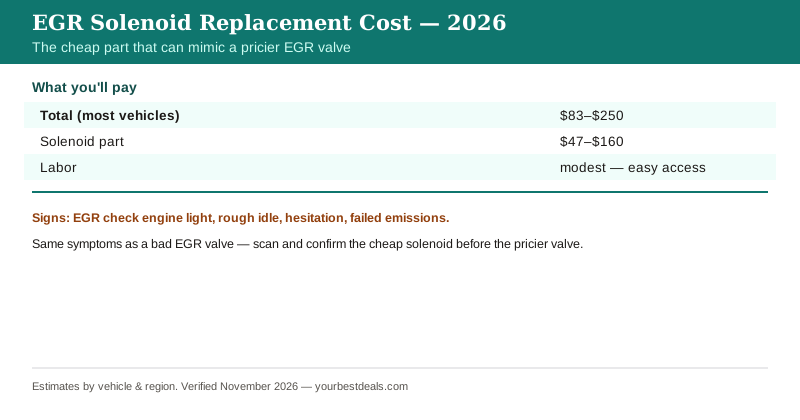
An EGR (vacuum control) solenoid replacement is a cheap repair – roughly $83 to $250 total depending on the vehicle. The solenoid itself is often $47 to $160, and labor is modest because it’s usually easy to reach. The solenoid controls the vacuum (or electrical signal) that opens and closes the EGR valve, so when it fails you get an EGR-related check engine light, rough idle, hesitation, or a failed emissions test – the same symptoms as a bad EGR valve. That overlap is the whole point of this page: because the cheap solenoid and the pricier EGR valve throw similar codes, and carbon buildup or wiring can also be the issue, you should scan the codes and confirm the solenoid is the fault before replacing the valve. When the solenoid is the cause, it’s the far cheaper fix.
This is the inexpensive EGR part that’s worth ruling in before anyone writes up the pricier valve. Let me cover the cost, the shared symptoms, and the confirm-first logic.
What you’ll actually pay
Here’s the price picture. These are estimated ranges that vary by vehicle and shop.
| Item | Cost | Notes |
|---|---|---|
| Total (most vehicles) | $83–$250 | Cheap repair |
| Solenoid part | $47–$160 | Inexpensive |
| Labor | modest | Usually easy access |
The solenoid is one of the cheaper EGR components, so confirming it’s the fault can save you from a pricier EGR valve. Our EGR valve guide and check engine light guide cover the valve and the codes that point to the EGR system.
Shop Talk
The EGR solenoid is the cheap control part that’s worth checking before anyone condemns the EGR valve. On vacuum-operated systems, the solenoid is an electrically controlled valve that routes engine vacuum to open the EGR valve when the computer calls for it; on others it’s an electronic control. When the solenoid fails, the EGR valve can’t operate correctly, and you get the same family of symptoms as a bad valve – an EGR check engine light (like a P0401 flow code or a solenoid-circuit code), rough idle, hesitation, pinging, or a failed emissions test. The key is that the solenoid is usually much cheaper than the valve and often easy to reach, so a proper diagnosis that pinpoints the solenoid can save you real money versus replacing the whole valve. A good tech reads the specific code (a solenoid-circuit code points here), checks the solenoid electrically and for vacuum flow, and inspects the wiring and vacuum lines, since a cracked vacuum hose or corroded connector can mimic a bad solenoid for even less. So if you’ve got an EGR code, don’t assume it’s the valve – have the solenoid, wiring, and vacuum lines checked first, because the cheapest fix is often right there.
Where Drivers Overpay
The overpay this page exists to prevent is replacing the pricier EGR valve when the cheap solenoid (or its wiring/vacuum lines) was the real fault. They throw overlapping EGR codes, so reading the specific code and testing the solenoid electrically and for vacuum flow before buying a valve is the key save.
Even cheaper culprits – a cracked vacuum hose or a corroded connector – can mimic a bad solenoid, so those get checked too. The pattern: scan for the specific code, test the solenoid and its vacuum/wiring, rule out a cracked hose or connector, and only then step up to the EGR valve if the solenoid checks out fine.
The Real Number
An EGR solenoid is $83 to $250 – a cheap, easy-access part that controls the EGR valve. Because it throws the same codes as a pricier EGR valve, confirming the solenoid (and ruling out a cracked vacuum hose or corroded connector) before replacing the valve can save real money. Scan for the specific code and test the solenoid before stepping up to the valve.
Frequently Asked Questions
How much does an EGR solenoid cost to replace?
Roughly $83 to $250 total depending on the vehicle, with the solenoid part often $47 to $160 and labor modest since it’s usually easy to reach. These are estimates that vary by vehicle and shop. It’s one of the cheaper EGR-system repairs, which is exactly why confirming the solenoid is the fault matters – it can save you from replacing the much pricier EGR valve when the cheap solenoid was the real cause. For an accurate figure, get a quote for your specific vehicle, but in most cases this is an inexpensive repair when the solenoid is correctly identified as the problem.
What does the EGR solenoid do?
It controls the operation of the EGR valve. On vacuum-operated EGR systems, the solenoid is an electrically controlled valve that routes engine vacuum to the EGR valve when the computer wants exhaust recirculation; on electronic systems it serves a similar control role. So the solenoid is the “switch” that tells the EGR valve to open and close. When it fails, the EGR valve can’t operate properly – it may not open when needed or may stay open – which disrupts the exhaust-recirculation function and triggers EGR codes and drivability symptoms. Because it’s the control part rather than the valve itself, and it’s cheaper, identifying a solenoid fault is a money-saving diagnosis compared with replacing the valve.
What are the signs of a bad EGR solenoid?
The signs overlap with a bad EGR valve: a check engine light with an EGR-related code (including solenoid-circuit codes or flow codes), a rough or unstable idle, hesitation or stumbling, engine pinging, reduced performance, and a failed emissions test. Because the solenoid controls the valve, its failure produces the same kind of EGR malfunction. The distinguishing factor is in the diagnosis – the specific trouble code and electrical/vacuum testing point to the solenoid versus the valve. If you have EGR symptoms, it’s worth having the solenoid tested, since it’s the cheaper part, before concluding the valve itself has failed. The symptoms alone don’t tell solenoid from valve; the testing does.
How do I know if it’s the solenoid or the EGR valve?
A proper diagnosis distinguishes them, which is worth doing because the solenoid is cheaper. The specific trouble code helps – a solenoid-circuit code points to the solenoid, while a flow code could be either. A technician tests the solenoid electrically (for proper resistance and operation) and checks that it routes vacuum or signal correctly, and inspects the EGR valve for carbon sticking and proper movement. They also check the vacuum lines and wiring. If the solenoid tests bad, you replace the cheap solenoid; if the solenoid is fine but the valve is stuck or worn, you address the valve. Doing this testing before buying parts prevents replacing the pricier valve when the inexpensive solenoid was the fault.
Can a vacuum hose or wiring cause the same symptoms?
Yes, and they’re even cheaper to fix. On vacuum-operated systems, the solenoid routes engine vacuum through hoses to the EGR valve, so a cracked, loose, or disconnected vacuum hose can prevent the valve from operating and throw the same EGR codes – without the solenoid being bad. Similarly, a corroded connector or damaged wiring to the solenoid can mimic a solenoid failure. A good diagnosis checks the vacuum lines and electrical connections, since fixing a cracked hose or a bad connection can resolve the problem for very little. So before replacing even the cheap solenoid, confirming the hoses and wiring are sound ensures you’re fixing the actual cause rather than swapping a part that wasn’t the issue.
Can I drive with a bad EGR solenoid?
You can usually drive short-term, since the symptoms are drivability issues and a check engine light rather than a breakdown. But it’s not ideal: rough running, hesitation, or pinging can stress the engine, you’ll fail an emissions test, and the persistent light masks other codes. Because the fix is inexpensive once the solenoid is confirmed, there’s little reason to put it off for long. If there’s noticeable pinging or stalling, address it sooner. As with the EGR valve, it comes down to confirming the diagnosis and then making the cheap repair, rather than driving indefinitely with an EGR fault that hurts performance and emissions.
Is replacing an EGR solenoid a DIY job?
Often yes, because the solenoid is usually accessible and inexpensive. Once a scan and testing confirm the solenoid (not the valve, vacuum hoses, or wiring) is the fault, replacing it is typically a matter of unplugging the electrical connector and vacuum lines, unbolting or unclipping the old solenoid, and installing the new one, then clearing the code. The keys are confirming the diagnosis first, labeling the vacuum lines so they go back correctly, and checking those lines and the connector for damage while you’re there. On most vehicles it’s one of the more approachable EGR repairs for a DIYer. If access is awkward or the diagnosis is unclear, a shop can confirm and handle it cheaply given the low part cost.
Sources
Price ranges verified against 2026 EGR solenoid pricing in November 2026. Dollar amounts are estimates that vary by vehicle and shop.
- RepairPal – EGR vacuum control solenoid estimates
- CostInsightHub – EGR system cost
- ASE – National Institute for Automotive Service Excellence
Related Guides
- EGR Valve Replacement Cost
- EGR Cooler Replacement Cost
- Check Engine Light Guide
- EVAP Purge Valve Replacement Cost
- Car Repair Cost Estimator

Diane Holcomb spent seven years as a service advisor at multi-brand dealerships in Charlotte, NC, where an EGR code got the cheap solenoid and vacuum lines checked before the pricier valve ever went on the estimate. She drives a 2019 Honda CR-V and a hand-me-down 2007 Toyota Camry, and takes no referral fees or advertising money from any shop or chain.