
Last updated: November 8, 2026 – By Diane Holcomb
November 2026 update: reconfirmed engine-source pricing and the swap-vs-car-value point.
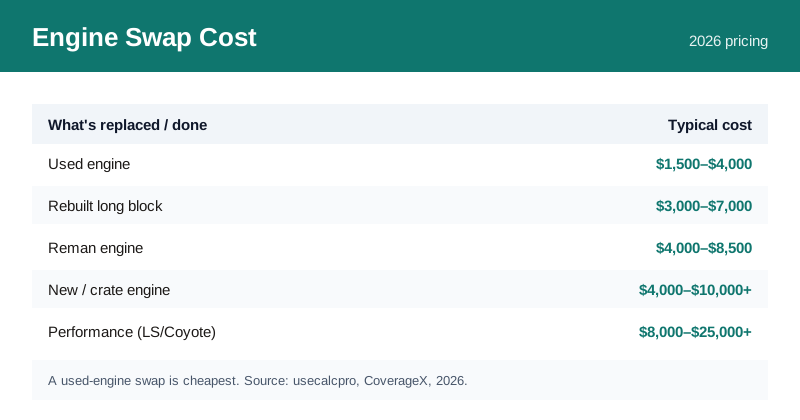
An engine swap’s cost is driven mostly by where the replacement engine comes from. A used engine swap runs about $1,500 to $4,000; a rebuilt long block $3,000 to $7,000; a remanufactured engine $4,000 to $8,500; and a new or crate engine $4,000 to $10,000 or more. Each includes the engine plus roughly 10 to 26 hours of labor and wear parts. A full OEM-parts swap on a mainstream 4-cylinder or V6 lands around $4,500 to $11,500 out the door. Performance swaps – dropping in an LS, Coyote, or similar upgraded engine – run $8,000 to $25,000 or more with the fabrication involved. An engine swap replaces a worn-out or failed engine with another unit; it can be a like-for-like replacement (same engine, because the original died) or a different/upgraded engine (a true “swap” for more power). The big decision on a high-mileage car: the swap can cost more than the car is worth, so weigh it against the vehicle’s value.
The engine source is the whole story on price, and on an older car you have to weigh the swap against what the car’s worth. Let me break it down.
What you’ll actually pay
Here’s the range by engine source. These are estimates that vary by vehicle and shop.
| Engine source | Cost | Notes |
|---|---|---|
| Used engine | $1,500–$4,000 | Cheapest |
| Rebuilt long block | $3,000–$7,000 | Mid |
| Remanufactured | $4,000–$8,500 | Warrantied |
| New / crate engine | $4,000–$10,000+ | Longest life |
An engine swap overlaps with other major engine work; our engine replacement guide, engine rebuild guide, and crankshaft guide cover the alternatives.
Shop Talk
Two conversations matter here. First, what kind of “swap” you mean. Most people searching this have a dead or dying engine and want to replace it with the same engine – that’s really an engine replacement, and your cheapest route is usually a good low-mileage used engine from a reputable yard ($1,500 to $4,000 installed on a common car), with a reman engine the step up that adds a warranty. A true performance swap – putting a different, more powerful engine in (the LS and Coyote swaps people talk about) – is a different beast involving mounts, wiring, fuel, cooling, and fabrication, which is why those run $8,000 to $25,000-plus. Be clear which you’re pricing. Second, and this is the one I always had with customers: weigh the swap against the car’s value. On a high-mileage everyday car, a $3,000-to-$5,000 engine job can exceed what the car is worth, and you have to ask whether that money is better put toward a different vehicle. It can still make sense – a car you know, that’s otherwise solid, with a cheap used engine available – but run the numbers honestly. A few practical notes: used engines are priced by mileage and often come with a short warranty (buy from a reputable source and get the warranty in writing); the labor is 10-plus hours, so get an itemized, out-the-door quote; and ask what wear parts (timing belt, water pump, seals, gaskets, motor mounts) are being done while the engine’s out, since doing them then is cheap insurance.
Where Drivers Overpay
The biggest money decision isn’t shopping the repair down – it’s whether to do it at all. On a high-mileage car, a $3,000–$5,000 engine job can exceed the car’s value, so running that against the vehicle’s worth (and a different car) is the real call.
If you do proceed, the save is the engine source: a quality low-mileage used engine is the cheapest route for a like-for-like replacement, with reman adding a warranty. The pattern: clarify like-for-like replacement vs performance swap, weigh the cost against the car’s value, choose the engine source deliberately (used/reman/new), get an itemized out-the-door quote, and do the cheap wear parts while the engine’s out.
The Real Number
An engine swap is $1,500 to $4,000 with a used engine, $3,000 to $7,000 rebuilt, $4,000 to $8,500 reman, and $4,000 to $10,000+ new/crate; performance swaps (LS, Coyote) run $8,000 to $25,000+. The engine source decides the price. On a high-mileage car, weigh the swap against the car’s value – a $4,000 job on a $3,000 car may not make sense. Get an itemized out-the-door quote and do the cheap wear parts while the engine’s out.
Frequently Asked Questions
How much does an engine swap cost?
It’s driven by the engine source. A used-engine swap runs about $1,500 to $4,000; a rebuilt long block $3,000 to $7,000; a remanufactured engine $4,000 to $8,500; and a new or crate engine $4,000 to $10,000 or more. Each includes the engine plus roughly 10 to 26 hours of labor and wear parts. A full OEM-parts swap on a mainstream 4-cylinder or V6 is about $4,500 to $11,500 out the door. Performance swaps (dropping in a different, more powerful engine like an LS or Coyote) run $8,000 to $25,000 or more due to the fabrication. These are estimates that vary widely by vehicle and shop. Because the range is so broad, the engine source (used, rebuilt, reman, new) is the biggest decision, and on an older car you should weigh the total against the car’s value before committing. Get an itemized, out-the-door quote.
What’s the difference between an engine swap and an engine replacement?
The terms overlap, but there’s a useful distinction. An engine replacement usually means installing the same type of engine your car came with, because the original failed – a like-for-like fix to get the car running again. An engine swap can mean that, but often refers to installing a different engine than the original – frequently a more powerful or different unit (a performance upgrade, like the well-known LS or Coyote swaps). A like-for-like replacement is more simple because everything bolts up and connects as designed. A true swap to a different engine is more complex and costly, because it may require different mounts, custom wiring, fuel and cooling changes, and fabrication to make an engine fit and work in a car it didn’t come in. So if your goal is simply to fix a dead engine, you want a replacement (same engine). If your goal is more power or a different engine, that’s a performance swap – pricier and more involved. Knowing which you mean sets expectations for both cost and complexity.
Should I use a used, rebuilt, remanufactured, or new engine?
It depends on your budget, the car’s value, and how long you’ll keep it. A good low-mileage used engine from a reputable salvage yard is the cheapest route ($1,500 to $4,000 installed) and makes sense on an older everyday car – but its condition and remaining life are less certain, so get a warranty in writing. A rebuilt long block (your or a core engine rebuilt) is a middle option. A remanufactured engine is rebuilt to spec with new wear parts and typically a solid warranty – more than used, but more predictable and reassuring. A new (or crate) engine costs the most but offers the longest, most reliable life, best for a vehicle worth keeping long-term or a performance build. For most people fixing a daily driver, a quality used or reman engine is the value sweet spot. Weigh the cost against the car’s worth, and prioritize a reputable source and a real warranty over the absolute lowest price – a cheap engine with no warranty is a gamble.
Is an engine swap worth it versus buying another car?
That’s the key question on a high-mileage vehicle, and it comes down to math. Add up the full swap cost (engine plus labor plus wear parts), then compare it to (a) the car’s value with a good engine and (b) what a replacement vehicle would cost. A swap is worth it when: the rest of the car (transmission, body, suspension) is solid, you know and trust the car, a reasonably priced engine is available, and the swap costs well under what a comparable replacement car would. It’s often not worth it when: the swap approaches or exceeds the car’s value, the car has other looming problems, or you could put that money toward a better vehicle. For example, a $4,000 engine job on a car worth $3,000 with a tired transmission is usually a poor bet; the same job on an otherwise-excellent car you plan to keep years can be smart. So run the honest numbers – the emotional attachment is real, but the finances should drive the decision. A good shop will give you a straight assessment.
Why does a performance swap cost so much more?
Because you’re not just bolting in the same engine – you’re adapting a different engine to a car it wasn’t designed for, which takes parts, fabrication, and expertise. A performance swap (like an LS into an older car, or a Coyote into something else) typically requires custom or adapter engine mounts, modified or custom wiring and engine management, fuel system upgrades (pump, lines, injectors), cooling system changes (a different radiator), exhaust fabrication, driveline and transmission matching, and often tuning afterward. All of that labor and those specialized parts add up fast, which is why performance swaps run $8,000 to $25,000 or more versus a few thousand for a like-for-like replacement. The more the donor engine differs from the original, the more fabrication and problem-solving required. So a performance engine swap is really a project build, not a repair – priced accordingly. If your aim is simply a running car, a same-engine replacement is far cheaper; the big numbers are for the power and the custom work of a true swap.
What wear parts should be done during an engine swap?
Since the engine is out (or the old one’s coming out), it’s the ideal, cost-effective time to replace wear and service parts that are hard to reach or that you don’t want failing soon on a “new” engine. Commonly recommended while everything’s apart: the timing belt (if the engine has one) and water pump, the clutch (on a manual – the transmission’s already separated), the rear main seal and other engine seals and gaskets, motor and transmission mounts if worn, hoses and the thermostat, spark plugs, and the serpentine belt and tensioner. Doing these during the swap is cheap insurance, because the labor to access them is already being spent – paying to do them separately later would mean taking things apart again. A used or reman engine especially benefits from fresh wear items so you’re not chasing a failure right after the big job. So ask your shop for a list of what wear parts they recommend doing with the swap; a thorough job includes the cheap-but-labor-intensive items while the engine’s accessible.
Does an engine swap affect my car’s value or registration?
It can, in a few ways worth knowing. For a like-for-like replacement with the same engine, there’s usually little registration impact – it’s the same vehicle specification. But a performance swap to a different engine can raise issues: in some states with emissions testing, swapping to a non-original engine may require the swap to meet emissions rules (sometimes you must use an engine of the same or newer year and keep its emissions equipment), and in strict areas an illegal swap can fail inspection or complicate registration. Rules vary a lot by state, so check your local emissions and registration requirements before a performance swap. On value: a documented engine replacement with a warranty can reassure a buyer, while an undocumented or amateur swap can hurt resale and insurability. Modified/swapped engines can also affect insurance. So for a standard replacement, impact is minimal; for a performance swap, research your state’s emissions and registration rules first, since compliance (and documentation) matters for staying legal and for the car’s value.
Sources
Price ranges verified against 2026 engine swap pricing in November 2026. Dollar amounts are estimates that vary by vehicle and shop.
- CalcPro – engine swap cost 2026
- CoverageX – engine replacement cost
- ASE – National Institute for Automotive Service Excellence
Related Guides
- Engine Replacement Cost
- Engine Rebuild Cost
- Crankshaft Replacement Cost
- Head Gasket Replacement Cost
- Car Repair Cost Estimator

Diane Holcomb spent seven years as a service advisor at multi-brand dealerships in Charlotte, NC, where the honest engine-swap conversation always started with the car’s value – a $4,000 engine on a $3,000 car is a hard sell, and she said so. She drives a 2019 Honda CR-V and a hand-me-down 2007 Toyota Camry, and takes no referral fees or advertising money from any shop or chain.