
Last updated: November 6, 2026 – By Eddie Brennan
November 2026 update: refreshed the by-fix ranges from gasket to full assembly against 2026 reporting and reconfirmed the muffler-shop-versus-dealer saving.
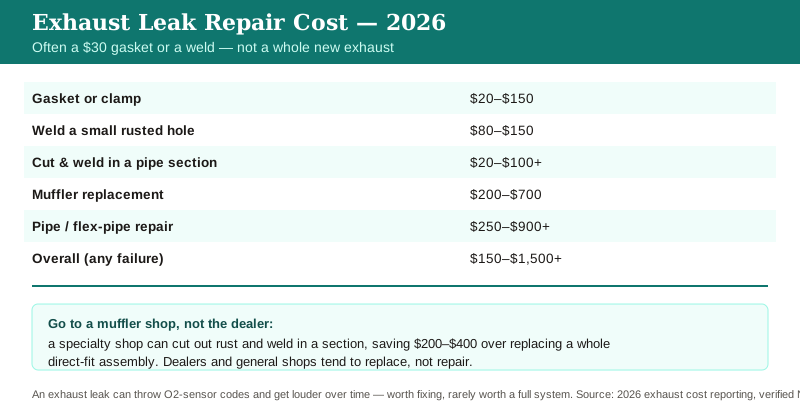
An exhaust leak repair in 2026 is often far cheaper than people fear – a leaking gasket or clamp is $20 to $150, welding a small rusted hole is $80 to $150, and cutting in a new pipe section can be as little as $20 to $100. It only gets expensive when a full component fails: a muffler replacement is $200 to $700, a pipe or flex-pipe repair $250 to $900-plus, and the overall range across all failures is $150 to $1,500 or more. The key is not replacing the whole exhaust for a leak a weld or gasket would fix.
Exhaust leaks sound alarming – a loud drone, a ticking near the manifold, sometimes a check-engine light – but the fix is usually small. I sent a lot of these to the muffler shop down the street, because a specialty shop with welding gear can repair a section for a fraction of what it costs to replace a whole assembly. This guide covers what each fix actually runs and, just as important, where to take it so you don’t overpay.
Exhaust leak repair cost by fix
The cost depends entirely on what’s leaking and whether it can be repaired or must be replaced.
| Fix | Cost | When it applies |
|---|---|---|
| Gasket or clamp | $20–$150 | Leak at a joint or flange |
| Weld a small rusted hole | $80–$150 | Rust-through in a pipe or muffler |
| Cut & weld in a pipe section | $20–$100+ | Localized rot, repairable |
| Muffler replacement | $200–$700 | Muffler itself is gone |
| Pipe / flex-pipe repair | $250–$900+ | Flex pipe or direct-fit section |
The overall range spans $150 to $1,500-plus, but most leaks land at the cheap end – a gasket, a clamp, or a weld. The expensive outcomes are a failed muffler or a flex pipe that has to be replaced as a direct-fit assembly. Where you take it decides a lot: a muffler shop that can weld a localized repair saves $200 to $400 over a shop that only replaces whole assemblies.
What gets misdiagnosed
The mistake here usually isn’t a wrong-part diagnosis – it’s overtreatment. A small leak at a gasket, a clamp, or a rust hole gets quoted as a full exhaust replacement by a shop that doesn’t weld and only sells direct-fit assemblies. The leak is real; the fix being sold is bigger than the problem. A rusted-through section that a muffler shop would cut out and weld for under $150 becomes a $600 assembly at a dealer that swaps the whole piece.
Where a real diagnosis matters is locating the leak precisely. A tick that sounds like an exhaust leak near the front can be a leaking exhaust manifold gasket or even a cracked manifold, which is a bigger job than a rear muffler weld. And an exhaust leak upstream of an oxygen sensor can throw a check-engine code and skew fuel trims, so it’s worth fixing beyond just the noise. A good shop finds exactly where it’s leaking and quotes the smallest fix that solves it, not the biggest.
Straight From the Invoice: exhaust jobs
These are jobs I either did myself or watched come through the bay – a cheap weld, a gasket, and a full-replacement quote that was overkill.
Invoice #1 – 2013 Honda Accord, welded rust hole, muffler shop, Ohio
Loud drone from a rusted-through spot in the mid-pipe. The muffler shop cut it out and welded in a section for $120. Loud car to quiet in an hour. Lesson: a rust hole in a pipe is a weld, not a new exhaust – a muffler shop fixes it for around $100 to $150.
Invoice #2 – 2015 Toyota Camry, leaking gasket, independent, Charlotte NC
Ticking near the front turned out to be a leaking gasket at a flange joint. A $40 gasket and new hardware, $110 all-in. Lesson: an exhaust leak at a joint is often just a gasket – one of the cheapest repairs on the car, not a system replacement.
Invoice #3 – 2014 Ford Escape, “$700 exhaust” that was a $180 weld, Texas
A general shop quoted a full rear-section replacement at $700 for a rusted hole. A muffler shop welded in a patch section for $180. Same fixed leak, $520 saved. Lesson: shops that only replace, don’t repair, quote the big number – take an exhaust leak to a muffler shop that welds.
Where to take an exhaust leak
A muffler shop, almost always
Specialty muffler shops have the welding equipment and the mindset to repair rather than replace, cutting out a rusted section and welding in new pipe for far less than swapping a whole assembly. That capability alone saves $200 to $400 on a typical rust-through leak. General shops and dealers tend to replace complete direct-fit sections because that’s what they stock and how they work, which is why the same leak costs three or four times more there. For a leak, the muffler shop is the value choice.
When replacement is the right call
Sometimes a weld isn’t the answer – a muffler that’s rotted through in multiple spots, a failed flex pipe, or a section so corroded there’s nothing solid to weld to needs replacement, and that’s legitimately $200 to $900-plus. A good muffler shop will tell you honestly whether your part is repairable or truly gone. The point isn’t to weld everything; it’s to not replace a whole assembly when a $150 weld or a $40 gasket would have solved the leak.
Shop Talk
If a general shop or dealer quotes you a full exhaust section for a leak, take it to a local muffler shop before you pay. Most exhaust leaks are a gasket, a clamp, or a rust hole a muffler shop can weld for $80 to $150, versus $200 to $700 to replace a whole assembly. Ask them straight: can this be welded or does it need replacing? An honest muffler shop welds what’s repairable and only replaces what’s truly rotted. That one detour regularly turns a $600 quote into a $150 fix.
What actually drives the price
What failed, and whether the shop repairs or replaces. A gasket, clamp, or weldable rust hole is cheap – $20 to $150 – while a rotted muffler or flex pipe that must be replaced runs $200 to $900-plus. You don’t control which part failed, but you do control where you take it: a muffler shop that welds a localized repair saves $200 to $400 over a general shop or dealer that only replaces whole assemblies.
The avoidable cost is replacing more than the leak requires. A rust hole welded for $150 does the same job as a $600 replaced section, and a $40 gasket beats a full flange assembly. The leak still needs fixing – an exhaust leak gets louder over time and can throw sensor codes – so it’s not a repair to ignore. But take it to a shop that welds, ask whether it’s repairable, and you’ll pay for the leak, not for a whole new exhaust.
The Real Number
Most exhaust leaks are cheap: $20 to $150 for a gasket, clamp, or welded rust hole. Only a failed muffler ($200 to $700) or flex pipe ($250 to $900+) runs into real money. The single best move is taking it to a specialty muffler shop that can weld a localized repair, which saves $200 to $400 over a dealer or general shop that only replaces whole assemblies. Ask whether it can be welded or must be replaced, fix it before it gets louder or trips a sensor, and don’t buy a new exhaust for a leak a weld would solve.
Frequently Asked Questions
How much does exhaust leak repair cost in 2026?
It depends on what’s leaking. A gasket or clamp is $20 to $150, welding a small rusted hole is $80 to $150, and cutting in a new pipe section can be $20 to $100 or more. It only gets expensive when a whole component fails: a muffler replacement is $200 to $700 and a pipe or flex-pipe repair $250 to $900-plus, with the overall range $150 to $1,500 or more. Most leaks land at the cheap end, and taking it to a muffler shop that welds keeps it there.
Can an exhaust leak be welded instead of replaced?
Very often, yes. A rusted-through hole or a leaking section can usually be repaired by a muffler shop that cuts out the bad spot and welds in new pipe, for $80 to $150 versus $200 to $700 to replace a whole assembly. Welding saves $200 to $400 on a typical rust leak. Replacement is only necessary when a part is rotted in multiple spots, a flex pipe has failed, or there’s nothing solid left to weld to. Ask a muffler shop whether your leak is weldable before accepting a full-replacement quote.
Why is my exhaust repair quote so much higher at the dealer?
Because dealers and many general shops replace whole direct-fit assemblies rather than repairing a section, and they stock and bill accordingly. A leak a muffler shop would weld for $150 becomes a $600 assembly replacement at a dealer. Neither is cheating you – it’s how each shop works – but for an exhaust leak, the muffler shop’s ability to weld a localized repair makes it far cheaper. Take an exhaust leak to a specialty muffler shop and ask if it can be welded before paying a dealer to replace the whole piece.
Is it safe to drive with an exhaust leak?
A small leak isn’t usually an immediate danger, but don’t ignore it, for two reasons. First, exhaust fumes contain carbon monoxide, and a leak near the cabin or under the car can let fumes in, which is a genuine health risk, especially with the windows down or in slow traffic. Second, a leak upstream of an oxygen sensor can throw a check-engine code and hurt fuel economy. Leaks also get louder and worse over time. Get it fixed reasonably soon, and address any leak you can smell in the cabin promptly.
What are the symptoms of an exhaust leak?
A louder-than-normal engine, a drone or roar that grows with acceleration, a ticking or hissing near the front that can mean a manifold gasket, a check-engine light from a skewed oxygen-sensor reading, and sometimes a faint exhaust smell. A leak often gets noticeably louder over weeks as the hole grows. A shop can pinpoint the source by listening and inspecting, and locating it precisely matters, since a front manifold leak is a bigger job than a rear muffler weld, even though both sound like an exhaust leak.
Does an exhaust leak affect gas mileage?
It can, if the leak is upstream of an oxygen sensor. A leak before the sensor lets extra air in, which can fool the sensor into reading lean and cause the computer to add fuel, hurting economy and sometimes tripping a check-engine light. A leak downstream of the sensors, like at the muffler, mostly just affects noise. That’s another reason to fix leaks rather than live with them, and to locate the leak precisely, since a leak’s effect on mileage and sensor codes depends on where in the system it is.
Should I replace my whole exhaust or just repair the leak?
Repair the leak, in almost every case. Replacing a whole exhaust system for a single leak is overkill and expensive when a gasket, clamp, or weld fixes the actual problem for a fraction of the cost. The exception is an exhaust that’s rotted through in many places at once on a high-mileage car, where piecemeal repairs stop making sense and a fuller replacement is reasonable. A good muffler shop will tell you honestly which situation you’re in, but for a single leak, the targeted repair is nearly always the right money.
Sources
Exhaust leak repair cost ranges verified against 2026 reporting on November 6, 2026. Ranges vary by what failed, whether it’s repairable, and the shop; confirm your exact price locally.
- SunCent Auto – exhaust leak repair cost guide, 2026
- RepairPal – exhaust muffler replacement cost estimate
- GetCostIdea – exhaust pipe welding cost, 2026
Related Guides
- Radiator replacement cost
- Car repair cost estimator hub
- Water pump replacement cost
- About Eddie Brennan – ASE Master technician

Eddie Brennan is an ASE Master Certified technician who spent 11 years at an independent shop in Columbus, OH, and sent countless exhaust leaks down the street to the muffler shop rather than sell a whole new system. He writes the repair and diagnostic guides on Your Best Deals and takes no referral fees. He drives a 250,000-mile 2015 Subaru Outback and a 2020 Ford F-150.