
Last updated: November 2, 2026 – By Diane Holcomb
November 2026 update: reconfirmed front pads-and-rotors pricing and the pads-vs-rotors point.
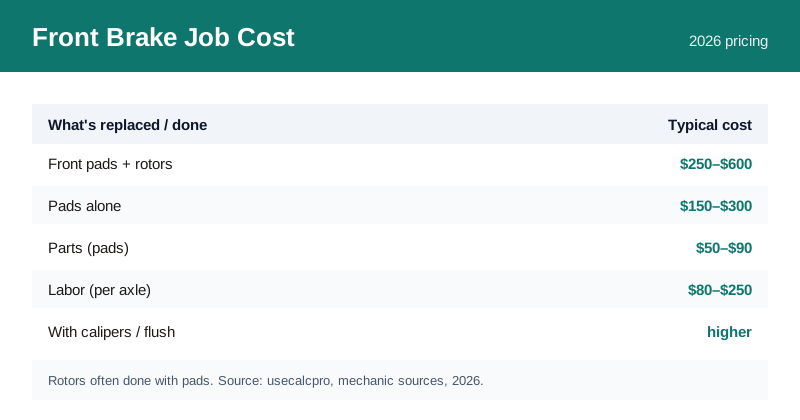
A front brake job with new pads and rotors runs about $250 to $600 per axle, or $150 to $300 for pads alone if the rotors are still good. Front pads are about $50 to $90 and labor $80 to $250 per axle; adding calipers or a brake fluid flush raises the total, and premium or performance vehicles cost more. The front brakes do most of the car’s stopping – physics shifts weight forward when you brake, so the fronts handle roughly 60–70% of the work – which is why front pads and rotors wear faster than the rears and get done more often. A front brake job replaces the worn front pads and, depending on their condition, either resurfaces or replaces the rotors. The signs it’s due: squealing (the wear indicator), grinding (metal-on-metal, you’ve waited too long), or a pulsing brake pedal and steering-wheel shake (warped rotors).
Brakes are the one repair you never put off, and the fronts come first. Let me cover the cost and the pads-versus-rotors question.
What you’ll actually pay
Here’s the picture. These are estimates that vary by vehicle and shop.
| Service | Cost | Notes |
|---|---|---|
| Pads + rotors (per axle) | $250–$600 | Common job |
| Pads alone | $150–$300 | If rotors okay |
| Parts (pads) | $50–$90 | Front set |
| Labor (per axle) | $80–$250 | Varies |
Brakes are a system; our brake rotor guide, brake fluid flush guide, and brake booster guide cover the related parts.
Shop Talk
The big cost question on a front brake job is pads only versus pads and rotors, and it comes down to the rotors’ condition. Rotors can be measured – they have a minimum thickness stamped on them – and if they’re above spec, smooth, and not warped, you can often just replace the pads and save the rotor cost. If they’re worn below minimum, warped (that pedal pulsing/steering shimmy when you brake), or deeply grooved, they need replacing or, less commonly now, resurfacing. These days many shops replace rotors rather than resurface, because rotors have gotten thinner and cheaper and machining them isn’t always worth it – but a good shop will measure and tell you honestly. A few things that save money or trouble. One, don’t wait for grinding. Squealing is the wear indicator telling you pads are low – handle it then, while it’s a pad job. Grinding means the pads are gone and you’re chewing up the rotors (and it’s unsafe), turning a cheap job expensive. Two, pads come in grades – economy to premium/ceramic – and better pads are quieter, cleaner (less dust), and often last longer, so the mid-grade is usually worth it over the cheapest. Three, it’s fine to do just the front axle if only the fronts are worn; brakes don’t have to be done all four at once. And always use a shop you trust for brakes – this is safety equipment, not a place to chase the rock-bottom price.
Where Drivers Overpay
The overpay is replacing rotors that didn’t need it. Rotors can be measured against a minimum-thickness spec, so if they’re in spec and not warped, a pads-only job saves the rotor cost. A shop that measures and tells you honestly is the save here.
The far bigger cost, though, is waiting too long: squealing is a cheap pad job, but grinding means the pads are gone and you’re destroying the rotors – and that’s unsafe. The pattern: act at the squeal, have the rotors measured rather than auto-replaced, choose a sensible mid-grade pad, and do only the axle that’s worn. On safety equipment, use a shop you trust over the cheapest quote.
The Real Number
A front brake job is $250 to $600 for pads and rotors, or $150 to $300 for pads alone if the rotors are still in spec. Have the rotors measured rather than auto-replaced – if they’re above minimum and not warped, pads-only saves money. Act at the squeal (the wear indicator); grinding means the pads are gone and you’re wrecking the rotors, which is unsafe and costly. Brakes are safety equipment – use a shop you trust, not the cheapest quote.
Frequently Asked Questions
How much does a front brake job cost?
A front brake job with new pads and rotors runs about $250 to $600 per axle, or $150 to $300 for pads alone if the rotors are still good. Front pads are roughly $50 to $90 and labor $80 to $250 per axle. Adding calipers (if one is seized or leaking) or a brake fluid flush raises the total, and premium, performance, or luxury vehicles cost more – sometimes two to three times as much. These are estimates that vary by vehicle and shop. The main cost variable is whether the rotors need replacing: if they’re within spec and not warped, you can often do pads only and save. Because brakes are safety equipment, it’s worth using a trusted shop rather than chasing the lowest price.
Why do the front brakes wear out faster than the rear?
Because the front brakes do most of the stopping. When you brake, the car’s weight shifts forward onto the front wheels (you can feel the nose dip), so the front brakes handle roughly 60–70% of the braking force – more in hard stops. Most cars are also front-heavy (engine up front), adding to the load on the front brakes. As a result, the front pads and rotors wear significantly faster than the rears, which is why front brake jobs come up more often and why “my brakes need doing” usually means the fronts first. It’s completely normal to replace front brakes once or even twice before the rears need attention. So if a shop says your fronts are worn but the rears are fine, that’s the expected pattern, not a reason for suspicion – you can do just the front axle.
Do I need new rotors or just pads?
It depends on the rotors’ condition, and this is the main thing that swings the cost. Rotors have a minimum thickness stamped on them, and a shop can measure them: if they’re above spec, smooth, and not warped, you can often just replace the pads and reuse the rotors, saving money. If the rotors are worn below minimum thickness, warped (causing pedal pulsation and steering shimmy when braking), deeply grooved, or cracked, they need replacing. Resurfacing (machining) rotors used to be common but is less so now, since modern rotors are thinner and relatively cheap, so many shops replace rather than machine. The key is that a trustworthy shop measures the rotors and tells you honestly whether they can be kept. So “pads or pads and rotors” isn’t a guess – it’s based on measuring your rotors. Ask them to show you the measurement.
What are the signs I need front brakes?
The classic early warning is a squeal or squeak when braking – most pads have a metal wear indicator that intentionally squeals when the pads get low, telling you it’s time. If you ignore that and keep driving, you’ll eventually get grinding (a harsh metal-on-metal sound), which means the pads are completely worn and the metal backing is destroying the rotors – that’s both expensive and unsafe. Other signs: a pulsing or vibrating brake pedal and steering-wheel shake when braking (warped rotors), a longer stopping distance or soft/spongy pedal, the car pulling to one side when braking, or a brake warning light. A burning smell after braking can indicate a stuck caliper. Because brakes are safety-critical, any of these warrants prompt attention. Catching it at the squeal keeps it a cheap pad job rather than a rotor-and-pad job.
Is it safe to drive with worn front brakes?
Up to a point, but it’s safety equipment, so don’t push it. If your pads are squealing (the wear indicator) but still have some material, you can drive briefly while you arrange the repair – but get it done soon. Once the brakes are grinding (metal on metal), stopping performance is compromised, you’re damaging the rotors, and it’s truly unsafe – that’s a stop-driving-and-fix-it situation. A pulsing pedal from warped rotors, a soft pedal, pulling to one side, or any significant loss of braking power all mean prompt attention. Brakes are the one system where you don’t gamble: compromised braking affects your ability to stop and avoid a crash. So while a fresh squeal gives you a little time, worn front brakes should be addressed quickly, and grinding or a failing pedal means now. The repair is far cheaper than the consequences.
Do I have to replace all four brakes at once?
No. Because the front and rear brakes wear at different rates (the fronts much faster), it’s completely normal and acceptable to replace just the front axle when only the fronts are worn. You don’t have to do all four at once. The fronts will typically need doing before the rears, often more than once over the car’s life. So if an inspection shows worn fronts and healthy rears, doing just the fronts is the right, cost-appropriate call. The same applies in reverse when the rears eventually wear. Each axle is a complete brake set (pads, and rotors if needed) and can be serviced on its own. A shop that insists on doing all four when only the fronts are worn is overselling – ask them to show you the measured pad thickness front and rear so you can see what actually needs doing.
Are more expensive brake pads worth it?
Often, the mid-grade is worth it over the cheapest, though you don’t necessarily need the top tier. Brake pads come in grades – economy, mid-grade, and premium/ceramic. Cheaper pads work but can be noisier, produce more brake dust (dirtying your wheels), and sometimes wear faster or fade more under heat. Mid-grade and premium ceramic pads are typically quieter, cleaner, and often last longer, which can make them better value over time despite the higher upfront cost. For most daily drivers, a good mid-grade or ceramic pad is the sweet spot. Performance or heavy-use vehicles (towing, mountains) may benefit from pads designed for that. So it’s usually worth stepping up from the rock-bottom pad, but you don’t have to buy the most expensive option unless your driving demands it. Ask the shop what grade they’re quoting and what the upgrade costs.
Sources
Price ranges verified against 2026 front brake job pricing in November 2026. Dollar amounts are estimates that vary by vehicle and shop.
- CalcPro – brake job cost 2026
- RepairPal – repair cost estimator
- ASE – National Institute for Automotive Service Excellence
Related Guides
- Brake Rotor Replacement Cost
- Brake Fluid Flush Cost
- Brake Booster Replacement Cost
- Drum Brake Replacement Cost
- Car Repair Cost Estimator

Diane Holcomb spent seven years as a service advisor at multi-brand dealerships in Charlotte, NC, where she’d have the tech measure the rotors and show the customer – so a front brake job was pads-only when the rotors still had life, and never a blanket all-four upsell. She drives a 2019 Honda CR-V and a hand-me-down 2007 Toyota Camry, and takes no referral fees or advertising money from any shop or chain.