
Last updated: November 2, 2026 – By Diane Holcomb
November 2026 update: reconfirmed pricing, the confirm-it’s-the-pump step, and the quarter-tank tip.
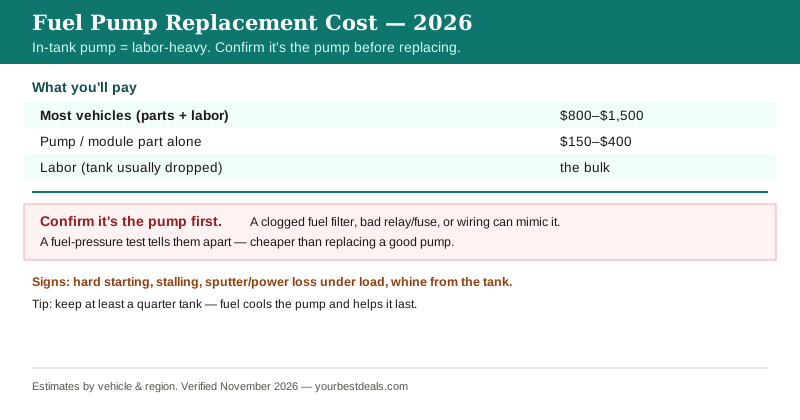
A fuel pump replacement costs about $800 to $1,500 for most vehicles, parts and labor. The reason it’s not cheap is location: most modern cars have an electric fuel pump inside the fuel tank, often as part of a pump module (with the sending unit and strainer), so reaching it means dropping the tank or accessing it through the floor – that’s the bulk of the labor. The pump/module part is often $150 to $400, and the rest is labor. Before authorizing a pump, confirm it’s actually the problem, because a clogged fuel filter, a bad fuel pump relay or fuse, or a wiring issue can mimic a failing pump – and a fuel-pressure test tells them apart. The signs of a failing pump are hard starting, stalling, sputtering or power loss under load, and a whining noise from the tank.
The fuel pump is one where the diagnosis matters as much as the price, because several cheaper problems feel the same from the driver’s seat. Let me cover the cost, how to confirm it’s really the pump, and the signs.
What you’ll actually pay
Here’s the price picture. These are estimated ranges that vary by vehicle and shop.
| Item | Cost | Notes |
|---|---|---|
| Most vehicles (parts + labor) | $800–$1,500 | In-tank electric pump |
| Pump / module part alone | $150–$400 | Often a full module |
| Labor (tank usually dropped) | the bulk | Access is the cost |
| Fuel-pressure test (diagnosis) | small | Confirms the cause |
Most cars use an in-tank electric fuel pump, frequently sold as a complete module including the pump, sending unit (fuel gauge sensor), and strainer. Reaching it means dropping the fuel tank (or, on some cars, an access panel under the rear seat or trunk), which is where the labor goes. Because the whole module often comes together, you typically get a fresh sending unit and strainer with it. Our fuel pump symptoms guide and clogged fuel filter guide cover the diagnosis side.
Shop Talk
Before anyone drops your tank for an $800-to-$1,500 pump, insist on a fuel-pressure test, because the pump’s symptoms – hard starting, stalling, power loss under load – are shared by several much cheaper problems: a clogged fuel filter, a failed fuel pump relay or fuse, or a wiring/connector fault. A gauge on the fuel rail shows whether you actually have low or no fuel pressure, and a tech can check the relay, fuse, and whether the pump is even getting power before condemning it. Replacing a pump that wasn’t the problem is an expensive mistake. Two more things. First, because the in-tank pump usually comes as a module with the fuel-level sending unit, replacing the pump often fixes a wonky fuel gauge at the same time – a bonus. Second, the maintenance tip that actually extends pump life: keep at least a quarter tank of fuel. The fuel surrounding the pump cools it, so habitually running near empty lets the pump run hot and wear out sooner. So don’t routinely run it down to the fumes. And if your car has an accessible inline fuel filter, replacing that cheap filter first (on a car with no service records) is a reasonable step before assuming the pump.
Where Drivers Overpay
The biggest overpay is replacing the fuel pump when the real problem was cheaper – a clogged filter, a bad relay or fuse, or wiring. Because dropping the tank for a pump costs $800 to $1,500, a wrong diagnosis here is costly, so insist on a fuel-pressure test and a check of the relay, fuse, and power to the pump before authorizing replacement. A failing pump and these cheaper faults feel identical from the driver’s seat.
The flip side is that once a pump is truly confirmed bad, the in-tank module is the job – there’s not much to economize beyond choosing a quality pump (a cheap no-name pump that fails means paying the tank-drop labor again). And the free maintenance win is keeping at least a quarter tank so the pump stays cool and lasts. The pattern: confirm with a fuel-pressure test and rule out the cheap causes, use a quality pump once it’s confirmed, and keep fuel in the tank to extend pump life.
The Real Number
A fuel pump is $800 to $1,500 – mostly labor, since it’s an in-tank module and the tank has to come down. The part is $150 to $400. Before paying, confirm it with a fuel-pressure test and rule out the cheaper mimics (clogged filter, bad relay or fuse, wiring). Use a quality pump once confirmed so you don’t repeat the tank-drop labor, and keep at least a quarter tank of fuel to help the pump stay cool and last longer.
Frequently Asked Questions
How much does it cost to replace a fuel pump?
About $800 to $1,500 for most vehicles, parts and labor. The pump or module part is often $150 to $400, and the rest is labor, because most cars have the electric fuel pump inside the tank, so the tank usually has to be dropped to reach it. These are estimates that vary by vehicle and shop. Before replacing, confirm the pump is actually the problem with a fuel-pressure test – a clogged filter, bad relay or fuse, or wiring can mimic it for far less, and dropping the tank for a pump that wasn’t bad is an expensive mistake.
Why is a fuel pump so expensive to replace?
Because most modern fuel pumps are electric and live inside the fuel tank, often as part of a module with the fuel-level sender and strainer. Reaching it means dropping the tank (or going through an access panel under the seat or trunk on some cars), which is hours of labor – and that labor, not the pump itself, is most of the cost. The part is often $150 to $400 while the total runs $800 to $1,500. This in-tank location is why a fuel pump is a pricier job than it might seem for what looks like a simple component.
How do I know if it’s the fuel pump or something cheaper?
Get a fuel-pressure test before assuming the pump. A failing pump causes hard starting, stalling, and power loss under load – but so do a clogged fuel filter, a bad fuel pump relay or fuse, and wiring faults, all cheaper to fix. A gauge on the fuel rail shows whether pressure is actually low, and a tech can verify the relay, fuse, and whether the pump is getting power. Because replacing the pump means expensive tank-drop labor, confirming low fuel pressure and ruling out the cheap causes first is essential. Don’t let the shared symptoms lead to an unnecessary pump.
What are the signs of a failing fuel pump?
Common signs are hard starting or long cranking, stalling (especially when hot), sputtering or hesitation and power loss under load or at high speed, engine surging, and a whining or buzzing noise from the fuel tank area. In a complete failure the car won’t start at all. These come from the pump not delivering adequate fuel pressure and volume. Because a clogged filter or electrical fault causes similar symptoms, confirm with a fuel-pressure test. A whine from the tank plus hard starting is a classic failing-pump pattern worth checking promptly.
Does replacing the fuel pump fix the fuel gauge too?
Often, yes, as a bonus. On most modern cars the in-tank fuel pump comes as a complete module that includes the fuel-level sending unit – the sensor that drives your fuel gauge. So when the pump module is replaced, you typically get a new sending unit as well, which can fix a fuel gauge that was reading erratically or stuck. It’s not the reason to replace the pump, but it’s a common side benefit of the module design. If your gauge is acting up along with pump symptoms, replacing the module may address both.
Does running on a low tank damage the fuel pump?
Habitually running very low can shorten its life. The electric in-tank pump relies on the surrounding fuel to keep it cool, so frequently running near empty lets the pump run hotter, which can wear it out sooner over time. It also risks drawing in sediment from the bottom of the tank. So while an occasional low tank won’t ruin the pump, making a habit of running on fumes isn’t ideal. Keeping at least a quarter tank is a simple, free way to help the pump stay cool and last – a small habit that protects an expensive part.
Can I replace a fuel pump myself?
It’s possible for an experienced DIYer but involves real cautions: the fuel system is under pressure and must be depressurized, gasoline is highly flammable, and you’re often dropping a tank (which should be low on fuel and supported safely) or working through an access panel. Mistakes risk fire or fuel leaks. If your car has a top-access panel under the seat or trunk, it’s more approachable; if the tank must come down, it’s a bigger job. Given the safety considerations and the diagnosis step, many people leave this to a shop, but a careful DIYer with the right precautions can do it.
Sources
Price ranges verified against 2026 repair pricing in November 2026. Dollar amounts are estimates that vary by vehicle and shop.
- RepairPal – fuel pump replacement estimates
- ASE – National Institute for Automotive Service Excellence
- AutoZone – fuel system information
Related Guides
- Signs of a Failing Fuel Pump
- 6 Signs of a Clogged Fuel Filter
- Fuel Filter Replacement Cost
- Engine Repair Guide
- Car Repair Cost Estimator

Diane Holcomb spent seven years as a service advisor at multi-brand dealerships in Charlotte, NC, where a fuel-pump quote always started with a fuel-pressure test so customers didn’t pay to drop a tank for a bad relay. She drives a 2019 Honda CR-V and a hand-me-down 2007 Toyota Camry, and takes no referral fees or advertising money from any shop or chain.