
Last updated: November 9, 2026 – By Diane Holcomb
November 2026 update: reconfirmed pricing and the switch-vs-lock-cylinder distinction.
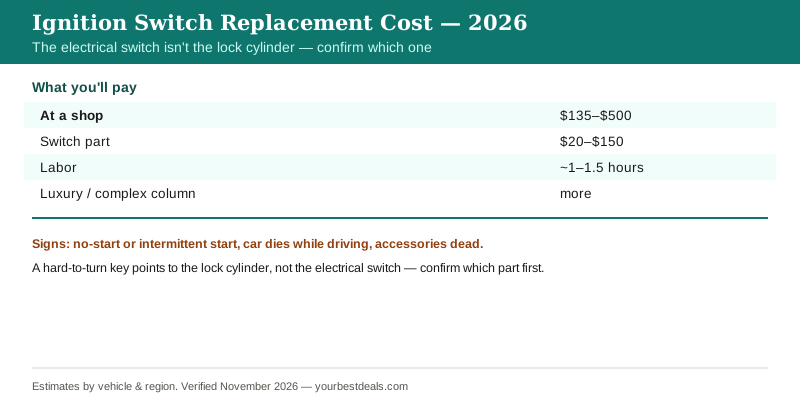
An ignition switch replacement runs about $135 to $500 at a shop, parts and labor, with the switch part roughly $20 to $150 and labor about one to one and a half hours; some luxury vehicles or complex steering-column designs run much more. A failing ignition switch can cause a no-start or intermittent start, the car dying while driving, accessories (radio, lights, power features) that won’t power on in the various key positions, or a key that’s hard to turn. One important distinction: the electrical ignition switch is different from the lock cylinder (the part the key physically turns). A sticking or hard-to-turn key usually points to the lock cylinder, while electrical no-start or power problems point to the switch – so confirm which part you actually need before buying.
“Ignition switch” gets used loosely, so the first job is figuring out whether you need the electrical switch or the lock cylinder. Let me cover the cost, the symptoms, and that distinction.
What you’ll actually pay
Here’s the price picture. These are estimated ranges that vary by vehicle and shop.
| Item | Cost | Notes |
|---|---|---|
| At a shop | $135–$500 | Parts + labor |
| Switch part | $20–$150 | Inexpensive |
| Labor | ~1–1.5 hours | Steering column area |
| Luxury / complex column | more | Harder access |
The electrical switch and the key lock cylinder are separate parts that are often confused, and the right fix depends on which one failed. Our car key replacement guide and check engine light guide cover related ignition and key issues.
Shop Talk
The phrase “ignition switch” gets used for two different parts, and sorting out which one you need is the whole game. The lock cylinder is the mechanical part your key goes into and turns; the electrical ignition switch is the component behind it that actually sends power to the starter and the various circuits as you turn through off, accessory, on, and start. If your key is hard to turn, sticks, or won’t go in or out smoothly, that’s usually the lock cylinder (a mechanical problem). If the key turns fine but you get a no-start, intermittent starting, the car dies while driving, or accessories don’t come on in the right key positions, that points to the electrical switch. They’re separate parts at different prices, so confirming which one failed before buying avoids replacing the wrong thing. A couple of notes: on many cars this work is in the steering column, so there’s some disassembly (and on some vehicles airbag/clockspring precautions), which is why labor is usually an hour or so and more on complex columns. And if the car has an immobilizer or chip key, a new lock cylinder or switch may need programming or re-keying – worth asking about up front so the quote is complete.
Where Drivers Overpay
The main overpay is replacing the wrong part because “ignition switch” covers two things. A hard-to-turn or sticking key is usually the mechanical lock cylinder, while a no-start or power-in-wrong-positions problem is the electrical switch – buying the switch for a cylinder problem (or vice versa) wastes money. Matching the symptom to the right part first is the save.
The other consideration is immobilizer/chip-key cars, where a new cylinder or switch may need programming or re-keying – getting that in the quote up front avoids a surprise. The pattern: confirm switch vs. lock cylinder from the symptom, and ask about any programming/re-keying before the work.
The Real Number
An ignition switch is $135 to $500 at a shop (more on complex columns) – a cheap part, mostly labor. First sort out which part you need: a hard-to-turn key is usually the lock cylinder, while a no-start or accessories-not-powering is the electrical switch. On immobilizer/chip-key cars, a new cylinder or switch may need programming – ask about that so the quote is complete.
Frequently Asked Questions
How much does it cost to replace an ignition switch?
About $135 to $500 at a shop, parts and labor, with the switch part itself roughly $20 to $150 and labor about one to one and a half hours since the work is usually in the steering column. Luxury vehicles or complex column designs run more. These are estimates that vary by vehicle and shop. The cost also depends on whether you actually need the electrical ignition switch or the lock cylinder (the key-turn part), which are separate components. On cars with an immobilizer or chip key, programming or re-keying may add to the total. For an accurate figure, confirm which part failed and ask whether programming is needed.
What’s the difference between the ignition switch and the lock cylinder?
They’re two separate parts often both called the “ignition switch.” The lock cylinder is the mechanical piece your key inserts into and turns – it’s what you’d suspect if the key is hard to turn, sticks, or won’t insert or release smoothly. The electrical ignition switch is the component behind the cylinder that actually directs power to the starter and the vehicle’s circuits as you move through the off, accessory, on, and start positions. Electrical problems – no-start, intermittent start, the car dying, or accessories not powering in the right positions – point to the switch. Because they’re different parts with different prices, correctly identifying which one failed is the key to not replacing the wrong component.
What are the signs of a bad ignition switch?
Signs of a failing electrical ignition switch include the car not starting or starting only intermittently, the engine stalling or dying while driving (as the switch loses contact), accessories like the radio, lights, or dash not powering on in the expected key positions, and the car losing power when you jiggle the key or hit a bump. If instead the problem is that the key is physically hard to turn, sticks, or won’t come out, that points to the lock cylinder rather than the electrical switch. Because the symptoms differ between the two parts, matching your specific symptom – electrical versus mechanical – helps confirm whether you need the switch or the lock cylinder.
Why won’t my car start – is it the ignition switch?
It can be, but a no-start has several possible causes, so it needs diagnosis. A failing ignition switch can cause a no-start or intermittent start by not sending power to the starter or ignition circuits, especially if the problem comes and goes or the car loses power when the key is jiggled. However, a no-start can also be a dead battery, a bad starter, the brake light switch (on push-button or interlock-equipped cars), a security/immobilizer issue, or other electrical faults. So while the ignition switch is a real suspect – particularly with intermittent, key-position-related symptoms – it’s worth confirming rather than assuming. A proper diagnosis distinguishes a switch problem from a battery, starter, or security issue so you fix the right thing.
Is it safe to drive with a failing ignition switch?
It’s risky. A failing ignition switch can cause the engine to stall or the car to lose power unexpectedly while driving – which is dangerous, especially at speed or in traffic, since you can lose power steering and brakes assist along with the engine. Intermittent switch problems are unpredictable, so you might start fine and then stall later. It can also leave you stranded with a no-start. Given those safety and reliability concerns, a confirmed failing ignition switch should be repaired promptly rather than driven on. If your car is stalling or losing power intermittently and the ignition switch is suspected, treat it as a priority repair rather than hoping it keeps working.
Does a new ignition switch or lock cylinder need programming?
Sometimes, depending on the vehicle. On cars with an immobilizer system or chip (transponder) keys, replacing the lock cylinder or certain switch components can require re-keying to your existing key or programming so the key and vehicle recognize each other – otherwise the car may not start even with the new part installed. Older vehicles without immobilizers typically don’t need programming. Because this can add cost and is easy to overlook, it’s worth asking up front whether your vehicle’s ignition repair involves programming or re-keying, so the quote is complete and there are no surprises. A shop or dealer familiar with your make can tell you whether your car’s security system requires that step.
Is replacing an ignition switch a DIY job?
For a mechanically inclined DIYer it can be, but there are cautions. The job is usually in the steering column, so it involves removing column covers and sometimes dealing with components near the airbag and clockspring (which require safety precautions to avoid accidental airbag deployment). You also need to correctly identify whether you need the electrical switch or the lock cylinder. And on immobilizer/chip-key cars, programming or re-keying may be required, which many DIYers can’t do at home. So while a basic switch on an older car can be DIY-friendly, modern columns with airbags and security systems often make a shop the safer choice. Confirming which part you need, and any programming requirement, comes first either way.
Sources
Price ranges verified against 2026 ignition switch pricing in November 2026. Dollar amounts are estimates that vary by vehicle and shop.
- Jerry – ignition switch repair cost
- RepairPal – ignition switch estimates
- ASE – National Institute for Automotive Service Excellence
Related Guides
- Car Key Replacement Cost
- Ignition Lock Cylinder Replacement Cost
- Starter Replacement Cost
- Car Battery Replacement Cost
- Car Repair Cost Estimator

Diane Holcomb spent seven years as a service advisor at multi-brand dealerships in Charlotte, NC, where “my ignition switch is bad” first got sorted into a mechanical lock-cylinder problem or an electrical switch problem – they’re different parts and prices. She drives a 2019 Honda CR-V and a hand-me-down 2007 Toyota Camry, and takes no referral fees or advertising money from any shop or chain.