
Last updated: November 8, 2026 – By Diane Holcomb
November 2026 update: reconfirmed sensor pricing and the confirm-real-pressure-first point.
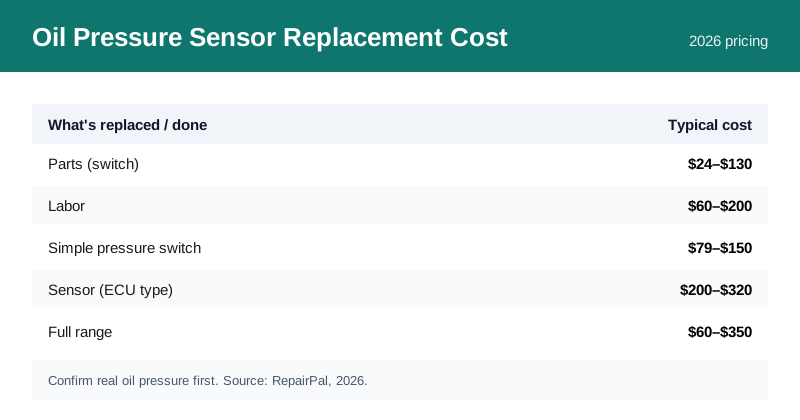
An oil pressure sensor (or switch) replacement runs about $60 to $350 total. A simple pressure switch (on/off, for the warning light) runs about $79 to $150, while a sensor that reports a reading to the computer runs about $200 to $320. Parts are roughly $24 to $130 and labor $60 to $200, depending on where the sensor is mounted – some are easy, some are buried. The oil pressure sensor reports the engine’s oil pressure to your gauge or warning light. When it fails, it can trigger a false low-oil-pressure light, a flickering light, or an erratic gauge. Here’s the critical part: because truly low oil pressure can destroy an engine in minutes, you must confirm the actual oil pressure with a mechanical gauge before assuming it’s just a bad sensor. A cheap sensor is good news – but only after you’ve ruled out a real pressure problem.
This is a cheap part with a serious caveat, so the diagnosis matters more than the price. Let me cover both.
What you’ll actually pay
Here’s the picture. These are estimates that vary by vehicle and shop.
| Item | Cost | Notes |
|---|---|---|
| Simple pressure switch | $79–$150 | Warning light type |
| Sensor (ECU type) | $200–$320 | Sends a reading |
| Parts / labor | $24–$130 / $60–$200 | Access varies |
| Full range | $60–$350 | By vehicle |
A low-oil-pressure light is one you never ignore; our oil pump guide and oil change guide cover the system behind the reading.
Shop Talk
This is the one cheap sensor where I’d never just “throw the part at it” – because the thing it’s warning about can kill your engine. The oil pressure sensor or switch only reports pressure; it doesn’t create it. So when the light comes on or the gauge drops, there are two possibilities: the sensor is lying (common, cheap fix), or your oil pressure really is low (low oil level, a worn oil pump, a clogged pickup, or internal engine wear – serious). The only way to know which is to put a mechanical oil pressure gauge on the engine and read the actual pressure. If the mechanical gauge shows normal pressure but the dash light or gauge is misbehaving, then yes, replace the sensor – it’s cheap and you’re done. But if the mechanical gauge confirms low pressure, the sensor is doing its job and the real repair is something bigger. Here’s the rule that saves engines: if the red oil pressure light comes on and stays on while driving (not the oil-change reminder, the actual pressure warning), pull over and shut the engine off, check the oil level, and don’t keep driving until you know the pressure is okay. An engine run without oil pressure can be ruined in minutes – far more than any sensor. Don’t gamble a motor to save a tow.
Where Drivers Overpay
The “overpay” on this one isn’t about dollars on the sensor – it’s about what happens if you guess wrong. Replacing the sensor on faith when oil pressure is actually low lets the real problem keep running, and a few more miles without pressure can cost an engine. The save is a mechanical-gauge test first: it’s a small diagnostic charge that either clears the sensor or catches a disaster.
On the dollars side, make sure you’re quoted the right part – a simple switch ($79–$150) versus an ECU-type sensor ($200–$320) are different prices. The pattern: confirm actual pressure with a mechanical gauge, replace the sensor only when real pressure is verified normal, and never keep driving on a red oil-pressure light.
The Real Number
An oil pressure sensor is cheap – $79 to $150 for a simple switch, $200 to $320 for an ECU-type sensor, $60 to $350 all in. But never replace it on a guess: have a mechanical gauge confirm your actual oil pressure first, because the same light means either a lying sensor (cheap) or truly low pressure that can destroy the engine. If the red oil-pressure light stays on while driving, stop and shut off – a motor beats a sensor every time.
Frequently Asked Questions
How much does it cost to replace an oil pressure sensor?
About $60 to $350 total, depending on the type and access. A simple oil pressure switch (the on/off type that just triggers the warning light) runs about $79 to $150, while a sensor that sends an actual pressure reading to the computer or gauge runs about $200 to $320. Parts are roughly $24 to $130 and labor $60 to $200, since some sensors are easy to reach and others are buried under or behind other components. These are estimates that vary by vehicle and shop. The sensor itself is inexpensive, but the important step before replacing it is confirming the engine’s actual oil pressure with a mechanical gauge, so you’re not replacing a sensor that’s correctly reporting a real problem.
What does the oil pressure sensor do?
The oil pressure sensor (or switch) monitors the oil pressure in the engine and reports it to the dashboard – either as a simple warning light (a switch that turns the light on below a threshold) or as an actual reading on a gauge (a sensor that sends a variable signal). Oil pressure is vital: the oil pump pushes pressurized oil through the engine to lubricate the bearings and moving parts, and without adequate pressure, those parts wear or seize rapidly. The sensor is how the car tells you whether that pressure is okay. Importantly, the sensor only reports pressure; it doesn’t create or control it. So a problem with the reading can mean a bad sensor, or it can mean the actual pressure is low.
Why do I need to confirm actual oil pressure before replacing the sensor?
Because the sensor only reports pressure – it doesn’t produce it – a low-pressure warning has two very different causes, and they look identical on the dash. Either the sensor is faulty and falsely reporting low pressure (a cheap fix), or the oil pressure really is low from low oil, a worn oil pump, a clogged pickup, or internal engine wear (a serious problem). The only reliable way to tell them apart is to connect a mechanical oil pressure gauge directly to the engine and read the true pressure. If it’s normal, the sensor is bad and you replace it. If it’s actually low, replacing the sensor would hide a problem that can destroy the engine. That’s why this confirmation step is essential – it’s the difference between a $100 repair and a ruined motor.
Can I drive with the oil pressure light on?
Not the red oil-pressure warning light – that one you treat as a stop-now alert. If the red oil pressure light comes on and stays on while driving (this is different from the oil-change reminder or an oil-level message), pull over safely, shut the engine off, and check the oil level. Running an engine with truly low or no oil pressure can destroy it – spun bearings or a seized engine – within minutes. Even though a bad sensor can cause a false light, you can’t assume that from the driver’s seat; the safe move is to stop and verify. Add oil if it’s low and the light clears, but still get the pressure checked. The cost of a tow is tiny next to a replacement engine. Don’t gamble on it being “just the sensor.”
What’s the difference between an oil pressure switch and a sensor?
A pressure switch is a simple on/off device: it closes or opens a circuit at a set pressure threshold and turns the warning light on or off. It’s cheaper, around $79 to $150 installed. A pressure sensor (sometimes called a sender or transducer) sends a continuously variable signal that represents the actual pressure, which the gauge or computer reads and displays – and on modern cars it may also feed engine management. It’s typically pricier, around $200 to $320. Some engines use the sensor’s data for functions like variable valve timing, so a fault can set a check engine code too. Which one your car has determines both the price and what symptoms a failure causes (a simple false light versus an erratic gauge reading or a computer code).
What are the symptoms of a bad oil pressure sensor?
Common signs of a faulty sensor include an oil pressure warning light that comes on when pressure is actually fine, a light that flickers or comes and goes, an oil pressure gauge that reads erratically (jumping, pegging high or low, or dropping to zero suddenly), or a gauge stuck at one reading. On some cars a failing sensor sets a check engine code. Sometimes you’ll also see oil weeping from the sensor itself if it’s leaking. The catch is that these same dash symptoms can appear when oil pressure is truly low – so a bad-sensor diagnosis should always be confirmed with a mechanical pressure test. If the real pressure is verified normal, these symptoms point to the sensor, and replacing it resolves them.
Can a bad oil pressure sensor cause other problems?
It can, depending on the car. On engines where the oil pressure sensor’s data is used by the computer – for example, to control variable valve timing (VVT) or to protect the engine – a faulty sensor can set a check engine light and, in some cases, cause drivability issues or trigger a protective mode. A sensor that leaks oil can also make a mess or drip onto other components. But a bad oil pressure sensor does not cause actual low oil pressure – it only misreports it – so it won’t harm the engine mechanically on its own. The real danger is indirect: if a false “it’s fine” reading ever masked a true low-pressure condition, that would be serious. That’s another reason to diagnose oil pressure accurately rather than relying on a suspect sensor.
Sources
Price ranges verified against 2026 oil pressure sensor pricing in November 2026. Dollar amounts are estimates that vary by vehicle and shop.
- RepairPal – repair cost estimator
- J.D. Power – car repair shopping guides
- ASE – National Institute for Automotive Service Excellence
Related Guides
- Oil Pump Replacement Cost
- Oil Change Cost
- Coolant Temperature Sensor Replacement Cost
- Crankshaft Replacement Cost
- Car Repair Cost Estimator

Diane Holcomb spent seven years as a service advisor at multi-brand dealerships in Charlotte, NC, where the oil pressure light was the one warning she never let a customer wave off – a mechanical-gauge check came first, every time. She drives a 2019 Honda CR-V and a hand-me-down 2007 Toyota Camry, and takes no referral fees or advertising money from any shop or chain.