
Last updated: November 10, 2026 – By Diane Holcomb
November 2026 update: reconfirmed PCM part, labor, and programming pricing.
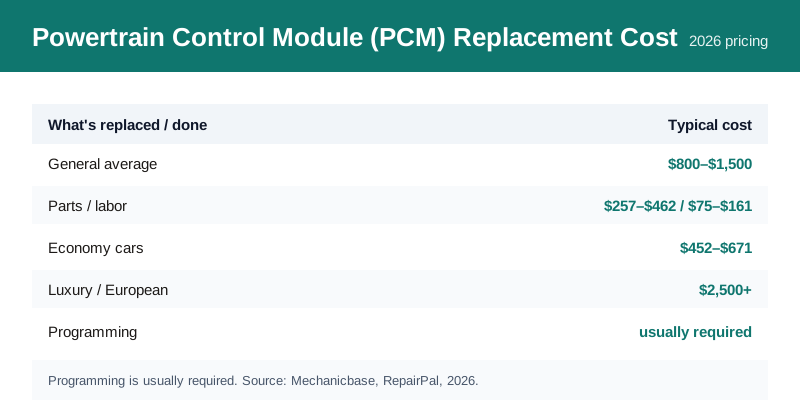
A powertrain control module (PCM) replacement averages about $800 to $1,500, with parts at roughly $257 to $462 and labor $75 to $161. Economy cars can be less – around $452 to $671 – while luxury and European vehicles run $2,500 or more. As with other control modules, the PCM usually has to be programmed to your vehicle, which is part of the cost. The PCM is the main computer that runs the engine (and on many vehicles, the transmission too) – it reads all the sensors and controls fuel, ignition, emissions, and more. When it truly fails, you can get a check engine light, a no-start or hard starting, stalling, erratic running or shifting, and multiple seemingly-unrelated trouble codes at once. But because those symptoms overlap heavily with failed sensors and wiring – and because the fix is sometimes a software reflash, or covered by warranty – the PCM should be confirmed bad before anyone replaces it.
A PCM is the car’s brain, and a true failure is less common than it’s blamed for – so confirmation comes first. Let me cover the cost and the cheaper possibilities.
What you’ll actually pay
Here’s the picture. These are estimates that vary by vehicle and shop.
| Item | Cost | Notes |
|---|---|---|
| General average | $800–$1,500 | Parts + labor |
| Parts / labor | $257–$462 / $75–$161 | Plus programming |
| Economy cars | $452–$671 | Lower end |
| Luxury / European | $2,500+ | Higher end |
PCM symptoms overlap with many sensors; our TCM guide, car diagnostic testing and cost guide, and crankshaft position sensor guide cover the parts it’s confused with.
Shop Talk
The PCM (sometimes called the ECM/ECU, or combined with the transmission computer into one “powertrain” module) is the engine’s brain, and the biggest thing to know is that it’s blamed far more often than it actually fails. Multiple weird codes, stalling, a no-start – those feel like “the computer’s bad,” but they’re usually caused by a failed sensor, bad wiring, corroded grounds, or low voltage feeding the module, all cheaper to fix. So before anyone sells you a PCM, insist on a real diagnosis that rules those out. A truly dead PCM does happen (water intrusion, internal failure, a voltage spike), but it should be confirmed, not assumed. Three money points. One, programming: a new PCM almost always has to be programmed/calibrated to your VIN and configuration, which needs dealer-level equipment – that’s why you can’t just buy one online and plug it in on most cars, and why programming is a line on the bill, not an upsell. Two, reflash: sometimes the fix is simply reprogramming the existing PCM with updated software (manufacturers release updates for driveability issues), which is far cheaper than a new module. Three, warranty: the PCM is part of the powertrain, so if your car’s still under powertrain or emissions warranty (emissions coverage on these modules is often long), it may be covered – check before paying out of pocket. A reman or properly programmed used module can also save money versus new OEM.
Where Drivers Overpay
The biggest overpay on this one is replacing a PCM that was never bad. Multiple codes, stalling, or a no-start usually trace to a sensor, wiring, a corroded ground, or low voltage – all cheaper – so a diagnosis that rules those out before a four-figure module is the critical save.
Even when the PCM is involved, a software reflash of the existing module or powertrain/emissions warranty coverage can mean you pay little or nothing. The pattern: confirm the PCM is truly dead (not a sensor or wiring), ask about a reflash, check warranty coverage, and consider a reman or programmed used module before new OEM.
The Real Number
A PCM is $800 to $1,500 on average ($452 to $671 economy, $2,500+ luxury), including programming, which is required on most cars. But the PCM is blamed far more than it fails – multiple codes, stalling, or a no-start usually trace to a sensor, wiring, or voltage issue. Confirm it’s truly dead before replacing, ask whether a reflash fixes it, and check powertrain/emissions warranty, which often covers these modules.
Frequently Asked Questions
How much does it cost to replace a PCM?
The general average is about $800 to $1,500, with parts at roughly $257 to $462 and labor $75 to $161, plus programming. Economy cars can run less, around $452 to $671, while luxury and European vehicles run $2,500 or more. These are estimates that vary widely by vehicle and shop. The module almost always has to be programmed or calibrated to your specific vehicle, which is a necessary part of the cost on most modern cars. Before paying, it’s worth confirming the PCM is actually the failed component (its symptoms overlap with cheaper sensor and wiring faults), checking whether a software reflash could fix the issue, and seeing whether a powertrain or emissions warranty covers it, since these modules are often covered.
What does the PCM do?
The powertrain control module (PCM) is the main computer that controls the engine and, on many vehicles, the transmission – essentially the car’s brain for how it runs. It takes inputs from dozens of sensors (airflow, oxygen, temperature, crank and cam position, throttle, and more) and controls fuel injection, ignition timing, emissions systems, idle, and often shifting. It’s what makes the engine run efficiently and cleanly and respond to your driving. On some vehicles the engine computer (ECM/ECU) and transmission computer (TCM) are separate; on others they’re combined into one PCM. Because it’s central to everything, a true PCM failure causes widespread, serious driveability problems. But it’s also durable and designed to last, which is why a genuine PCM failure is less common than the number of times it gets blamed for problems actually caused by sensors or wiring.
What are the symptoms of a bad PCM?
A failing PCM can cause a check engine light (often with multiple, seemingly unrelated trouble codes at once), a no-start or hard starting, stalling, rough or erratic running, poor performance or fuel economy, erratic shifting (if it controls the transmission), and failed emissions. The giveaway that points toward the module – rather than a single sensor – is multiple unrelated systems acting up together, or codes that don’t make sense individually. However, these same symptoms are far more often caused by a failed sensor, bad wiring, a corroded ground, or low/unstable voltage feeding the module. So a bad PCM should never be assumed from symptoms alone; it must be confirmed by diagnosis that rules out those cheaper causes. Replacing a PCM on a guess, when the real problem was a $100 sensor or a corroded connector, is a costly, common mistake.
Does a new PCM need to be programmed?
On almost all modern vehicles, yes – this is a key cost and practicality point. A new PCM has to be programmed (flashed) with your vehicle’s software and calibrated to its VIN and configuration to function, and often it must learn or be matched to anti-theft/immobilizer systems too. This requires dealer-level or specialized programming equipment, which is why programming appears on the bill and why you generally can’t buy a PCM online and simply plug it in. Some suppliers pre-program a module if you provide the VIN, but many still need on-vehicle setup. This programming requirement is a legitimate, necessary part of the job, not an inflated charge. It also means PCM replacement usually has to be done somewhere with the right tools (a dealer or a well-equipped shop), which affects where you can have it done and is part of why the job costs what it does.
Can a reflash fix it instead of a new PCM?
Sometimes, and it’s worth asking because it’s much cheaper. Manufacturers periodically release updated PCM software to fix known driveability issues, so in some cases reprogramming (reflashing) the existing module with the latest calibration resolves the problem without replacing the module. This is a dealer or specialized-shop procedure and far less expensive than a new programmed PCM. So before authorizing a full replacement, it’s reasonable to ask whether a software update or reflash is available for your vehicle’s symptoms, especially if there’s a technical service bulletin. Of course, if the module has an actual hardware failure, a reflash won’t help and it must be replaced. But confirming whether a reflash applies first can save you the cost of a new module when the issue is really a software calibration problem. Your dealer can check for applicable updates for your VIN.
Is a PCM covered under warranty?
Often, yes – this is worth checking before paying out of pocket. The PCM is part of the powertrain, so it may be covered by a vehicle’s powertrain warranty. Additionally, in the U.S., emissions-related components (which the PCM is, since it controls emissions systems) carry a federally mandated emissions warranty that’s typically longer than the basic warranty – often covering major emissions components, including the PCM, for an extended period or mileage. So even on a vehicle out of its basic warranty, the PCM might still be covered under powertrain or emissions coverage. Before authorizing an expensive PCM replacement, check your warranty booklet or ask the dealer whether the module is covered. Given the cost, a covered PCM is a significant savings. Extended warranties or recalls/TSBs may also apply, so it’s always worth confirming coverage first.
Could the problem be a sensor or wiring instead?
Very likely – this is the most important thing to rule out, because it’s usually the real cause. The PCM relies on inputs from many sensors and on clean power and ground connections. A failed sensor (crank/cam position, oxygen, airflow, coolant temp, etc.), corroded or broken wiring, a bad ground, or low/unstable voltage can all produce the exact symptoms blamed on a PCM – check engine lights, stalling, no-start, erratic running – while the module itself is fine. Water intrusion into a connector is a common culprit. Replacing the PCM won’t fix any of those. That’s why a proper diagnosis traces the actual fault: scanning codes, testing sensors and circuits, and checking power and grounds to the module before condemning it. Given a PCM costs many times more than a sensor or a wiring repair, confirming it’s truly the module – not something feeding it – is the step that protects you from an expensive, unnecessary replacement.
Sources
Price ranges verified against 2026 PCM pricing in November 2026. Dollar amounts are estimates that vary by vehicle and shop.
- Mechanic Base – PCM symptoms and replacement cost
- RepairPal – repair cost estimator
- ASE – National Institute for Automotive Service Excellence
Related Guides
- Transmission Control Module Replacement Cost
- Car Diagnostic Testing and Costs
- Crankshaft Position Sensor Replacement Cost
- Body Control Module Repair Cost
- Car Repair Cost Estimator

Diane Holcomb spent seven years as a service advisor at multi-brand dealerships in Charlotte, NC, where “the computer’s bad” almost always turned out to be a sensor, wiring, or a ground – and where she’d check emissions warranty coverage before quoting a module. She drives a 2019 Honda CR-V and a hand-me-down 2007 Toyota Camry, and takes no referral fees or advertising money from any shop or chain.