
Last updated: November 4, 2026 – By Diane Holcomb
November 2026 update: reconfirmed pricing by mirror type and the glass-only-versus-whole-assembly option.
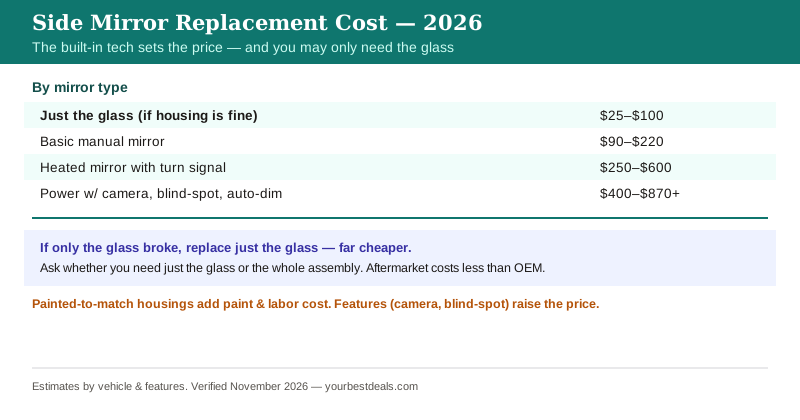
Side mirror replacement cost depends on how much technology is built into the mirror. Just the mirror glass – if only the glass cracked and the housing and motor are fine – is cheap at $25 to $100. A basic manual mirror runs $90 to $220; a heated mirror with a turn signal about $250 to $600; and a power mirror with a camera, blind-spot sensor, or auto-dimming can run $400 to $870 or more. The big cost drivers are the built-in features, whether you need just the glass or the whole assembly, and whether the housing has to be painted to match your car. The money tip: if only the glass broke, replacing just the glass is far cheaper than the whole mirror assembly – so ask which you actually need.
Side mirrors range from a cheap piece of glass to a sensor-packed assembly, so the first question is always “what exactly is broken.” Let me cover the cost by type, the glass-only option, and what drives the price up.
What you’ll actually pay
Here’s the price picture. These are estimated ranges that vary by vehicle and features.
| What you replace | Cost | Notes |
|---|---|---|
| Just the glass (housing intact) | $25–$100 | Cheapest; glass only cracked |
| Basic manual mirror | $90–$220 | No power or heat |
| Heated mirror with turn signal | $250–$600 | Power, heat, signal |
| Power w/ camera / blind-spot / auto-dim | $400–$870+ | Sensors and electronics |
The more the mirror does – power adjustment, heat, a turn-signal, a blind-spot indicator, a camera, auto-dimming, power-folding – the more the assembly costs and the more there is to connect and sometimes calibrate. Painting the housing to match your car’s color adds labor and paint cost. Aftermarket mirrors cost less than original-equipment (dealer) ones and are often fine. Our body & paint guide covers the painting side, and the estimator hub other body parts.
Shop Talk
Before you buy a whole mirror assembly, figure out what actually broke – because “just the glass” versus “the whole mirror” is a huge price difference. If someone clipped your mirror and only the glass is cracked while the housing and the power/heat functions still work, you often only need the replacement mirror glass, which is $25 to $100 and frequently a snap-in or adhesive DIY job. You’d only need the full assembly if the housing is cracked, the mirror won’t adjust or fold, or the motor/wiring is damaged. So have someone confirm whether the housing and electronics still function before ordering the expensive complete unit. Two more cost levers: first, aftermarket mirror assemblies are much cheaper than dealer OEM and usually work fine – just match the exact features (heat, signal, blind-spot, camera, power-fold) and the color/paint-ready finish. Second, the paint. A replacement housing often comes primered or black, and painting it to match your car adds body-shop labor and paint cost; some people live with a black cap on an older car to save that, or buy a pre-painted mirror in their color code. And note that a mirror with a blind-spot camera or sensor may need the feature checked or calibrated after replacement, so factor that in on tech-heavy mirrors.
Where Drivers Overpay
The biggest overpay is buying a full mirror assembly when only the glass broke. If the housing, power, and heat still work and just the glass is cracked, a $25-to-$100 glass replacement does the job instead of a $250-to-$870 assembly. So confirm what’s actually damaged before ordering. The second is paying dealer OEM prices when a quality aftermarket mirror with matching features would cost much less and work fine.
Watch two other cost adds: painting the housing to match (which adds body-shop labor – some owners accept a black cap on an older car, or buy a mirror pre-painted in their color code to skip the paint-shop step), and calibration on mirrors with blind-spot sensors or cameras. The flip side: match the exact features when buying aftermarket, because a cheaper mirror missing your heat, signal, blind-spot, or power-fold won’t fully work. The pattern: replace just the glass if that’s all that’s broken, consider aftermarket with matching features, weigh the paint-match cost, and account for any sensor calibration.
The Real Number
Side mirror cost runs from $25 to $100 for just the glass, to $90 to $220 (manual), $250 to $600 (heated/signal), or $400 to $870+ (camera/blind-spot/auto-dim). First find out what broke: if only the glass cracked and the housing and electronics work, replace just the glass – far cheaper than a whole assembly. Consider aftermarket with matching features over dealer OEM, weigh the paint-to-match cost, and account for calibration on sensor/camera mirrors.
Frequently Asked Questions
How much does it cost to replace a side mirror?
It depends on the mirror. Just the glass (if the housing and electronics are fine) is $25 to $100; a basic manual mirror is $90 to $220; a heated mirror with a turn signal is $250 to $600; and a power mirror with a camera, blind-spot sensor, or auto-dimming can run $400 to $870 or more. Painting the housing to match adds cost, and aftermarket mirrors are cheaper than OEM. These are estimates that vary by vehicle and features. The first step is determining whether you need just the glass or the whole assembly, since that’s the biggest price difference.
Can I replace just the mirror glass instead of the whole mirror?
Often yes, and it’s much cheaper. If someone clipped your mirror and only the glass cracked while the housing, power adjustment, and heat still work, you usually only need the replacement mirror glass, which runs $25 to $100 and is frequently a DIY snap-in or adhesive job. You’d need the full assembly only if the housing is cracked, the mirror won’t adjust or fold, or the motor or wiring is damaged. So confirm whether the housing and electronics still function before ordering the expensive complete unit – replacing just the glass can save hundreds.
Why do some side mirrors cost so much more than others?
Because of the technology built in. A basic manual mirror is just a housing and glass, but modern mirrors can include power adjustment, heating, a turn-signal, a blind-spot indicator, a camera, auto-dimming, and power-folding – each feature adds electronics, wiring, and cost, and some need calibration after replacement. A loaded power mirror with a blind-spot camera can cost several times a basic manual one. Painting the housing to match your car’s color adds more. So the price gap comes down to how many features your specific mirror has and whether it needs paint and calibration.
Is an aftermarket side mirror as good as OEM?
Quality aftermarket mirrors are usually fine and much cheaper than dealer OEM. The key is matching the exact features – power, heat, turn signal, blind-spot sensor, camera, power-fold – and getting the correct color or a paint-ready finish, because a cheaper mirror missing one of your features won’t fully work. Reputable aftermarket brands fit and function well for most cars. The main cautions are very cheap no-name units (which may fit poorly or lack features) and tech-heavy mirrors with cameras or sensors, where OEM or a careful aftermarket match matters more. For a standard mirror, aftermarket is a solid value.
Does a replacement side mirror need to be painted?
Often, if you want it to match. Replacement mirror housings frequently come primered or in black rather than your car’s color, so matching them requires a body shop to paint the housing, which adds labor and paint cost. To avoid that, some owners buy a mirror pre-painted in their factory color code, and others simply accept a black cap on an older vehicle to save the paint-shop expense. A black or mismatched housing is purely cosmetic – it doesn’t affect function. So the paint decision is about appearance and budget; factor it in when comparing the all-in cost.
Does a side mirror with a camera or blind-spot sensor need calibration?
It can. Mirrors with blind-spot monitoring sensors, cameras, or other driver-assist features may need the system checked or calibrated after replacement so it works correctly, which can add a step and cost. This is more likely on tech-heavy mirrors and varies by vehicle. So if your mirror has a blind-spot indicator, camera, or similar feature, ask whether calibration is required and factor it in – it’s part of making sure the safety feature functions after the repair. A basic mirror with no sensors doesn’t need calibration.
Is it legal and safe to drive with a broken side mirror?
It depends on your state and which mirror. Many states require a driver’s-side mirror and at least one other mirror (driver-side plus either passenger or rearview), so a broken or missing driver’s mirror can be a ticketable violation and is a real safety issue for lane changes and blind spots. A cracked mirror that still gives a usable reflection is less urgent than one that’s shattered or hanging off. So while a minor crack may be drivable briefly, a broken driver’s mirror or one you can’t see out of should be fixed promptly for both safety and legal reasons. Check your state’s specific mirror requirements.
Sources
Price ranges verified against 2026 repair pricing in November 2026. Dollar amounts are estimates that vary by vehicle, mirror features, and region.
- Lemonade – side mirror replacement cost
- RepairPal – mirror replacement estimates
- NHTSA – vehicle safety and mirror requirements
Related Guides
- Windshield Replacement Cost
- Car Key Replacement Cost
- Body & Paint Guide
- How to Fix Deep Scratches
- Car Repair Cost Estimator

Diane Holcomb spent seven years as a service advisor at multi-brand dealerships in Charlotte, NC, where she’d check whether a clipped mirror needed just $40 of glass or a full painted assembly before quoting. She drives a 2019 Honda CR-V and a hand-me-down 2007 Toyota Camry, and takes no referral fees or advertising money from any shop or chain.