
Last updated: November 9, 2026 – By Eddie Brennan
November 2026 update: consolidated two spark-plug cost guides, reconciled the by-engine and high-end ranges, and added the symptoms, plug-gap, and DIY detail.
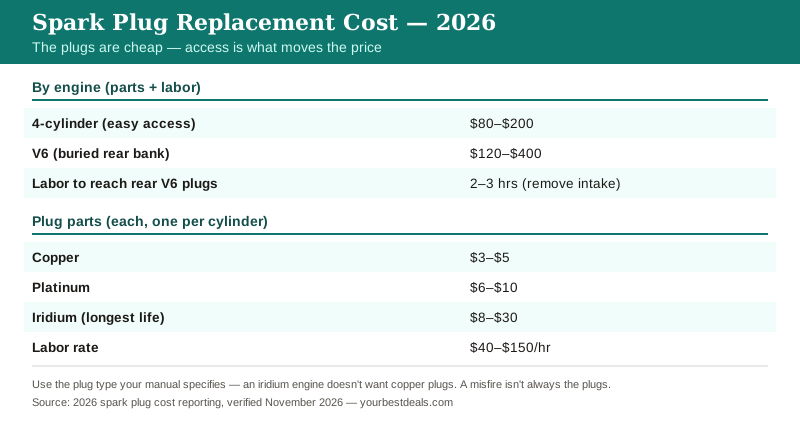
Spark plug replacement in 2026 runs $80 to $200 on a four-cylinder with easy-to-reach plugs and $120 to $400 on a V6 where the back three plugs are buried against the firewall; luxury or very hard-to-reach engines can run $600 to $900. Here’s the thing that surprises people: the plugs themselves are cheap, $2 to $30 each, so almost the entire price difference is labor – specifically, whether a tech can reach your plugs in twenty minutes or has to pull the intake manifold to get at the rear bank.
I did a lot of these in Columbus, and the quote depends more on your engine layout than on anything else. A four-cylinder is a quick, cheap job. A transverse V6 with the rear plugs jammed against the firewall is a two-to-three-hour job because the intake has to come off, and that labor is the whole reason the same “spark plugs” can be $90 or $380. This guide sorts out what you’re really paying for, and how to tell whether a misfire is even the plugs in the first place.
Spark plug cost by engine
These are parts-and-labor totals. The engine layout is the deciding factor, far more than the plugs.
| Engine | Typical cost | Why |
|---|---|---|
| 4-cylinder (easy access) | $80–$200 | Plugs on top, ~20–40 min |
| V6 (buried rear bank) | $120–$400 | Intake off to reach rear plugs, 2–3 hrs |
| V8 / truck | $150–$450 | Eight plugs, sometimes tight access |
| Luxury / very hard to reach | $600–$900 | Extensive teardown to reach plugs |
Plugs cost $2 to $10 each for copper, $6 to $10 for platinum, and $8 to $30 for iridium, and you need one per cylinder – so even eight iridium plugs are rarely more than $150 in parts. Labor at $40 to $150 an hour is where the bill is made. A four-cylinder is cheap because the plugs sit right on top; a firewall-side V6 bank, or a tightly packaged luxury engine, is expensive purely because of the access. Because a misfire often involves the plug and its coil together, our ignition coil guide and tune-up guide are worth a look alongside this.
What gets misdiagnosed
A rough-running engine or a misfire code sends people straight to “I need spark plugs,” but plugs are only one of several causes. On a modern engine, each plug usually has its own ignition coil sitting right on top of it, and a failing coil throws the exact same misfire on that cylinder as a worn plug. Bad plug wires on older engines, a clogged fuel injector, or a vacuum leak can all mimic it too. Replacing plugs when the real culprit is a dead coil means the misfire comes right back.
The good news is that a misfire usually logs a code telling you which cylinder, and a decent tech can swap a suspect coil to a different cylinder to see if the misfire follows it – if it does, it’s the coil, not the plug. When you’re already in there replacing plugs on high mileage, it’s reasonable to do coils too if any test weak, since the labor overlaps on a buried engine. But don’t let a shop sell you a full set of coils on a hunch; the diagnosis should point to them.
Straight From the Invoice: plug jobs
These are jobs I either did myself or watched come through the bay – an easy four-cylinder, a buried V6, and a misfire that wasn’t the plugs.
Invoice #1 – 2017 Honda Civic, four plugs, independent, Ohio
Iridium plugs, right on top of the engine, about thirty minutes of labor. $120 all-in. Textbook easy job. Lesson: on a four-cylinder, spark plugs are one of the cheapest scheduled services there is – if a shop quotes you $300 for a four-cylinder plug job, something’s off.
Invoice #2 – 2015 Toyota Camry V6, six plugs, independent, Charlotte NC
The rear three plugs sat against the firewall, so the intake plenum had to come off – about two and a half hours of labor. $360 all-in, and $40 of that was the plugs. Lesson: a transverse V6 plug job is expensive because of access, not parts; the labor is real, not padding.
Invoice #3 – 2013 Ford Escape, misfire that was a coil, Columbus
Cylinder-3 misfire, owner wanted all new plugs. Swapped the coil from cylinder 3 to cylinder 1 and the misfire followed it – a $60 coil, not a plug set. Lesson: a single-cylinder misfire is often a coil, and the swap test proves it in five minutes before you pay to replace anything.
Which plug type, gap, and how often?
Use what your engine specifies
Modern engines are designed around a specific plug – usually iridium or platinum – and you should run what the manufacturer specifies, not downgrade to copper to save a few dollars. Copper plugs are cheap but wear fast and can misfire in an engine built for iridium, so the “savings” turns into a repeat job. Iridium plugs cost more up front but last 60,000 to 100,000 miles, which is why they’re the value choice despite the higher per-plug price. Just as important is the gap: many modern plugs come pre-gapped and shouldn’t be re-gapped, since mishandling can damage them, and “upgrading” to a fancier plug than the manufacturer calls for rarely helps and can cause running problems. Match the plug and gap to the spec in your manual.
Follow the interval, don’t chase it
Most modern iridium-equipped engines go 60,000 to 100,000 miles between plug changes, so this is not a frequent service; older copper-plug engines need them sooner, often around every 30,000 miles. Replacing plugs way ahead of the interval wastes money, especially on a buried V6 where the labor is the cost. Do them at the manufacturer’s interval, or sooner only if you have an actual plug-related misfire or fouling. On a high-mileage buried engine, it’s reasonable to do the plugs and any weak coils together since the intake’s already off.
Shop Talk
Before you pay for a full set of plugs on a misfire, ask the shop to do the coil-swap test – move the coil from the misfiring cylinder to a good one and see if the misfire moves with it. It takes five minutes and tells you whether you’re buying a $60 coil or a plug job. And if you drive a transverse V6, don’t be shocked when the plug quote is triple a four-cylinder’s; the rear bank against the firewall really takes hours to reach, and that labor is real. What’s not fair is a $300 quote to change four plugs sitting right on top of a four-cylinder. Two more money points: use the exact plug your engine specifies, with the correct pre-set gap – don’t re-gap pre-gapped plugs or over-upgrade to a fancier plug, which rarely helps and can cause problems – and because a misfire is often a plug and its coil working as a pair, if the coils are high-mileage or you’re already deep in the engine to reach the plugs, do any worn coils at the same time rather than paying that access labor twice.
What actually drives the price
Engine access, full stop. The plugs are a rounding error – even a premium set is under $150 – so the difference between a $90 job and a $380 one (or a $600-to-$900 luxury job) is entirely how hard your plugs are to reach, plus how many there are. A four-cylinder with plugs on top is cheap; a transverse V6 with the rear bank against the firewall requires pulling the intake and books two to three hours. Knowing your engine layout tells you which quote to expect before you ever call a shop.
The avoidable cost is replacing plugs that weren’t the problem, or doing the job far ahead of the interval. A single-cylinder misfire is often a coil, provable with a five-minute swap test, and iridium plugs last 60,000 to 100,000 miles, so there’s rarely a reason to do them early. Diagnose the misfire, run the specified plug and gap at the specified interval, and on a buried engine bundle any truly weak coils into the same visit.
The Real Number
Budget $80 to $200 for a four-cylinder and $120 to $400 for a V6, with luxury or very buried engines reaching $600 to $900 – the whole difference being access, not the plugs, since even a premium set is under $150 in parts. Run the plug type and gap your manual specifies (don’t re-gap pre-gapped plugs or over-upgrade) and change them at the 60,000-to-100,000-mile interval rather than early. If you have a misfire, get the coil-swap test before buying plugs, because a single-cylinder misfire is often a $60 coil. On a buried engine, bundle any real weak coils into the same job since the intake’s already off.
Frequently Asked Questions
How much does spark plug replacement cost in 2026?
A four-cylinder with easy-access plugs runs $80 to $200, a V6 with a buried rear bank $120 to $400, and a V8 or truck $150 to $450; luxury or very hard-to-reach engines can run $600 to $900. The plugs themselves are cheap – $2 to $10 for copper, $6 to $10 for platinum, and $8 to $30 for iridium, one per cylinder – so almost the entire price difference is labor. A four-cylinder is quick, while a transverse V6 needs the intake removed to reach the rear plugs, which is a two-to-three-hour job and the reason for the higher cost. Because the cost is driven by access and the number of plugs (four, six, or eight), a quote for your specific engine is the most accurate guide.
Why are spark plugs so expensive on some cars?
Because of access, not the plugs. On many transverse-mounted V6 engines, the rear bank of three plugs sits against the firewall, and reaching them requires removing the intake manifold, which turns a quick job into two to three hours of labor; luxury engines can require even more teardown. The plugs might be $40 total, but the labor to reach them is where the $360 – or $600-plus – comes from. Larger engines also have more plugs to do. This is a real, legitimate cost of the engine’s design, not padding: a four-cylinder with plugs on top is far cheaper for exactly the same service.
What are the signs of worn spark plugs?
Common signs include a rough or unstable idle, an engine misfire (a stumble or shake, sometimes with a check-engine light), hard starting, hesitation or sluggish acceleration, and reduced fuel economy. As plugs wear, the spark weakens and combustion becomes less consistent. Because a misfire can also come from the ignition coil, a fuel injector, or other issues on that cylinder, the specific symptoms and any trouble codes help confirm it’s the plugs. If your plugs are near or past their service interval and you’re seeing these symptoms, worn plugs are a likely cause – and replacing them (often with any worn coils) typically restores smooth running.
How do I know if I need spark plugs or ignition coils?
A misfire can be either, but the coil-swap test settles it fast. On a modern engine each plug has its own coil, and if one cylinder misfires, a tech can move that cylinder’s coil to a different cylinder – if the misfire follows the coil, it’s the coil; if it stays put, it’s the plug or something else on that cylinder. It’s a five-minute test that can save you from buying plugs when a $60 coil was the problem. Always get the misfire diagnosed rather than replacing plugs on a guess.
What kind of spark plugs should I use, and what about the gap?
Use the exact type your manufacturer specifies – the correct heat range, design, and material, usually iridium or platinum on modern engines. Don’t downgrade to cheaper copper in an engine designed for iridium, since copper wears fast and can cause misfires, turning the savings into a repeat job; copper usually only makes sense where the manufacturer calls for it. Iridium plugs cost more per plug but last 60,000 to 100,000 miles, making them the value choice over their life. On the gap: many modern plugs come pre-gapped and shouldn’t be re-gapped, as mishandling can damage them, and it’s best not to “upgrade” to a different plug than specified. Matching the specified plug and gap matters more than the brand.
How often should spark plugs be replaced?
Most modern engines with iridium plugs go 60,000 to 100,000 miles between changes, so it’s an infrequent service – check your owner’s manual for the exact interval. Older engines with copper plugs need them more often, around every 30,000 miles. There’s no benefit to replacing plugs far ahead of the interval, and on a buried V6 where labor is the cost, doing them early just wastes money. Replace them on schedule, or sooner only if you have an actual plug-related misfire or fouling confirmed by diagnosis.
Can bad spark plugs cause other problems?
Yes. Worn or fouled plugs cause misfires, rough idle, hard starting, reduced fuel economy, and hesitation on acceleration, and a persistent misfire can eventually damage the catalytic converter, which is a far more expensive repair. That’s why staying on the plug interval matters even though it’s infrequent. If you’re noticing rough running or a check-engine light with a misfire code, get it diagnosed promptly – catching a plug or coil issue early is cheap, while ignoring a misfire until it kills the catalytic converter is not.
Is it worth replacing coils with spark plugs?
Only the coils that are actually weak. On a high-mileage buried engine where the intake is already off for the plugs, it can be reasonable to replace coils that test weak at the same time, since the labor overlaps and you avoid paying twice for access. But replacing a full set of good coils on a hunch is unnecessary spending, and if the coils are in good shape or recently replaced, you don’t need to redo them just because you’re changing plugs. Have the coils tested, do the ones that are failing along with the plugs, and leave the healthy ones alone unless your engine has a known coil-failure pattern.
Can I replace spark plugs myself?
On engines with accessible plugs, yes – it’s a classic DIY job: remove the coil or wire, use a spark-plug socket to remove the old plug, and install the new one to the correct torque. The keys are using the exact specified plug and gap (don’t re-gap pre-gapped plugs), not overtightening (which can damage threads) or cross-threading, applying anti-seize only if the plug maker recommends it, and swapping one plug at a time so you keep the firing order and coil connections straight. On engines where the plugs are buried under the intake manifold, it’s much harder and often better left to a shop. For an accessible engine, DIY saves the labor, which is the bulk of the cost.
Sources
Spark plug cost ranges verified against 2026 parts-and-labor reporting in November 2026. Ranges vary by engine layout, plug type, and region; confirm your exact price locally.
- CarParts.com – spark plug replacement cost, parts and labor
- RepairPal – spark plug replacement cost estimate
- J.D. Power – spark plug replacement cost
Related Guides
- Ignition Coil Replacement Cost
- Tune-Up Cost
- Fuel Injector Replacement Cost
- What Does a Check Engine Light Mean?
- Car Repair Cost Estimator

Eddie Brennan is an ASE Master Certified technician who spent 11 years at an independent shop in Columbus, OH, chasing misfires and pulling intake manifolds to reach buried spark plugs before moving to writing full time in 2023. He writes the repair and diagnostic guides on Your Best Deals and takes no referral fees. He drives a 250,000-mile 2015 Subaru Outback and a 2020 Ford F-150.