
Last updated: November 5, 2026 – By Diane Holcomb
November 2026 update: reconfirmed the cost range, the chain-vs-belt distinction, and the full-kit note.
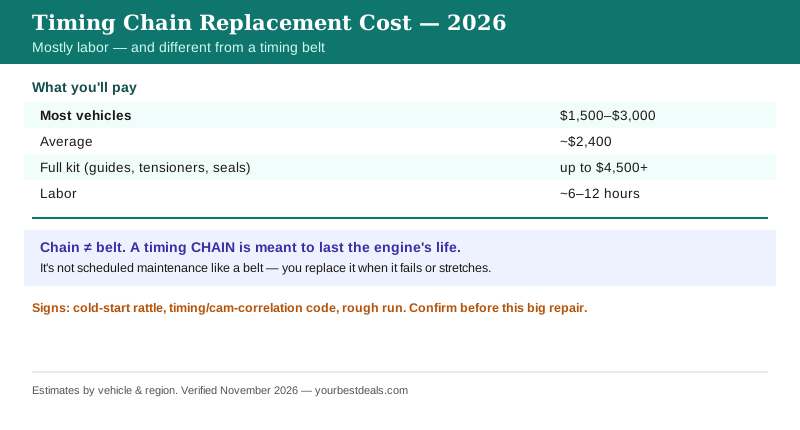
A timing chain replacement costs about $1,500 to $3,000 for most vehicles (averaging around $2,400), and a complete job with new guides, tensioners, gaskets, and seals can exceed $4,500 on some engines. Almost all of that is labor – reaching the chain means removing timing covers and a lot of front-of-engine parts, often 6 to 12 hours of work. One key thing people get wrong: a timing chain is designed to last the life of the engine and is not a routine maintenance item, unlike a timing belt, which is a scheduled replacement. So a chain is replaced when it actually fails or stretches, not on a mileage schedule. Because it’s such a big labor job, shops replace the guides and tensioners at the same time, since they wear together and the engine is already apart.
The timing chain is one of the biggest repair bills most drivers will ever face, and the confusion with timing belts causes a lot of unnecessary worry (and sometimes unnecessary work). Let me cover the cost, the chain-versus-belt distinction, and when a chain actually needs replacing.
What you’ll actually pay
Here’s the price picture. These are estimated ranges that vary a lot by engine.
| Item | Cost | Notes |
|---|---|---|
| Most vehicles | $1,500–$3,000 | Average around $2,400 |
| Full kit (guides, tensioners, seals) | up to $4,500+ | Complex or V6/V8 engines |
| Labor | ~6–12 hours | Most of the cost |
| Parts (chain + kit) | smaller share | Labor dominates |
The chain and its hardware aren’t that expensive as parts – it’s the labor that makes this costly, because the timing cover and many front-of-engine components have to come off to reach the chain. That’s why a thorough job replaces the whole timing set (chain, guides, tensioners, and often the water pump if it’s driven back there) while the engine is open, rather than just the chain – redoing this labor later would be wasteful. Our engine guide covers related repairs.
Shop Talk
The most important thing to understand is chain versus belt, because it changes everything about whether you need this. A timing belt is a rubber belt that’s a scheduled maintenance item – you replace it on an interval (often 60,000 to 105,000 miles) before it breaks, because if it snaps it can wreck the engine. A timing chain is a metal chain designed to last the life of the engine with proper oil changes, and is not on a replacement schedule. So if your car has a chain, nobody should be selling you a scheduled timing chain replacement the way they would a belt – you replace a chain only when it actually fails or stretches. How do you know it’s failing? A rattle on cold start (before oil pressure builds), a check engine light for timing or camshaft/crankshaft correlation, a rough run, or in bad cases the chain jumping a tooth. Worn guides and a weak tensioner are usually what let a chain get noisy or stretch, which is why the whole set gets replaced together. One more money note: on engines where the water pump is driven by or behind the timing cover, do the water pump at the same time – it’s cheap while you’re already in there and saves a second huge labor bill later. And because this is a $2,000-plus job, confirm the chain is really the problem (not, say, a cheaper oil-pressure or VVT issue causing a similar rattle) before authorizing it.
Where Drivers Overpay
The clearest overpay would be letting someone sell you a “scheduled” timing chain replacement as if it were a belt – chains aren’t on a maintenance interval, so a healthy chain doesn’t need replacing by mileage. Only replace a chain when there’s real evidence it’s failing (noise, codes, stretch). The second overpay is authorizing this big job without confirming the chain is actually the cause, since a cold-start rattle can also come from oil-pressure or variable-valve-timing issues that are cheaper to fix.
The flip side – a real saving – is doing the whole timing set and the water pump (if it’s back there) at once rather than piecemeal. Because the labor to open the engine is the expensive part, replacing just the chain and leaving worn guides, an old tensioner, or an aging water pump means risking paying that huge labor again soon. So if the chain really needs doing, do the complete job. The pattern: don’t replace a chain on a schedule, confirm it’s the real cause of the symptom, and when it is due, replace the full set and water pump together to avoid repeat labor.
The Real Number
A timing chain replacement runs $1,500 to $3,000 (avg ~$2,400), up to $4,500+ for a full kit – almost all labor. Crucially, a chain is NOT scheduled maintenance like a belt: you replace it only when it fails or stretches (cold-start rattle, timing code, rough run), never on a mileage schedule. Confirm the chain is the real cause before this big job, and when it’s truly due, replace the full set plus the water pump (if it’s back there) to avoid paying the huge labor twice.
Frequently Asked Questions
How much does it cost to replace a timing chain?
About $1,500 to $3,000 for most vehicles, averaging around $2,400, and a complete job with new guides, tensioners, gaskets, and seals can exceed $4,500 on some engines. The cost is mostly labor – 6 to 12 hours – because reaching the chain requires removing the timing cover and many front-of-engine parts. The chain and hardware aren’t expensive as parts; the labor dominates. These are estimates that vary a lot by engine (V6 and V8 or complex engines cost more). Confirm the chain is actually the problem before authorizing such a large repair.
What’s the difference between a timing chain and a timing belt?
A timing belt is a rubber belt that’s a scheduled maintenance item – you replace it on an interval (often 60,000 to 105,000 miles) before it breaks, because a snapped belt can destroy the engine. A timing chain is a metal chain designed to last the life of the engine with proper oil changes, and is not on a replacement schedule. So a chain is replaced only when it actually fails or stretches, while a belt is replaced preventively by mileage. This is the key distinction: if your car has a chain, you shouldn’t be sold a scheduled chain replacement the way you would a belt.
How do I know if my timing chain needs replacing?
The signs that a timing chain is failing include a rattle on cold start (before oil pressure builds and takes up the slack), a check engine light for timing or camshaft/crankshaft correlation codes, a rough-running engine, and in bad cases the chain jumping a tooth (causing serious running problems). Worn guides and a weak tensioner usually cause the noise or let the chain stretch. Because these symptoms can overlap with cheaper oil-pressure or variable-valve-timing issues, confirm the chain is really the cause before authorizing the big replacement rather than assuming from a rattle alone.
Does a timing chain need to be replaced on a schedule?
No. Unlike a timing belt, a timing chain is designed to last the life of the engine with regular oil changes, and is not a scheduled maintenance item. You replace it only when there’s real evidence it’s failing – noise, timing codes, or stretch. So a healthy chain at high mileage doesn’t need replacing just because of the odometer. Be cautious if a shop recommends a “scheduled” chain replacement by mileage the way they would a belt; that’s not how chains work. Good oil maintenance is the best thing you can do to make a chain last.
Why is timing chain replacement mostly labor?
Because reaching the chain is a deep job. The chain sits at the front of the engine behind the timing cover, and getting to it means removing accessories, belts, pulleys, and the cover itself – often 6 to 12 hours of work. The chain and its guides and tensioner aren’t expensive parts, but the hours of labor to access and reassemble everything are what make the total $1,500 to $3,000 or more. This is also why shops replace the entire timing set (and often the water pump) while they’re in there, since the expensive part is the labor, not the components.
Should I replace the water pump with the timing chain?
On engines where the water pump is driven by or located behind the timing cover, yes – it’s strongly recommended. The water pump is a wear item, and replacing it while the engine is already open for the chain costs only the part plus a little extra labor, versus paying the entire huge labor bill again later when the pump fails. So if your water pump is back there, doing it at the same time is smart, economical insurance. On engines where the pump is separate and accessible, it’s a different decision. Ask the shop whether your water pump is in the timing area.
What happens if a timing chain fails completely?
It can be catastrophic. If a timing chain breaks or jumps enough teeth, the camshaft and crankshaft lose their synchronization, and on an “interference” engine (most modern engines) the pistons can strike the valves, causing major internal damage that can require an engine rebuild or replacement – far more than the chain repair. That’s why you address the warning signs (cold-start rattle, timing codes) promptly rather than ignoring them until the chain fails. Catching a stretching chain early, while it’s still a $2,000-ish repair, is vastly cheaper than a destroyed engine.
Sources
Price ranges verified against 2026 repair pricing in November 2026. Dollar amounts are estimates that vary widely by engine and vehicle.
- RepairPal – timing chain replacement cost
- ConsumerAffairs – timing chain replacement cost
- ASE – National Institute for Automotive Service Excellence
Related Guides
- Engine Repair Guide
- 7 Engine Noises You Should Never Ignore
- Engine Rebuild Cost
- What Does a Check Engine Light Mean?
- Car Repair Cost Estimator

Diane Holcomb spent seven years as a service advisor at multi-brand dealerships in Charlotte, NC, where part of the job was explaining that a timing chain isn’t a scheduled service like a belt. She drives a 2019 Honda CR-V and a hand-me-down 2007 Toyota Camry, and takes no referral fees or advertising money from any shop or chain.