
Last updated: November 6, 2026 – By Diane Holcomb
November 2026 update: refreshed every tier from fluid service to new OEM against 2026 transmission-cost reporting and reconfirmed rebuild-versus-reman-versus-used pricing.
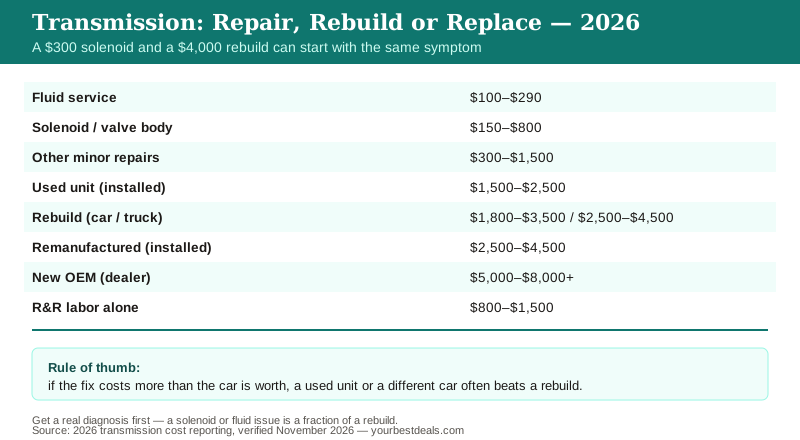
Transmission problems in 2026 range from a $150 solenoid to an $8,000 replacement, and the single most important thing is to find out which one you’re facing before you spend anything. A fluid service is $100 to $290, a solenoid or valve-body repair $150 to $800, a rebuild $1,800 to $3,500 on most cars, a remanufactured unit $2,500 to $4,500 installed, a used transmission $1,500 to $2,500, and a new OEM unit from a dealer $5,000 to $8,000 or more. The same symptom – slipping, a hard shift, a warning light – can point to any of these, so a real diagnosis is everything.
This is the estimate I dreaded delivering at the service desk, because “your transmission” makes people brace for the worst number. But not every transmission problem is a rebuild. Plenty of “the transmission’s shot” cases turned out to be a solenoid, a valve body, or even just fluid – a few hundred dollars, not a few thousand. This guide lays out every tier and, more importantly, how to decide between fixing it, rebuilding, dropping in a used or reman unit, or walking away from the car.
Transmission cost by fix
These are the real tiers, from cheapest to most expensive. Where you land depends entirely on the diagnosis.
| Fix | Cost | When it applies |
|---|---|---|
| Fluid service | $100–$290 | Maintenance or minor issue |
| Solenoid / valve body | $150–$800 | Specific shift fault |
| Other minor repairs | $300–$1,500 | External components |
| Used unit (installed) | $1,500–$2,500 | Budget, unknown mileage |
| Rebuild (car / truck) | $1,800–$3,500 / $2,500–$4,500 | Internal failure |
| Remanufactured (installed) | $2,500–$4,500 | Factory-rebuilt, tested |
| New OEM (dealer) | $5,000–$8,000+ | Newest, priciest |
Just the labor to remove and reinstall a transmission is $800 to $1,500, which is why anything involving pulling the unit is expensive regardless of the part. That’s also why diagnosing before you commit matters so much – if the fix is a solenoid that can be reached without dropping the transmission, you may avoid that big labor number entirely.
Why your quote looks different
The enormous spread here comes down to what actually failed. Slipping, harsh shifts, or a check-engine light can be caused by low or burnt fluid, a failed shift solenoid, a valve-body problem, or genuine internal wear of clutches and gears – and those span $100 to $4,000-plus. A shop that quotes a rebuild off the symptom alone, without a proper diagnosis including a scan and sometimes a fluid inspection, is guessing at your most expensive possible outcome. The diagnosis is what turns “your transmission” into a specific, priced problem.
The second big variable is the path you choose once a major failure is confirmed: rebuild, remanufactured, used, or new. Each is a very different number with different risk, and the right choice depends on your car’s value and how long you plan to keep it. That decision is where thousands of dollars are won or lost, and it’s the part a rushed quote skips.
Straight From the Invoice: transmission calls
I pulled these from actual repair orders I either wrote or reviewed – a scare that was cheap, a rebuild that was real, and a car that wasn’t worth saving.
Invoice #1 – 2015 Honda Accord, “failing transmission” that was a solenoid, Charlotte NC
Harsh shifting and a code, owner braced for a rebuild quote. A scan pointed to a single shift solenoid, replaced for about $380. Lesson: a scan turned a feared $3,000 rebuild into a $380 repair. Never authorize a rebuild off symptoms alone – get the diagnosis first.
Invoice #2 – 2013 Toyota Sienna, genuine rebuild, suburban Ohio
Slipping badly with metal in the fluid – real internal failure. A rebuild on a van worth keeping came to $3,100. Steep, but the vehicle was worth more than the fix. Lesson: when the fluid shows metal and the unit’s slipping, it’s a real rebuild, and $1,800 to $3,500 is the fair range on a car worth saving.
Invoice #3 – 2008 sedan, rebuild not worth it, Charlotte NC
A tired sedan worth maybe $3,000 needed a $3,200 rebuild. The math didn’t work, so the owner put in a $1,900 used unit as a stopgap instead – and honestly, moving on to another car was the better long-term call. Lesson: when the fix costs more than the car is worth, a used unit or a different car usually beats a full rebuild.
Rebuild vs reman vs used vs new
Rebuild and remanufactured
A rebuild means your existing transmission is taken apart and its worn parts replaced, at $1,800 to $3,500 for cars and $2,500 to $4,500 for trucks – quality depends heavily on the shop doing it. A remanufactured unit is a factory-rebuilt transmission, fully disassembled, inspected, rebuilt to spec, and dyno-tested before shipping, at $2,500 to $4,500 installed. Reman gives you more consistent quality and usually a better warranty, while a rebuild by a trusted transmission specialist can be excellent and sometimes cheaper. Both are solid choices for a car worth keeping.
Used and new
A used transmission is the cheapest at $1,500 to $2,500 installed, but it’s a gamble – you’re buying an unknown unit with unknown mileage and usually a short warranty, so it’s best as a stopgap on a car you won’t keep long. A new OEM unit from a dealer at $5,000 to $8,000-plus is the priciest and rarely makes sense outside a newer or high-value vehicle. For most drivers with a major failure, the real choice is between a reman unit, a rebuild by a good specialist, and, on a low-value car, a used unit or moving on.
Shop Talk
Never authorize a rebuild off symptoms alone – pay for a real diagnosis first, including a scan and a fluid check, because a slipping, hard-shifting transmission is a solenoid or a valve body surprisingly often, and that’s hundreds instead of thousands. And take a big transmission quote to a dedicated transmission specialist, not just a general shop, for a second opinion; they diagnose these all day and will tell you honestly whether it’s a repair or a rebuild. The most expensive mistake here is spending $3,000 on a rebuild for a problem a $400 part would have fixed.
Where drivers overpay
The biggest transmission overpay by far is skipping the diagnosis and authorizing a rebuild off the symptom. Slipping and hard shifts really are a solenoid, valve body, or fluid problem a large share of the time, and those are $150 to $800, not $3,000. A shop that jumps to a rebuild quote without a scan and a fluid inspection is quoting your worst case, and paying it blind is how people spend thousands on a problem a few hundred dollars would have solved. Always get the specific failure identified first.
The second overpay is rebuilding a car that isn’t worth it. If your vehicle is worth $3,000 and the rebuild is $3,200, you’re putting more into it than you’d get back, and a used unit as a stopgap or moving to another car is often the smarter money. The third is defaulting to the dealer’s new OEM unit at $5,000-plus when a quality reman or a trusted specialist’s rebuild does the job for far less on anything but a newer vehicle. Match the fix to the diagnosis and the car’s value.
The Real Number
Before you brace for a $3,000 rebuild, get a real diagnosis – a scan and a fluid check – because a slipping or hard-shifting transmission is a $150-to-$800 solenoid or valve-body fix a large share of the time. If it’s a genuine internal failure, weigh a rebuild ($1,800–$3,500 cars, $2,500–$4,500 trucks), a reman unit ($2,500–$4,500), or a used unit ($1,500–$2,500) against your car’s value. The rule of thumb: if the fix costs more than the car is worth, a used unit or a different car usually beats a full rebuild. Take any big quote to a transmission specialist for a second opinion.
Frequently Asked Questions
How much does transmission repair cost in 2026?
It ranges enormously by what’s wrong: a fluid service is $100 to $290, a solenoid or valve-body repair $150 to $800, other minor repairs $300 to $1,500, a used transmission $1,500 to $2,500 installed, a rebuild $1,800 to $3,500 for cars and $2,500 to $4,500 for trucks, a remanufactured unit $2,500 to $4,500, and a new OEM unit $5,000 to $8,000 or more. Just the labor to remove and reinstall a transmission is $800 to $1,500. Because the same symptoms span all these tiers, a real diagnosis is essential before spending anything.
Should I repair, rebuild, or replace my transmission?
Start with a diagnosis, because many “failing transmission” cases are actually a solenoid, valve body, or fluid issue costing $150 to $800, not a rebuild. If it’s a genuine internal failure, choose based on your car’s value: a rebuild or remanufactured unit ($1,800 to $4,500) makes sense on a car worth keeping, a used unit ($1,500 to $2,500) is a stopgap on a low-value car, and a new OEM unit ($5,000-plus) rarely makes sense outside a newer vehicle. The rule of thumb is that if the fix costs more than the car is worth, a used unit or a different car often beats a rebuild.
Is a slipping transmission always a rebuild?
No, and assuming so is the most expensive mistake you can make. Slipping, harsh shifts, and shift-related warning lights are frequently caused by low or burnt fluid, a failed shift solenoid, or a valve-body problem – all far cheaper than a rebuild, in the $150 to $800 range. Only genuine internal wear of the clutches and gears requires a rebuild. A proper diagnosis with a scan and a fluid inspection tells you which it is. Never authorize a rebuild off symptoms alone; get the specific fault identified first, because it’s often the cheap fix.
What’s the difference between a rebuilt and remanufactured transmission?
A rebuild takes your existing transmission apart and replaces its worn parts, so quality depends on the shop doing the work, and it runs $1,800 to $3,500 for cars. A remanufactured unit is a factory-rebuilt transmission that’s fully disassembled, inspected, rebuilt to specification, and dyno-tested before shipping, at $2,500 to $4,500 installed. Reman offers more consistent quality and usually a stronger warranty, while a rebuild by a trusted transmission specialist can match it and sometimes cost less. Both are good choices for a car worth keeping; the used and new-OEM options sit at the budget and premium ends.
Is a used transmission worth the risk?
Sometimes, as a stopgap. A used transmission is the cheapest option at $1,500 to $2,500 installed, but you’re buying an unknown unit with unknown mileage and usually a short warranty, so it can fail sooner than a rebuild or reman. It makes the most sense on a low-value car you don’t plan to keep long, where a $3,000 rebuild would cost more than the vehicle is worth. On a car you want to keep for years, a reman unit or a quality rebuild is the safer money despite the higher price. Match the risk to how long you’ll keep the car.
Is it worth fixing a transmission on an old car?
Only if the fix costs less than the car is worth to you. If your vehicle is worth $3,000 and needs a $3,200 rebuild, you’re spending more than you’d get back, and a used unit as a stopgap or moving to another car is usually smarter. But if the failure is a cheap solenoid or fluid issue, even an old car is worth the couple hundred dollars. Get the diagnosis, compare the fix cost to the car’s value, and remember that a used unit at $1,500 to $2,500 can keep an old car going without the full rebuild investment.
Can regular fluid changes prevent transmission repair?
They significantly reduce the risk. Transmission fluid breaks down with heat and age, and old, burnt fluid is a leading cause of premature wear on solenoids, the valve body, and internal clutches. Changing the fluid at your manufacturer’s interval – and it’s truly one of the cheaper services at $100 to $290 – is one of the best ways to avoid a four-figure rebuild down the road. It won’t save an already-failing transmission, and on very high-mileage units that never had service, opinions vary, so ask a specialist. But for maintenance, staying on the fluid interval is cheap insurance.
Sources
Transmission cost ranges verified against 2026 repair-cost reporting on November 6, 2026. Ranges vary enormously by the specific failure, vehicle, and repair path; a proper diagnosis and local quote are essential.
- Bumper – transmission repair, rebuild, or replace cost
- UseCalcPro – transmission rebuild vs reman vs used, 2026
- Transmission repair cost guide, 2026
Related Guides

Diane Holcomb spent seven years at Charlotte dealership service desks, where the transmission estimate was the one she dreaded delivering – and often the one a proper diagnosis made far smaller. She writes the cost and pricing guides on Your Best Deals and takes no referral fees. She drives a 2019 Honda CR-V and a 2007 Toyota Camry.