
Last updated: November 9, 2026 – By Diane Holcomb
November 2026 update: reconfirmed rebuild/reman/new pricing and the fix-or-move-on framing on older cars.
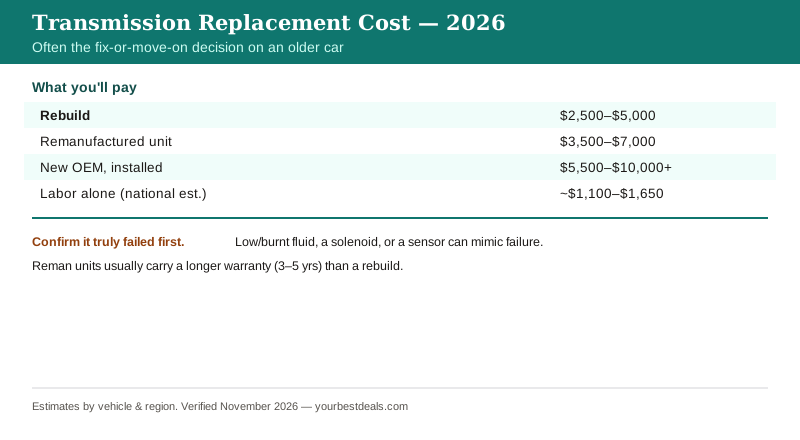
Replacing a transmission is one of the biggest common repair bills. A rebuild runs about $2,500 to $5,000, a remanufactured unit about $3,500 to $7,000, and a new OEM transmission about $5,500 to $10,000 or more installed. Labor alone, in a mid-2026 national estimate, runs roughly $1,100 to $1,650. A reman unit usually carries a longer warranty – often three to five years versus one to three for a rebuild – but it costs more up front. Because the numbers are so large, on a high-mileage car the repair often approaches or exceeds the car’s value, which makes this as much a fix-or-move-on decision as a repair. And before spending anything, confirm the transmission truly failed – low or burnt fluid, a solenoid, or a sensor can mimic transmission failure for far less.
This is the repair where “is it even worth it” is a fair question, and where confirming the real problem first can save thousands. Let me cover the rebuild-vs-reman-vs-new choice, the warranty trade-off, and how to decide on an older car.
What you’ll actually pay
Here’s the price picture. These are estimated ranges that vary by vehicle and shop.
| Option | Cost | Warranty (typical) |
|---|---|---|
| Rebuild | $2,500–$5,000 | 1–3 years |
| Remanufactured unit | $3,500–$7,000 | 3–5 years |
| New OEM, installed | $5,500–$10,000+ | Varies |
| Labor alone (national est.) | ~$1,100–$1,650 | – |
A rebuild reuses your transmission case with worn parts replaced; a reman is a factory-rebuilt unit swapped in with standardized quality control; a new OEM unit is the most expensive. CVTs and dual-clutch transmissions often favor a reman swap. Our transmission guide and transmission fluid service guide cover maintenance that helps avoid this bill.
Shop Talk
Two things can save you from the big bill, and the first is diagnosis. A car that slips, shifts hard, or won’t move isn’t automatically a dead transmission. Low or badly burnt fluid, a failed shift solenoid, a clogged filter, a bad sensor, or even a wiring or valve-body issue can produce scary symptoms for a fraction of a replacement – sometimes a few hundred dollars. So before you authorize a teardown, get a real diagnosis, including a fluid check and a scan for codes. The second is the warranty math between rebuild and reman. A local rebuild can be cheaper up front, but the quality depends entirely on who does it, and the warranty is often shorter. A remanufactured unit costs more but comes with standardized factory quality control and usually a longer, nationwide warranty – which matters a lot on a transmission, because a comeback is a huge labor job. On the bigger question: if you’re looking at $4,000-plus on a car worth $5,000, do the honest math on the car’s value, its other needs, and what a replacement vehicle would cost before pouring a transmission into it. Sometimes the repair is right; sometimes it’s throwing good money after bad.
Where Drivers Overpay
The biggest avoidable spend is replacing a transmission that didn’t need replacing. Slipping, harsh shifts, or a no-move condition can come from low or burnt fluid, a shift solenoid, a clogged filter, a sensor, or a valve-body issue – repairs that can cost a few hundred dollars instead of several thousand. A real diagnosis with a fluid check and a code scan before any teardown is the single best protection.
The second consideration is the rebuild-vs-reman trade-off: a cheap rebuild can be false economy if the warranty is short and the work is uncertain, since a comeback means paying the heavy labor again. And on a low-value car, the honest fix-or-move-on math matters. The pattern: diagnose before replacing, weigh warranty against up-front price, and compare the repair to the car’s value.
The Real Number
A rebuild is $2,500 to $5,000, a reman $3,500 to $7,000, a new OEM unit $5,500 to $10,000+. First, diagnose – slipping or no-move can be low/burnt fluid, a solenoid, or a sensor for a few hundred dollars, not a replacement. If it truly needs replacing, weigh a cheaper rebuild (shorter warranty) against a reman (longer, nationwide warranty) – a comeback means paying the heavy labor twice. On a low-value car, do the honest fix-or-move-on math.
Frequently Asked Questions
How much does it cost to replace a transmission?
A rebuild runs about $2,500 to $5,000, a remanufactured unit about $3,500 to $7,000, and a new OEM transmission about $5,500 to $10,000 or more installed. Labor alone, in a mid-2026 national estimate, runs roughly $1,100 to $1,650, with parts making up the larger share. These are estimates that vary a lot by vehicle, transmission type, and shop. CVTs, dual-clutch units, and luxury or truck transmissions tend toward the higher end. Because the totals are so large, it’s worth getting a firm, itemized quote for your specific vehicle and confirming the transmission actually needs replacing before committing.
What’s the difference between a rebuild, a reman, and a new transmission?
A rebuild means your existing transmission is disassembled and its worn parts (clutches, seals, bands, and so on) are replaced, then it’s reassembled and reinstalled – quality depends on the shop doing it. A remanufactured (reman) unit is a transmission rebuilt to standardized specifications at a factory, with consistent quality control, that’s swapped in for yours. A new unit is a brand-new transmission, typically OEM, and the most expensive. Reman units usually carry longer, often nationwide warranties than a local rebuild, which is a meaningful advantage on a part this costly to service. The best choice depends on price, warranty, and the type of transmission.
Is it worth replacing a transmission?
It comes down to the repair cost versus the car’s value and condition. On a newer or well-maintained vehicle worth well above the repair, replacing the transmission is usually worthwhile. On a high-mileage, lower-value car where a $4,000-plus transmission approaches or exceeds what the car is worth – and especially if other major repairs loom – it may make more sense to put that money toward a different vehicle. There’s no universal answer; do the honest math on the car’s value, its other needs, and replacement-vehicle costs. A big part of making a good decision is first confirming the transmission truly failed rather than a cheaper component.
Can transmission problems be something cheaper than a replacement?
Yes, and this is worth checking before any teardown. Symptoms like slipping, harsh or delayed shifts, or a no-move condition can come from low or burnt transmission fluid, a failed shift solenoid, a clogged filter, a faulty sensor, or a valve-body issue – repairs that can run a few hundred dollars rather than several thousand. Sometimes even a simple fluid-and-filter service resolves shifting complaints caught early. A proper diagnosis, including checking the fluid level and condition and scanning for codes, tells you whether you’re facing a minor repair or a full replacement, which can save you from an unnecessary multi-thousand-dollar job.
How long does a transmission replacement last?
A quality rebuild or a reman unit, properly installed and maintained, can last many years and well over 100,000 miles – often the remaining life of the car. Longevity depends heavily on the quality of the work or the reman supplier, on correct installation (including related items like cooler lines being clean), and on maintenance afterward, especially regular fluid service. This is one reason the warranty matters so much: a longer, nationwide reman warranty signals confidence and protects you if something goes wrong. Keeping up with transmission fluid changes on the new unit is the best way to get full life out of an expensive replacement.
What causes a transmission to fail?
Heat and neglected fluid are the leading culprits. Transmission fluid lubricates, cools, and transmits power; when it’s old, low, or burnt, internal parts overheat and wear out. Skipped fluid changes, overheating from heavy towing or stop-and-go driving, and leaks all shorten a transmission’s life. Hard use, certain known-weak designs, and simple high mileage contribute too. Because fluid condition is so central, regular transmission fluid service is the single most effective way to prevent failure – many expensive transmission replacements trace back to fluid that was never changed. Catching a leak or a shifting problem early also prevents a small issue from destroying the unit.
Can I drive with a failing transmission?
It’s risky and generally not advisable. Driving a slipping or overheating transmission accelerates the damage and can turn a repairable problem into a total failure, and a transmission that fails while driving can leave you stranded or create a hazard. If you notice slipping, harsh shifting, a burning smell, or warning lights, it’s best to have it diagnosed promptly rather than keep driving. If the fluid is simply low or there’s a minor issue caught early, addressing it quickly can prevent major damage. Once a transmission is clearly failing, continuing to drive usually just raises the eventual repair cost.
Sources
Price ranges verified against 2026 transmission replacement pricing in November 2026. Dollar amounts are estimates that vary by vehicle and shop.
- J.D. Power – transmission replacement cost
- RepairPal – transmission repair estimates
- ASE – National Institute for Automotive Service Excellence
Related Guides
- Transmission Guide
- Transmission Fluid Change Cost
- Truck Transmission Replacement Cost
- Clutch Replacement Cost
- Car Repair Cost Estimator

Diane Holcomb spent seven years as a service advisor at multi-brand dealerships in Charlotte, NC, where the transmission quote was the one she dreaded delivering – and the one where she made sure the car had really been diagnosed, not just condemned. She drives a 2019 Honda CR-V and a hand-me-down 2007 Toyota Camry, and takes no referral fees or advertising money from any shop or chain.