
Last updated: November 7, 2026 – By Diane Holcomb
November 2026 update: reconfirmed the per-door range, part-vs-labor split, and the cheaper causes that mimic a dead motor.
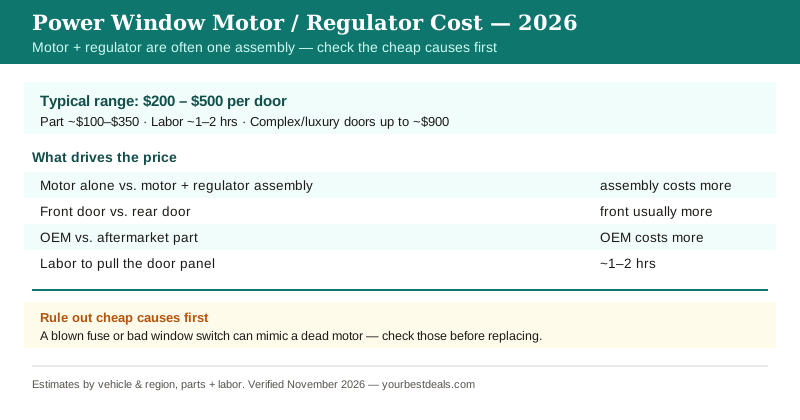
A power window motor or regulator replacement runs about $200 to $500 per door at most shops in 2026, with the broader range reaching $200 to $900 on luxury or complex doors. The part is roughly $100 to $350, and labor is about one to two hours to pull the door panel and swap it. One thing that catches people off guard on the estimate: the motor and the regulator (the scissor or cable mechanism that actually raises the glass) are often sold as a single assembly, so a “window motor” repair frequently replaces both together. Before you approve any of it, though, check the cheap stuff – a blown fuse or a bad switch can act exactly like a dead motor for a fraction of the price.
This was a satisfying one to quote because the fix is usually contained to one door, but I always slowed customers down first: a window that won’t move isn’t automatically a motor. I saw plenty of “dead motors” that were a $15 fuse or a failed switch. So let me give you the real cost, explain the motor-plus-regulator thing, and walk through what to rule out before spending on the assembly.
What you’ll actually pay
Here’s the price picture per door. These are estimated ranges that vary by vehicle, part choice, and shop.
| Item | Typical cost | Notes |
|---|---|---|
| Motor or regulator part | $100–$350 | OEM higher, aftermarket lower |
| Labor (pull door panel) | $120–$220 | About 1–2 hours |
| Typical total per door | $200–$500 | Most common cars |
| Luxury / complex door | up to $900 | Pricier parts, more trim |
| Blown fuse (if that’s all) | $5–$30 | Check this first |
Front doors usually cost a little more than rear because the glass and motor are larger and lift more weight. OEM parts cost more than aftermarket but fit precisely and tend to last; a good-quality aftermarket assembly is often a reasonable way to keep the bill down. The core repair, when it really is the motor or regulator, lands around $200 to $500 for most cars. Our repair cost estimator covers other jobs.
Motor vs. regulator – why they’re often one part
The window motor is the electric motor that provides the power; the regulator is the mechanical arm-and-track (or cable) system that translates that into raising and lowering the glass. On many vehicles these are bolted together and sold as one assembly, so if either fails, you replace the unit. That’s usually more economical than trying to separate them, because most of the cost is the labor to open the door – doing it once for the whole assembly beats going back in later for the other half. So don’t be surprised when a “motor” quote includes the regulator; it’s often the sensible way to do it.
Shop Talk
Before you pay for a motor, run this thirty-second triage. First, does the window switch make any sound or do anything on that door? Try the other door’s controls too, and (if your car has one) the master switch on the driver’s door. If no window works, suspect a fuse or the master switch, not four dead motors. If only one window is dead and you hear a click or a motor hum but the glass doesn’t move, that points more at the regulator or a motor that’s spinning but not lifting. If you hear nothing at all, it could be the motor, the switch, or a fuse. Check the fuse first – it’s cheap and easy, and a blown window fuse is a common, tidy answer. One more field tip: if the glass is stuck all the way down, you can usually reach in, push it up by hand, and tape it in place to keep rain out until the repair – a lot cheaper than a soaked interior.
Where Drivers Overpay
The biggest overpay is authorizing a motor and regulator assembly when the real fault was a fuse or the switch. Because the symptom (window won’t move) is identical, it’s easy to jump to the expensive part. A quick check – does any other window work, does the switch do anything, is the fuse good – can save you the whole $200-to-$500 job if the answer turns out to be a $15 fuse or a switch. Ask the shop to confirm they’ve verified the motor is actually dead, not just assumed it from the symptom.
The second overpay is paying dealer prices for a routine part. A window regulator assembly is a common wear item, and a quality aftermarket unit installed by an independent shop is often meaningfully cheaper than the dealer’s OEM-only quote, with no real downside for an out-of-warranty car. And if a shop pushes to do all the door’s other “worn” bits while they’re in there, apply the same test as any add-on: is that part actually failing, or is it a just-in-case upsell? Fix the window that’s broken, confirm the cause, and don’t pay assembly prices for a fuse.
The Real Number
Budget about $200 to $500 per door for a real window motor or regulator (part $100–$350, labor 1–2 hrs), up to $900 on complex luxury doors. Motor and regulator are often one assembly, so expect both. But check the cheap causes first – a blown fuse ($5–$30) or a bad switch mimics a dead motor exactly. Confirm the motor is actually dead before approving the assembly, and a quality aftermarket part at an independent shop usually beats the dealer price.
Frequently Asked Questions
How much does it cost to replace a power window motor?
About $200 to $500 per door in 2026 for most cars, with the part running roughly $100 to $350 and labor about one to two hours to open the door panel. Luxury or complex doors can reach $900. Because the motor and regulator are often sold as one assembly, many repairs replace both together. Front doors usually cost a little more than rear. Before paying for the motor, rule out a blown fuse or a bad switch, which can cause the same “window won’t move” symptom for far less. These are estimates that vary by vehicle.
What’s the difference between the window motor and the regulator?
The motor is the electric part that provides power; the regulator is the mechanical mechanism (an arm-and-track or cable system) that converts that power into raising and lowering the glass. On many vehicles they’re bolted together and sold as a single assembly, so if either fails you replace the unit. That’s usually more economical than separating them, since most of the cost is the labor to open the door – doing that once for the whole assembly beats going back in later. So a “motor” repair often includes the regulator.
Why won’t my power window go up but I hear a noise?
If you hear a click, hum, or grinding but the glass doesn’t move, the motor may be getting power and spinning while the regulator has failed – a broken cable, stripped gear, or the glass off its track. That points more at the regulator (or the combined assembly) than a totally dead motor. If you hear nothing at all when you press the switch, it’s more likely a dead motor, a bad switch, or a blown fuse. The sound is a useful clue, so note exactly what you hear when telling the shop.
Can a blown fuse cause a window not to work?
Yes, and it’s one of the first things to check because it’s cheap. A blown power-window fuse can stop one or all windows from working, mimicking a dead motor exactly. If none of your windows work, a fuse or the master switch is a likely culprit rather than several failed motors. Checking and replacing a fuse costs only a few dollars, so confirm the fuse is good before authorizing a $200-to-$500 motor job. A quick test at the fuse box can save the whole repair.
Is it cheaper to replace just the motor or the whole regulator?
It depends on your vehicle. On cars where the motor and regulator are separate, replacing only the failed part can be cheaper. But on the many vehicles where they’re a combined assembly, you replace the unit, and even when separate, it’s often smarter to do both together because most of the cost is the labor to open the door – going back in later for the other half means paying that labor twice. Ask the shop whether your car uses a combined assembly and price it both ways.
Can I drive with a broken power window?
Yes, a broken window doesn’t affect how the car drives, but a window stuck down is a problem for rain and security. If the glass is stuck all the way down, you can usually push it up by hand and tape it in place to keep water out and deter theft until you get it fixed. If it’s stuck up, you simply lose that window’s use until repaired. It’s not an urgent safety repair like brakes, but a window stuck down should be addressed reasonably soon to protect your interior.
Should I use an OEM or aftermarket window regulator?
For an out-of-warranty car, a quality aftermarket regulator assembly is usually a reasonable choice and meaningfully cheaper than OEM, which is why independent shops often quote less than the dealer. OEM parts fit precisely and tend to last, which some owners prefer, but the price gap is real. The main caution is very cheap no-name parts, which can fail early. A mid-tier reputable aftermarket assembly generally balances cost and durability well for this kind of common wear item.
Sources
Cost ranges verified against 2026 repair-cost data and shop pricing in November 2026. Dollar amounts are estimates that vary by vehicle, region, and shop.
- RepairPal – window regulator motor replacement cost
- J.D. Power – window regulator replacement cost
- Kelley Blue Book – window regulator replacement costs
Related Guides
- Car Repair Cost Estimator
- Electrical System Guide
- Alternator Replacement Cost
- Car Maintenance Guide
- What Does the Battery Light Mean?

Diane Holcomb spent seven years as a service advisor at multi-brand dealerships in Charlotte, NC, where “the window won’t work” tickets taught her to check a fuse before quoting a motor. She drives a 2019 Honda CR-V and a hand-me-down 2007 Toyota Camry, and takes no referral fees or advertising money from any shop or chain.