
Last updated: November 7, 2026 – By Eddie Brennan
November 2026 update: reconfirmed the steady-vs-blinking distinction, the cold-weather trigger, and sensor-fault symptoms.
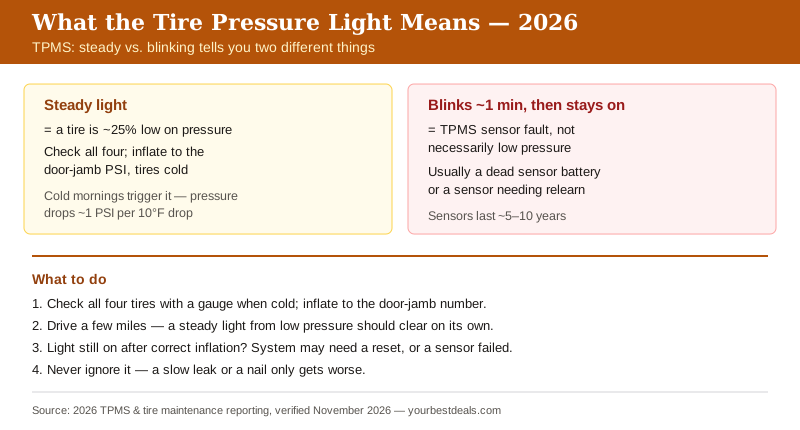
A steady tire pressure light means at least one of your tires is about 25% below the recommended pressure, and you should check all four and inflate to the number on your driver’s door-jamb sticker. That’s the everyday version. But the light behaves two different ways, and the difference matters: a steady light points at low pressure, while a light that blinks for about a minute at startup and then stays on is telling you a sensor has failed, not that a tire is flat. Read the light wrong and you either ignore a slow leak or chase a tire problem that doesn’t exist.
I’ve had people come into the shop convinced they had a flat when the tires were fine – the system just had a dead sensor. And I’ve had the opposite, someone ignoring a steady light for a week with a nail slowly leaking a tire down. The light isn’t complicated once you know what it’s saying. Here’s how to read it and what to do.
Steady light: a tire is low
A steady, solid tire pressure light is the common one, and it means the tire pressure monitoring system (TPMS) has detected at least one tire roughly 25% below the recommended cold pressure. That’s the threshold most systems use, so by the time the light is on, the tire is meaningfully low – not just a couple of PSI. Grab a gauge, check all four (the light doesn’t tell you which one), and inflate to the pressure listed on the sticker inside your driver’s door jamb, not the higher max number stamped on the tire sidewall.
Check and set pressure when the tires are cold – before driving, or at least three hours after – because driving heats the air and raises the reading, so a “correct” hot reading can leave you underinflated once things cool. After you inflate to spec, drive a few miles and a steady low-pressure light usually clears on its own once the system re-reads the tires. If it doesn’t clear, either a tire is still low or you’re looking at the second scenario.
Why cold weather sets it off
The single most common reason a tire pressure light shows up overnight is a temperature drop. Air pressure falls as it gets colder – roughly 1 PSI for every 10-degree drop in temperature – so a cold snap can pull a tire that was fine yesterday down past the warning threshold. That’s why the light so often greets you on the first cold morning of the season and sometimes clears by afternoon once the day warms up and the driving heats the tires.
Don’t just wait for it to go away, though. If the cold dropped your pressure below the threshold, your tires were probably a little low to begin with, so top them off to the door-jamb spec. Underinflated tires wear faster, hurt fuel economy, and handle worse, so the cold-morning light is a useful reminder to set them right rather than a false alarm to ignore. Set them cold, to spec, and the light clears.
Blinking light: a sensor problem
Here’s the distinction that trips people up. If the light blinks for about 60 to 90 seconds when you start the car and then stays on solid, that’s not a low-tire warning – it’s the system telling you a TPMS sensor has faulted. The sensors live inside each wheel and run on small batteries that last about 5 to 10 years, so on an older car a blinking-then-solid light usually means a sensor battery has died. It can also mean a sensor was damaged, or that the system needs to relearn the sensors after a tire service.
The reason this matters: with a sensor fault, your tire pressures might be perfectly fine, so airing up the tires won’t fix the light. You need the faulty sensor diagnosed and usually replaced – a job where a shop reads the system to see which sensor isn’t reporting. Sensor replacement typically runs somewhere in the range of $50 to $250 per sensor installed depending on the vehicle and part, though confirm locally since it varies. Don’t assume a blinking light means a flat, and don’t assume a solid light means a sensor – the pattern tells you which problem you have.
What Gets Misdiagnosed
The most common mix-up is treating a sensor fault like a pressure problem. Someone sees the light, airs up four perfectly good tires, and the light stays on – because a blinking-then-solid light was never about pressure. The flip side happens too: a steady light gets ignored as “just the cold” when a tire actually has a slow leak from a nail, and the tire keeps dropping until it’s dangerously low or flat on the highway. The pattern of the light is the tell, so read it before you act.
The other misdiagnosis is the light that comes on right after new tires or a rotation and won’t clear. That’s usually not a failed sensor – it’s a system that needs to relearn sensor positions, or a shop that didn’t reset it after the service. A quick relearn procedure (some cars do it automatically after driving, others need a tool) fixes it. So a light that appears immediately after tire work points at a reset issue, not a part failure. Knowing which of these three you’re dealing with keeps you from paying for the wrong fix.
Shop Talk
Keep a $10 pencil gauge or a digital one in the glovebox and check your pressures cold once a month – you’ll catch a slow leak before the light ever comes on, and you’ll know instantly whether a lit warning is real pressure or a sensor issue. The TPMS light only triggers around 25% low, which is already low enough to wear the tire and hurt handling, so it’s a last warning, not an early one. And if the light blinks then stays solid, save yourself the air-pump trip: that’s a sensor talking, and it needs a scan tool, not a compressor.
The Real Number
A steady tire pressure light means a tire is about 25% low – check all four and inflate to the door-jamb PSI when the tires are cold, and it should clear after a few miles. A light that blinks for a minute then stays on is a sensor fault, usually a dead sensor battery, and airing up won’t fix it; that’s a $50-to-$250-per-sensor shop job, so confirm locally. Cold weather commonly trips a steady light overnight because pressure drops with temperature. Never ignore a steady light for long – it’s a last warning at 25% low, and behind it could be a slow leak from a nail.
Frequently Asked Questions
What does it mean when the tire pressure light comes on?
A steady tire pressure light means at least one tire is about 25% below the recommended pressure. Check all four with a gauge – the light doesn’t say which tire – and inflate to the PSI on your driver’s door-jamb sticker, not the max number on the sidewall. Set the pressure when the tires are cold for an accurate reading. After inflating, drive a few miles and the light should clear on its own. If it stays on after correct inflation, either a tire is still leaking or you have a sensor fault.
Why did my tire pressure light come on in cold weather?
Air pressure drops as temperature falls, about 1 PSI for every 10-degree drop, so a cold snap can pull a tire below the warning threshold overnight. That’s why the light often appears on the first cold morning of the season and sometimes clears by afternoon as the day warms and driving heats the tires. Don’t just wait it out, though – top the tires up to the door-jamb spec, since they were probably a little low to begin with. Underinflated tires wear faster and handle worse, so the cold-weather light is a useful nudge to set them correctly.
Why is my tire pressure light blinking?
A light that blinks for about 60 to 90 seconds at startup and then stays on solid indicates a TPMS sensor fault, not low pressure. The sensors inside each wheel run on batteries that last about 5 to 10 years, so on an older car this usually means a dead sensor battery. It can also mean a damaged sensor or one that needs relearning after tire service. Because the tires themselves may be fine, airing them up won’t fix a blinking light – you need the faulty sensor diagnosed and typically replaced at a shop.
Is it safe to drive with the tire pressure light on?
You can drive short distances to a gas station or shop, but don’t ignore a steady light for long. It comes on around 25% low, which is already low enough to wear the tire unevenly, hurt fuel economy, worsen handling, and raise the risk of a blowout on the highway. A steady light can also mean a slow leak from a nail that will keep dropping. Check and inflate as soon as you safely can. If the tire is very low or going flat, don’t drive on it – a run-flat-low tire can be destroyed and become unsafe quickly.
How do I reset the tire pressure light?
First fix the cause: inflate all tires to the door-jamb spec when cold. Many cars then clear the light automatically after a few miles of driving once the system re-reads the tires. Some vehicles have a TPMS reset button or a menu procedure – check your owner’s manual, since it varies by make. If the light was caused by a sensor fault or came on right after new tires, the system may need a relearn with a scan tool, which a shop can do. If the light won’t clear after correct inflation and a drive, have it scanned rather than forcing a reset.
How much does it cost to replace a TPMS sensor?
A TPMS sensor replacement typically runs in the range of $50 to $250 per sensor installed, depending on the vehicle, the sensor type, and whether it’s an OEM or aftermarket part; confirm locally since it varies. Because sensor batteries all age together, if one dies the others often aren’t far behind, so some people replace all four at once during a tire change to save on repeated labor. Many shops also reset or relearn the system as part of the job. If your light blinks then stays solid, that’s the sensor-fault pattern that leads to this repair rather than a simple inflation.
The light came on right after I got new tires – why?
A tire pressure light that appears immediately after new tires or a rotation is usually not a failed sensor. It typically means the system needs to relearn the sensor positions, or the shop didn’t reset it after the service. Some cars relearn automatically after a few miles of driving; others need a scan tool to complete the procedure. If it doesn’t clear on its own within a drive or two, take it back to the shop that did the work – a proper relearn is quick and shouldn’t cost you extra when it follows their service.
Sources
TPMS behavior, thresholds, and sensor costs verified against 2026 tire maintenance reporting on November 7, 2026. Sensor cost is a labeled range; confirm locally as it varies by vehicle and part.
- UseCalcPro – tire and TPMS service costs, 2026
- OK Tire – tire maintenance guidance, 2026
- K&K Richardson – tire care and pricing, 2026
Related Guides
- Tire care guide: pressure, tread, and cost
- How often should I rotate my tires?
- What does a check engine light mean?
- Tie rod replacement cost

Eddie Brennan spent 11 years as an ASE Master Certified technician at an independent shop in Columbus, OH, where he handled his share of “I have a flat” calls that turned out to be dead TPMS sensors. His A6 electrical certification covers exactly this kind of sensor diagnostics. He takes no referral fees and drives a 250,000-mile 2015 Subaru Outback and a 2020 Ford F-150.