
Last updated: November 8, 2026 – By Diane Holcomb
November 2026 update: reconfirmed Firestone’s $29.99 conventional offer and full-synthetic rebate, Jiffy Lube’s Signature Service tiers, and Walmart’s $28.88 conventional starting price against each chain’s official pages.
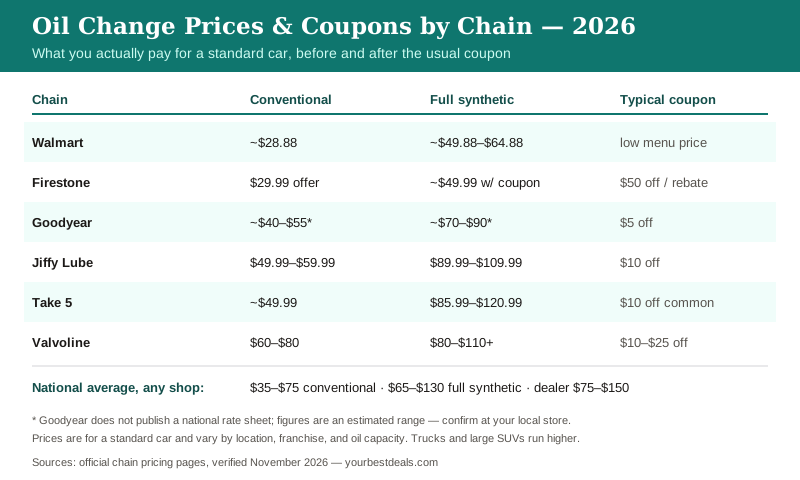
A standard oil change in 2026 runs anywhere from about $29 on a conventional deal to $130 for full synthetic at a dealer – and the coupon in your hand matters as much as the chain you pick. For most cars taking full synthetic, you’re realistically looking at $65 to $100 out the door, and a good coupon knocks $10 to $50 off that depending on where you go. Below is what each major chain actually charges and which one is the right call for your car.
I spent seven years writing oil-change tickets at a dealership service desk, and the thing customers never believed is how little the sticker means. Two cars, same “oil change,” forty dollars apart because one holds five quarts and the other holds seven and takes a pricier filter. So I don’t hand you a single number – I break it down by oil type and by chain, then tell you where the coupon is real and where it’s marketing.
Quick reality check before the table: I take no referral fee from any of these chains. If Walmart is the best value for your car – and for a lot of people it is – I’ll say so even though Walmart will never send me a dime for it.
Quick answer: oil change price by chain
These are the prices for a standard car – a sedan or small SUV taking about five quarts. Trucks, large SUVs, and anything requiring extra oil or a diesel filter run higher everywhere. Chains are listed cheapest full-synthetic first.
| Chain | Conventional | Full synthetic | Coupon that helps | Best for |
|---|---|---|---|---|
| Walmart | ~$28.88 | ~$49.88–$64.88 | Already low; no coupon needed | Lowest price, standard cars |
| Firestone | $29.99 offer | ~$49.99 with coupon | $50 off / Visa rebate on full synthetic | Coupon hunters, inspection included |
| Goodyear | ~$40–$55 (est.) | ~$70–$90 (est.) | $5 off conventional/blend | Bundling with tires |
| Jiffy Lube | $49.99–$59.99 | $89.99–$109.99 | $10 off Signature Service | Speed, no appointment |
| Take 5 | ~$49.99 | $85.99–$120.99 | $10 off common | Stay-in-your-car speed |
| Valvoline | $60–$80 | $80–$110+ | $10–$25 off synthetic | Stay-in-car, consistent service |
Goodyear’s figures are an estimated range – the company doesn’t publish a national rate sheet, so confirm the number at your local store. Everything else is drawn from each chain’s official pricing, verified in November 2026 and linked in the Sources section.
Why your quote looks different
If your ticket came in higher than the table above, it’s almost never because someone padded it – it’s usually one of four things. First, oil capacity: a truck that holds seven or eight quarts costs more than a sedan holding five, because you’re literally paying for more oil. Second, oil type: full synthetic is the biggest single jump, often $40 more than conventional, and a lot of newer cars require it whether you like it or not. Third, the filter: some cars take a $6 filter, some take a $22 cartridge, and cartridge filters take longer to change. Fourth, location – a shop in a high-rent metro pays more for the bay it’s standing in, and that shows up on your ticket.
The coupon confusion is its own thing. A “$50 off full synthetic” offer sounds enormous until you read that it’s a mail-in Visa rebate, which means you pay full price at the counter and wait weeks for a card. That’s still real money, but it’s not the same as $50 off today. I’ll flag which coupons are instant and which make you wait as I go chain by chain.
Straight From the Invoice: what these oil changes actually cost
I pulled these from actual repair orders I either wrote or reviewed. They’re the everyday version of the pricing above – including one where the coupon worked exactly as advertised and one where it didn’t.
Invoice #1 – 2016 Honda Civic, Firestone, suburban Ohio
Expected around $75 for full synthetic. Walked out having paid $49.99 because the driver stacked the current full-synthetic coupon, and the 19-point inspection actually caught a wiper blade splitting before winter. This is the coupon working exactly as intended – the number on the offer matched the number on the ticket, no rebate wait. Lesson: at Firestone, pull the live coupon before you go; the counter won’t always volunteer it.
Invoice #2 – 2011 Toyota Camry, Jiffy Lube, Charlotte NC
Expected $70 for a synthetic blend, paid $79.99 before the $10 coupon brought it to $69.99. Fair and fast, in and out in twenty minutes with no appointment. But the tech pushed a $40 fuel-system cleaning the car didn’t need at 90,000 miles on clean fuel. Lesson: Jiffy Lube’s oil price is honest; the upsells are where the ticket grows, so know your “no” before you pull in.
Invoice #3 – 2019 Ram 1500, Valvoline, Texas
Expected $90 for full synthetic, paid $118 – and this one was legitimate. The truck holds seven quarts, not five, and takes a larger filter, so the price was right even though it stung. No coupon applied because the online offer excluded the Hemi’s oil spec. Lesson: on a truck, don’t anchor to the “standard car” price; the extra two quarts and the bigger filter are a real $25 to $30 every single time.
Chain-by-chain breakdown
Walmart – the lowest sticker, with limits
Walmart’s Auto Care Centers start conventional oil changes around $28.88 and full synthetic around $49.88 to $64.88, which is the cheapest menu price in this whole comparison. Every package includes a new filter, up to five quarts of oil, chassis lube, and courtesy checks on your battery, tires, and fluids. The catch is fit: Walmart won’t service some newer or higher-spec vehicles, the wait can be long since it’s first-come, and there’s no fast in-and-out lane. If your car takes standard five-quart synthetic and you’re not in a hurry, this is the value play. Best for: standard cars where price is the only priority.
Firestone – the coupon chain
Firestone Complete Auto Care leans hardest on coupons. Their recurring offers include a $29.99 conventional oil change and full-synthetic deals that can land the job near $49.99, sometimes structured as $50 off via a mail-in Visa rebate. Every oil change includes a genuine 19-point inspection, which is worth something if you actually want eyes on your belts, battery, and brakes. Read whether your coupon is instant or a rebate before you go, because the two feel very different at the counter. Best for: drivers who’ll pull the live coupon and want an inspection bundled in.
Goodyear – fine, better with tires
Goodyear Auto Service does conventional, synthetic blend, and full synthetic, with the oil, filter, and a fluid check included. They don’t publish a national price sheet, so I won’t pretend to a precise figure – expect something in the middle of this pack, with a modest $5-off coupon on conventional or blend floating around. Where Goodyear earns its keep is bundling: if you’re already buying tires or an alignment there, adding the oil change is convenient and sometimes discounted as part of a package. On its own, it’s rarely the cheapest. Best for: bundling with a tire or alignment visit.
Jiffy Lube – speed you pay a little for
Jiffy Lube’s Signature Service is the no-appointment, twenty-minute option. Conventional runs $49.99 to $59.99, synthetic blend and high mileage $69.99 to $79.99, and full synthetic $89.99 to $109.99, with a $10-off national coupon and often better ZIP-code coupons on their site. The service includes a 19-point check, fluid top-offs, and a vacuum. You’re paying a small premium over Walmart for speed and convenience, which is a fair trade if your time is worth more than fifteen dollars. Just hold firm on the upsells. Best for: fast service with no appointment.
Take 5 – stay in the car, pay for it
Take 5 built its whole model on speed and not leaving your seat – you pull in, they change the oil while you sit, you pull out. Conventional starts around $49.99 and full synthetic runs $85.99 to $120.99, so you’re paying near the top of this group for the convenience. A $10 coupon is common and worth grabbing. If you value never getting out of your car and being done in ten minutes, it delivers exactly that. If you’re price-first, it’s not your chain. Best for: drivers who prize speed and staying in the car.
Valvoline – consistent, mid-to-premium priced
Valvoline Instant Oil Change is the other big stay-in-your-car chain, and it prices similarly to Take 5: conventional $60 to $80, full synthetic $80 to $110 or more, with online coupons frequently taking $10 to $25 off synthetic. Valvoline’s strength is consistency – the service is standardized location to location, and the coupons are really useful if you grab one first. Like Take 5, you’re paying for convenience, not for the lowest number. Best for: reliable, standardized service with a coupon in hand.
Shop Talk
The coupon isn’t the only lever, and it’s not even the biggest one. Ask the counter whether your car actually needs full synthetic or just takes it well on a synthetic blend – a lot of older cars that don’t require full synthetic get sold up to it out of habit, and that upsell is often bigger than any coupon you’d save. Bring your owner’s manual page or know your car’s oil spec, and you’ll skip the single most common way people overpay at every one of these chains.
Where drivers overpay
The biggest overpay isn’t picking the “wrong” chain – it’s buying more oil than your car needs. Full synthetic is truly required on many modern engines, and on those you should pay for it without a second thought. But plenty of drivers with older cars that call for conventional or a synthetic blend get talked into full synthetic every visit, adding thirty or forty dollars for a benefit their engine and mileage don’t cash in on. Check what your manufacturer actually specifies before you accept the upgrade.
The second overpay is chasing a headline coupon to the wrong store. A “$50 off” rebate that requires driving across town, paying full price up front, and mailing a form for a card that arrives in six weeks can be worth less than a $10 instant coupon at the shop two minutes away. Do the math on the real, today-dollars price, not the number on the banner. And the third is ignoring the upsell line entirely – the oil change is honestly priced almost everywhere; it’s the “recommended” fuel cleaning, cabin filter, and flush add-ons that quietly double the ticket.
The Real Number
For a standard car taking full synthetic in 2026, budget $65 to $100 and expect to land near the low end with a coupon. If price is all that matters, Walmart’s ~$50–$65 full synthetic is tough to beat. If you want a coupon and an inspection, Firestone can get you near $50. If you want speed, Jiffy Lube, Take 5, or Valvoline cost a bit more for the convenience – all fair, none a rip-off. The thing that actually blows your budget isn’t the chain; it’s getting sold full synthetic you don’t need or an upsell you didn’t ask for. Know your car’s oil spec and your “no,” and you’ll pay a fair price anywhere on this list.
Frequently Asked Questions
What is the cheapest place to get an oil change in 2026?
Walmart is the cheapest chain for a standard car, with conventional oil changes starting around $28.88 and full synthetic around $49.88 to $64.88, and it needs no coupon to get there. Firestone can rival it on full synthetic if you use a live coupon, sometimes landing near $49.99. The tradeoff at Walmart is that it won’t service every vehicle, there’s no express lane, and the wait can be long. For the absolute lowest sticker on a standard five-quart car, Walmart wins; if you want an inspection bundled in, Firestone’s coupon price is close.
How much does a full synthetic oil change cost in 2026?
Full synthetic runs about $65 to $130 nationally, with most standard cars landing between $65 and $100 before a coupon. Walmart is lowest at roughly $50 to $65, Firestone can hit near $50 with a coupon, and stay-in-car chains like Jiffy Lube, Take 5, and Valvoline sit higher at $85 to $120 for the added speed and convenience. Trucks and large SUVs cost more everywhere because they hold more oil – often seven or eight quarts instead of five – and may take a larger filter. See our full oil change cost breakdown for how oil type and vehicle size change the math.
Are oil change coupons actually worth it, or just marketing?
Most are real money, but you have to read the terms. An instant $10-off coupon at Jiffy Lube or a live full-synthetic coupon at Firestone drops your price at the counter, no strings. A “$50 off” mail-in Visa rebate is also real, but you pay full price up front and wait weeks for a prepaid card, so it’s worth less than the headline suggests and worthless if you forget to mail it. The rule of thumb: an instant coupon at a nearby shop usually beats a bigger rebate that requires a drive and a mailing. Always price the real, today-dollars number.
Why is my oil change more expensive than the advertised price?
Almost always one of four reasons, and none of them is the shop cheating you. Your car may hold more oil than the “standard” five quarts the ad assumes – trucks often take seven or eight, which adds $20 to $30. It may require full synthetic, the single biggest price jump at roughly $40 over conventional. It may take a pricier cartridge filter instead of a $6 spin-on. Or you’re simply in a high-cost metro where every bay costs more to run. Ask the counter to itemize, and the extra almost always traces to one of those.
Is it worth paying more for full synthetic oil?
If your manufacturer requires it, yes, without question – running conventional in an engine designed for synthetic risks real damage and voids goodwill on warranty claims. If your car only recommends it or calls for conventional, the answer is “it depends.” Full synthetic lasts longer between changes – often 7,500 to 10,000 miles versus 3,000 to 5,000 – so the higher per-visit price partly evens out over a year. But paying $40 more per change on an older car that runs fine on conventional and that you change on the conventional schedule is money you don’t need to spend. Check your owner’s manual for what’s required versus recommended.
How often should I actually change my oil?
Follow your owner’s manual, not the sticker on your windshield – that sticker is often set conservatively to bring you back sooner. Most modern engines on full synthetic go 7,500 to 10,000 miles between changes, while conventional oil typically wants 3,000 to 5,000. Many newer cars also have an oil-life monitor that tells you when it’s actually due based on how you drive, and it’s more accurate than a fixed mileage. Changing more often than specified doesn’t hurt the engine, but it wastes money; going well past the interval is where you risk sludge and wear.
Should I get my oil changed at a dealer or a chain?
For a routine oil change, a reputable chain or independent shop does the identical job for less – dealerships charge $75 to $150 where a chain charges $50 to $100, and the oil and filter are the same commodity parts. The dealer makes sense in two cases: if your car is under warranty and you want the service history logged there for peace of mind, or if it takes an unusual oil spec the dealer stocks and the chain might not. Otherwise, the chain price is real savings on a job that isn’t complicated. Our oil change cost guide compares dealer and independent pricing in more detail.
Sources
Prices verified against each chain’s official pricing and offers pages, plus national averages from consumer-finance reporting, on November 8, 2026. Chain prices vary by location, franchise, and vehicle; confirm your exact price locally.
- Firestone Complete Auto Care – official oil change offers
- Jiffy Lube – official coupons and Signature Service
- Goodyear – oil change service and coupons
- Walmart Auto Care Center – oil change service
- SoFi – average cost of an oil change, 2026
Related Guides
- Firestone oil change coupons and price
- Jiffy Lube oil change coupons and price
- Goodyear oil change coupons and price
- How much does an oil change cost? Full breakdown
- About Diane Holcomb – how we price service

Diane Holcomb spent seven years writing oil-change and repair tickets at Charlotte dealerships and two more at an independent shop before she started writing about real car service costs in 2023. She covers pricing, coupons, and chain comparisons on Your Best Deals and takes no referral fees from any chain she writes about. She drives a 2019 Honda CR-V and a hand-me-down 2007 Toyota Camry.