
Last updated: November 1, 2026 – By Diane Holcomb
November 2026 update: reconfirmed that both oils meet current industry specs, the used-oil-analysis edge for Mobil 1 on extended intervals, and Valvoline’s typical $1–$3 price advantage per jug.
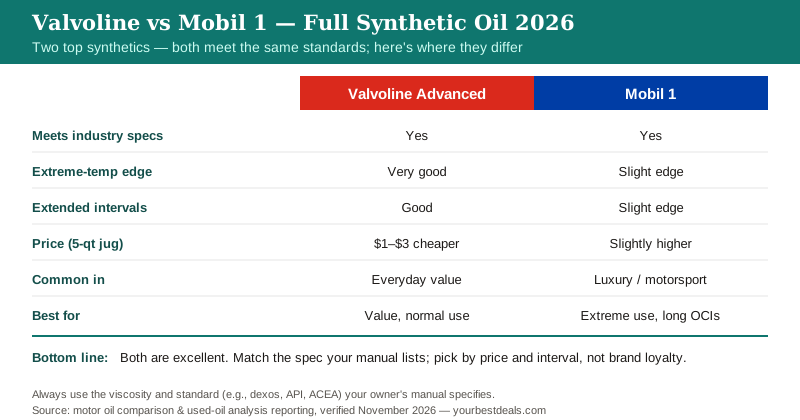
Both Valvoline Advanced Full Synthetic and Mobil 1 are excellent oils that meet the same industry performance standards, so for the vast majority of drivers, either one protects your engine just fine. Mobil 1 has a slight edge in extreme-temperature film strength and in extended-interval used-oil analysis, which is why it shows up in luxury cars and motorsport. Valvoline is typically $1 to $3 cheaper per five-quart jug and offers strong wear protection for everyday driving, with a slightly shorter recommended interval.
Quick verdict: For normal daily driving, buy whichever is cheaper in the correct spec for your car – Valvoline usually wins on price. If you push extended oil-change intervals, tow heavy, or drive in extreme heat or cold, Mobil 1’s slight performance edge is worth the small premium. The single most important thing is matching the viscosity and standard your owner’s manual lists, not the brand on the bottle.
I spent years translating “which oil is best” questions for customers, and the honest answer disappoints people who want a clear winner: at this tier, both are so good that your driving pattern matters more than the brand. Marketing claims like “3x better wear protection” are real in a lab against a baseline, but for your commute, either oil outlasts the interval you’ll actually drive it.
Protection: a real but small Mobil 1 edge
Head to head, Mobil 1 tends to come out slightly ahead in independent used-oil analysis, particularly for film strength under extreme heat and cold and for holding up over longer intervals. Its uniform molecular structure is really good at maintaining protection when conditions get harsh, which is why it’s a common factory fill and motorsport choice. Valvoline Advanced isn’t far behind – it meets the same specs and protects well – but it can run a lower total base number, meaning it’s not the first pick for stretching intervals well past the recommendation.
For everyday driving, though, this gap is mostly academic. If you change your oil on the manufacturer’s schedule with either brand, your engine sees excellent protection either way. The Mobil 1 edge becomes meaningful when you deliberately push the interval, tow heavy loads, or live somewhere with brutal summers or winters. For a normal commute changed on time, both are more than enough.
Price and intervals: where Valvoline wins
Valvoline is typically $1 to $3 cheaper per five-quart jug than Mobil 1, which adds up if you do your own changes over a car’s life. That price advantage partly offsets its slightly shorter recommended interval – you might change Valvoline marginally sooner, but you paid a bit less per jug. Mobil 1 costs a touch more but is more comfortable at extended intervals, so if you run a long oil-change interval, the math can swing back toward Mobil 1 because you buy fewer changes.
For most drivers changing on the normal schedule, Valvoline’s lower price is the practical winner, and the interval difference doesn’t matter because you’re not stretching it. For the driver who truly runs 10,000-plus-mile intervals, Mobil 1’s extended-interval strength and fewer changes can make it the better value despite the higher shelf price. Match the choice to how you actually change your oil.
Straight From the Invoice: how it plays out in real use
I pulled these from actual repair orders and owner situations I either handled or reviewed, to show how the choice looks in practice.
Invoice #1 – 2019 Honda CR-V, normal commuter, Valvoline Advanced
Changed on Honda’s schedule with Valvoline Advanced in the correct 0W-20 spec, a few dollars cheaper per jug than Mobil 1. Engine stayed clean, no issues. Lesson: for a normal commuter changed on time, Valvoline’s lower price is the whole story – the protection difference never comes into play.
Invoice #2 – 2020 Ford F-150 tow rig, Texas heat, Mobil 1
A truck towing in Texas summers ran Mobil 1 for its extreme-heat film strength, and used-oil analysis came back strong at the extended interval the owner ran. Worth the small premium here. Lesson: heavy loads and extreme heat are exactly where Mobil 1’s slight edge earns its extra dollar or two.
Invoice #3 – 2016 Toyota Camry, wrong-spec mistake
An owner bought premium Mobil 1 but in the wrong viscosity, thinking the brand mattered more than the number. The right move was the correct spec in either brand. Lesson: the biggest oil mistake isn’t Valvoline versus Mobil 1 – it’s using the wrong viscosity or standard, which matters far more than the label.
What each is best for
Valvoline Advanced’s case
Lower price per jug, strong everyday wear protection, and full compliance with the same specs as any top synthetic. For the normal driver who changes oil on schedule, Valvoline is the value pick – you get excellent protection and save a few dollars each change. Over a car’s life of dozens of oil changes, that adds up without any real downside for typical use.
Mobil 1’s case
A slight edge in extreme-temperature film strength and extended-interval performance, plus a track record in luxury and motorsport applications. If you tow, drive in harsh climates, or deliberately run long oil-change intervals, Mobil 1’s extra margin is worth the small premium, and running fewer changes at longer intervals can even make it cheaper overall. It’s the pick when your conditions are demanding rather than average.
Shop Talk
Before you compare brands, get the spec right – open your owner’s manual and note the exact viscosity (like 0W-20) and any standard it requires (dexos for many GM engines, a specific API or ACEA rating, or a manufacturer approval). Buying the correct spec in the cheaper of the two brands beats buying the “better” brand in the wrong number every single time. Once the spec matches, let price decide for normal driving and let your interval and conditions decide if you tow or run extended changes. Brand loyalty is the least important factor here.
Where drivers overpay or go wrong
The real mistake isn’t picking the “wrong” brand – both are excellent – it’s obsessing over Valvoline versus Mobil 1 while ignoring the viscosity and standard your engine actually requires. Using the wrong spec, even in a premium oil, is a genuine problem; using the right spec in either brand is fine. So the first and most important decision is the number on the bottle matching your manual, not the logo.
The second overpay is buying Mobil 1’s small premium when your driving doesn’t need it. If you’re a normal commuter changing on schedule, you’re paying a couple of extra dollars per jug for extended-interval and extreme-condition performance you’ll never tap. That’s fine if you prefer it, but it’s not buying you protection your engine will ever notice. Conversely, choosing Valvoline purely on price while running 12,000-mile intervals in desert heat is stretching it past where the value holds.
The Real Number
Both Valvoline Advanced and Mobil 1 are excellent full synthetics that meet the same standards, so the honest answer is that your driving decides, not the brand. For normal commuting changed on schedule, buy whichever is cheaper in the correct spec – usually Valvoline, by $1 to $3 a jug. For towing, extreme climates, or extended intervals, Mobil 1’s slight edge earns its small premium. Above all, match the viscosity and standard your owner’s manual lists; the right spec in either brand beats the wrong spec in the “premium” one.
Frequently Asked Questions
Is Valvoline or Mobil 1 better for my engine?
For most engines and drivers, both are equally good, since Valvoline Advanced and Mobil 1 meet the same industry performance standards and protect well when changed on schedule. Mobil 1 has a slight edge in extreme-temperature film strength and extended-interval performance, so it’s marginally better for towing, harsh climates, or long intervals. Valvoline is a few dollars cheaper per jug and ideal for everyday driving. The most important factor for your engine isn’t the brand but using the correct viscosity and standard from your owner’s manual.
Is Mobil 1 worth the extra money over Valvoline?
It depends on how you drive. If you tow heavy loads, live somewhere with extreme heat or cold, or deliberately run extended oil-change intervals, Mobil 1’s slight edge in film strength and extended-interval performance is worth the $1 to $3 premium per jug, and fewer changes at longer intervals can even make it cheaper overall. For a normal commuter changing on the manufacturer’s schedule, the premium buys performance you won’t tap, so Valvoline’s lower price is the better value. Match the oil to your actual driving.
Do Valvoline and Mobil 1 meet the same specifications?
Yes, both meet the same major industry performance standards and are available in the common specifications modern engines require, including manufacturer approvals like dexos. That’s why either is a safe choice as long as you buy the correct viscosity and standard for your car. The differences between them are at the margins – Mobil 1’s slight extreme-condition and extended-interval edge, Valvoline’s price advantage – not in whether they meet your engine’s basic requirements. Always confirm the specific spec on the bottle matches your owner’s manual.
Which lasts longer, Valvoline or Mobil 1?
Mobil 1 generally holds up slightly better over extended intervals, based on used-oil analysis, and can run a higher total base number that resists breakdown longer. Valvoline Advanced has a marginally shorter recommended interval, though its lower price offsets that for drivers changing on the normal schedule. If you deliberately stretch intervals to 10,000 miles or more, Mobil 1 is the safer choice; if you change on the manufacturer’s standard interval, both last comfortably and the difference doesn’t matter. Never exceed your manual’s maximum interval with either.
Does the oil brand matter more than the viscosity?
No – the viscosity and standard matter far more than the brand. Using the correct spec, like 0W-20 with the right manufacturer approval, in either Valvoline or Mobil 1 protects your engine properly, while using the wrong viscosity even in a premium oil can cause real problems. The single biggest oil mistake drivers make is fixating on brand while getting the number wrong. Check your owner’s manual for the exact viscosity and any required standard first, then choose between brands on price and your driving conditions.
Can I switch between Valvoline and Mobil 1?
Yes, you can switch between Valvoline and Mobil 1 freely at any oil change, as long as both are the correct viscosity and meet your engine’s required specification. There’s no need to flush or do anything special – modern synthetics are compatible, and mixing what’s left of one with the other during a change causes no harm. Many drivers switch based on whatever’s on sale in the right spec, which is a perfectly reasonable way to buy oil at this tier since both protect your engine well.
Are Valvoline and Mobil 1 both full synthetic?
Yes, both Valvoline Advanced and Mobil 1 discussed here are full synthetic oils, engineered for better performance and longer intervals than conventional or synthetic blend. Both brands also sell conventional, synthetic blend, and high-mileage lines, so make sure you’re comparing the full synthetic products if that’s what your car requires. If your manufacturer requires full synthetic, run it in either brand; if your car only recommends it, weigh the longer interval against the higher price using our oil change guide.
Sources
Oil performance comparison based on manufacturer specifications and independent used-oil-analysis reporting, verified November 1, 2026. Always follow the viscosity and standard specified in your vehicle’s owner’s manual.
- Mobil 1 – full synthetic motor oil (official)
- Valvoline Advanced Full Synthetic (official)
- Used-oil-analysis discussion (independent)
Related Guides
- Valvoline oil change coupons and price
- Jiffy Lube vs Valvoline oil change
- Oil change coupons and prices by chain
- How much does an oil change cost? Full breakdown

Diane Holcomb spent seven years at Charlotte dealership service desks and two at an independent shop, where “which oil is best” was a daily question with a less exciting answer than customers hoped. She writes pricing and product-comparison pages on Your Best Deals and takes no referral fees. She drives a 2019 Honda CR-V and a 2007 Toyota Camry.