
Last updated: November 10, 2026 – By Diane Holcomb
November 2026 update: reconfirmed the 2-to-3-year interval, flush cost, and the moisture-absorption reason.
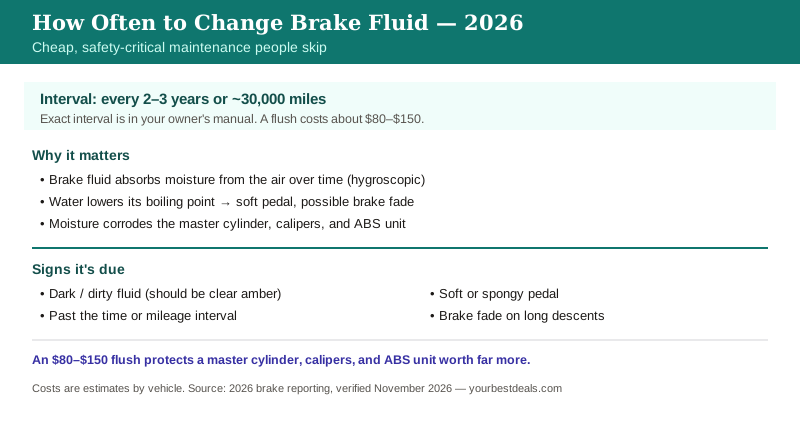
Most manufacturers recommend changing brake fluid every 2 to 3 years or about 30,000 miles, and it’s one of the cheapest safety-critical services there is – a flush runs about $80 to $150. It’s also one of the most skipped, because brake fluid isn’t something you top off or think about between brake jobs. But it matters: brake fluid absorbs moisture from the air over time, and that water lowers the fluid’s boiling point and corrodes expensive internal parts. The result can be a soft, spongy pedal and, in extreme cases, brake fade when you need the brakes most. Your owner’s manual has the exact interval, but the 2-to-3-year rule holds for most cars. Here’s why it matters and how to know when it’s due.
At the service desk, brake fluid was the service people were most surprised to hear about – “you have to change the brake fluid?” Yes, and it’s cheap insurance for something you really don’t want failing. Let me explain why it degrades, the signs it’s overdue, and why this small service protects some expensive parts.
Why brake fluid needs changing
Brake fluid is hygroscopic, which means it absorbs moisture from the air over time – through the reservoir, seals, and hoses. That absorbed water causes two problems. First, water has a much lower boiling point than brake fluid, so moisture-laden fluid can boil under hard or repeated braking (like a long mountain descent), and boiling fluid creates compressible vapor that makes the pedal go soft and reduces braking – a dangerous condition called brake fade. Second, the water corrodes the metal parts of the brake system from the inside.
That internal corrosion is the quiet, expensive part. Moisture in old fluid rusts and pits the master cylinder, calipers, wheel cylinders, and the ABS unit – components that cost far more to replace than a fluid flush. So changing the fluid on schedule isn’t just about pedal feel; it protects the pricey hydraulic parts from being destroyed from the inside. That’s why a cheap, regular flush is really good value. See our brakes guide for the full system and part costs.
Signs your brake fluid is due
A few things tell you it’s time. The simplest is the schedule: if it’s been 2 to 3 years or you’ve passed your manual’s mileage interval, it’s due regardless of how it looks. Beyond that, check the fluid in the reservoir – fresh brake fluid is clear to light amber, and dark, brown, or dirty fluid means it’s absorbed moisture and contaminants and should be changed. A soft or spongy brake pedal, especially one that improves if you pump it, can indicate moisture or air in the fluid.
And brake fade – a pedal that goes soft or braking that weakens during long or hard braking, like descending a long grade – is a serious sign that moisture-laden fluid is boiling, and it means the fluid is overdue. Because you can’t always see moisture content by eye (shops can test it with a moisture meter or test strips), the calendar interval is your safest guide. If any of these show up, or you’re past the interval, get the fluid flushed. Our maintenance schedule puts it alongside your other services.
Shop Talk
A smart, free money-saver: have the brake fluid flushed at the same time you’re getting a brake job. The system is already open and the shop is already in there, so combining them saves a separate labor visit – ask for it when you replace pads or rotors. Also, don’t confuse “topping off” with changing. Adding fluid to a low reservoir doesn’t replace the old moisture-laden fluid, and a low reservoir usually means worn pads (the fluid level drops as pads wear), not a leak – so if your fluid is low, check your pad thickness rather than just topping off. And one caution: brake fluid comes in types (DOT 3, DOT 4, DOT 5.1), and you should use the type your manual specifies. They’re not all interchangeable, especially the silicone-based DOT 5, so match the spec.
Where Drivers Overpay
The overpay on brake fluid is mostly the reverse – underpaying by skipping it and paying later for corroded hydraulic parts. A neglected flush lets moisture rust the master cylinder, calipers, or ABS unit, and replacing those costs many times an $80-to-$150 flush. So the “savings” from skipping this cheap service can turn into a big repair down the road. Staying on the 2-to-3-year interval is the value play, especially since it also protects your braking safety.
The second saver is timing: bundling the flush with a brake job you’re already paying for, since the labor overlaps. And the third is not paying dealer prices for a service an independent shop does for less – a brake fluid flush is standard work that doesn’t require the dealer. The one thing not to cheap out on is the fluid type: use the DOT specification your manual calls for, because the wrong type can cause problems. So the money-smart pattern is: flush on schedule at an independent shop, bundle it with brake work when you can, use the correct fluid, and don’t skip it into a corrosion repair. Cheap now beats expensive later.
The Real Number
Change your brake fluid every 2 to 3 years or about 30,000 miles (check your manual), with a flush costing $80 to $150 – cheap, safety-critical maintenance most people skip. Brake fluid absorbs moisture, which lowers its boiling point (risking a soft pedal and brake fade) and corrodes the master cylinder, calipers, and ABS unit, all of which cost far more than the flush. Watch for dark fluid, a soft pedal, or fade on long descents, but the calendar is your safest guide. Bundle the flush with a brake job to save labor, use the DOT type your manual specifies, and don’t skip it into an expensive corrosion repair.
Frequently Asked Questions
How often should brake fluid be changed?
Most manufacturers recommend changing brake fluid every 2 to 3 years or about 30,000 miles, though the exact interval is in your owner’s manual and varies by vehicle. The main driver is time rather than mileage, because brake fluid absorbs moisture from the air whether you drive a lot or a little. So even a low-mileage car should have its fluid changed on the time interval. If you’re past 2 to 3 years, it’s due regardless of how the fluid looks. Some vehicles specify slightly different intervals, so the manual is the authority, but the 2-to-3-year rule is a safe default for most cars.
How much does a brake fluid flush cost?
A brake fluid flush typically costs $80 to $150 at a shop, which includes removing the old moisture-laden fluid throughout the system and replacing it with fresh fluid. These are estimated ranges that vary by vehicle and shop. It’s an inexpensive service relative to what it protects: neglecting it can corrode the master cylinder, calipers, and ABS unit, which cost far more to replace. A cost-saving tip is to have the flush done at the same time as a brake job, since the labor overlaps and you avoid a separate visit. An independent shop generally charges less than a dealer for this standard service.
What happens if you never change brake fluid?
Two bad things build up over time. First, the fluid absorbs more and more moisture, which lowers its boiling point and can cause a soft, spongy pedal and brake fade – reduced braking under hard or repeated use, which is a safety hazard. Second, the accumulated water corrodes the brake system’s metal components from the inside: the master cylinder, calipers, wheel cylinders, and ABS unit. Replacing those corroded parts costs many times more than a routine flush. So never changing brake fluid risks both your braking safety and expensive hydraulic repairs. It’s one of the clearest cases where a cheap, regular service prevents a costly and potentially dangerous problem.
What color should brake fluid be?
Fresh brake fluid is clear to light amber, almost like a light cooking oil. As it ages and absorbs moisture and contaminants, it darkens to brown or nearly black. So a quick check is to look at the fluid in the reservoir: if it’s dark, brown, or dirty, it’s overdue for a change, while clear amber fluid is still in good shape. That said, color isn’t a perfect gauge of moisture content – fluid can be moisture-laden before it looks bad – so the time interval remains the safest guide. Shops can test the actual moisture level with test strips or a meter. If your fluid looks dark, don’t wait for the interval; change it.
Can I change brake fluid myself?
It’s possible for the mechanically inclined, but it takes care and the right method, so many people leave it to a shop. Properly changing brake fluid means bleeding the old fluid out of each brake in the correct sequence while keeping the reservoir topped up, and never letting air into the system, which would require more bleeding. You also must use the exact DOT fluid type your manual specifies. Done wrong, air in the lines causes a soft pedal, which is a safety issue. If you have the tools, knowledge, and patience, it’s a doable DIY job; if not, the $80-to-$150 shop flush is inexpensive enough that many drivers simply have it done.
Is a brake fluid flush the same as brake bleeding?
They’re related but not identical. Brake bleeding removes air from the lines, usually after a repair that opened the system, and may only cycle some fluid. A brake fluid flush is a more thorough process that pushes out essentially all the old fluid throughout the system and replaces it with fresh fluid – which is what you want for the periodic maintenance service. When you have your fluid “changed” on the 2-to-3-year interval, you want a full flush, not just a bleed. Bleeding is part of the process, but a flush ensures the old, moisture-laden fluid is fully replaced. Ask for a flush when it’s time for the maintenance service.
Does low brake fluid mean I need a flush?
Not necessarily – low brake fluid more often means worn brake pads than a need for a flush. As pads wear down, the caliper pistons extend further and hold more fluid, so the reservoir level drops. So a low reservoir is usually a sign to check your pad thickness rather than just to top off or flush. If the fluid is low and the pads are fine, then you may have a leak, which needs attention. Topping off doesn’t address old, moisture-laden fluid anyway – that requires a flush. So if your fluid is low, first check the pads; a flush is a separate, time-based maintenance service.
Sources
Brake fluid interval and flush cost verified against 2026 brake maintenance reporting on November 10, 2026. Costs are estimated ranges that vary by vehicle; follow your owner’s manual for the exact interval and fluid type.
- RepairPal – brake fluid flush cost estimate, 2026
- CarParts.com – brake fluid flush cost and interval, 2026
- Motorist Care – vehicle fluid service intervals, 2026
Related Guides
- Brakes guide: pads, rotors, and cost
- How to stop brakes from squeaking
- Brake master cylinder replacement cost
- Car maintenance schedule and cost

Diane Holcomb spent seven years at Charlotte dealership service desks, where “you have to change the brake fluid?” was a question she heard constantly – and where she saw skipped flushes turn into corroded master cylinders. She writes the cost and maintenance guides on Your Best Deals and takes no referral fees. She drives a 2019 Honda CR-V and a 2007 Toyota Camry.