
Last updated: November 9, 2026 – By Eddie Brennan
November 2026 update: reconfirmed the squeal-vs-grind distinction, cheap fixes, and pad/rotor costs.
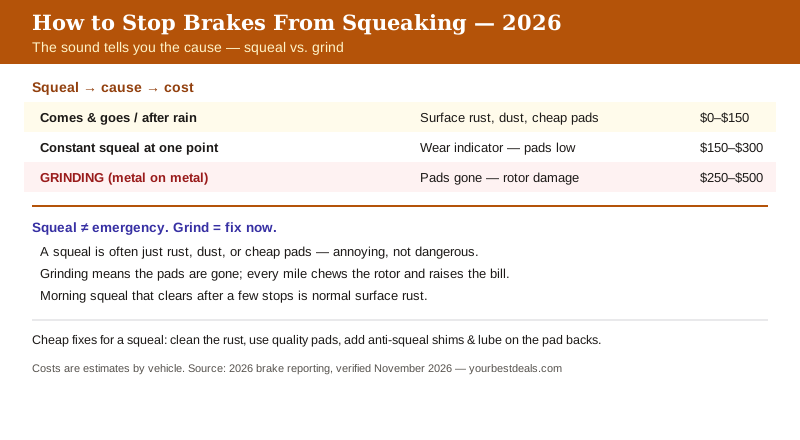
Most brake squeaks are annoying, not dangerous – but the exact sound tells you which. A high-pitched squeal that comes and goes, or shows up after rain or overnight, is usually just surface rust, brake dust, or cheap or glazed pads, and it’s often fixed for $0 to $150 with cleaning, quality pads, or anti-squeal shims and lubricant. A constant squeal at one point in each stop is often the pads’ built-in wear indicator telling you they’re low – time for a pad replacement at $150 to $300 per axle. The one sound you must not ignore is grinding: that means the pads are gone and metal is scraping the rotor, which turns a pad job into a pricier pad-and-rotor job. Here’s how to read the noise and stop it.
Brake noise scared a lot of my customers more than it needed to, because a squeal and a grind feel similar but mean very different things for your wallet and safety. Let me break down what each sound means, the cheap fixes for a harmless squeal, and the line where it becomes urgent.
What the sound tells you
Brakes make noise for specific reasons, and the character of the sound narrows it down. A squeal that comes and goes – worse in the morning, after rain, or in humid weather, and clearing after a few stops – is usually a thin layer of surface rust on the rotors or accumulated brake dust, both harmless and often self-clearing. A persistent high-pitched squeal that happens at a consistent point in braking is frequently the wear indicator, a small metal tab designed to squeal when the pads get low, warning you to replace them.
Cheap or glazed pads squeal too: low-quality pads and pads that have overheated and hardened (glazed) tend to be noisy. And a grinding or growling – a rough, metallic scraping rather than a squeal – is the serious one: it usually means the pads have worn away completely and the metal backing is grinding the rotor. That’s both a safety issue and a cost escalator, since it damages the rotor. So the quick rule is: squeal is usually minor, grinding is urgent. See our brakes guide for the full system.
Cheap fixes for a squeal
If it’s a harmless squeal – comes and goes, no grinding, pads not worn out – several inexpensive fixes usually quiet it. Surface rust and dust often clear on their own after a few firm stops, or with a brake cleaning. If the noise persists, the common shop fixes are: applying anti-squeal shims or a dab of high-temperature brake lubricant to the back of the pads (never the friction surface) to damp vibration, and cleaning and lubricating the caliper slide pins and hardware. These run $0 to $150 and often solve a nuisance squeal without new pads.
Pad quality matters too. If cheap pads are the culprit, upgrading to better-quality pads – often ceramic, which run quieter and cleaner – can end chronic squealing when you next replace them. And if the pads are glazed from hard use, replacing them and bedding the new ones in properly stops the noise. So a squeal doesn’t automatically mean a big repair; it often means cleaning, hardware, lubricant, or better pads. Our ceramic vs organic pads guide covers the pad choice.
Shop Talk
The morning squeal that clears after your first few stops is almost always just overnight surface rust burning off the rotors, especially after the car sat in dew or rain – totally normal, no fix needed. Don’t let a shop sell you a brake job over that. The sound to actually worry about is grinding: the moment brakes go from squealing to grinding, stop driving on them and get them in, because you’ve gone from “pads are low” to “pads are gone and I’m destroying the rotors.” Every day of grinding can add rotor cost to the bill. One more real fix people skip: when new pads are installed, the caliper hardware and slide pins should be cleaned and lubricated. A lot of comeback squeaks are just dry, sticking hardware, not the pads themselves.
What Gets Misdiagnosed
The most common mistake goes both ways. On one side, people panic at a harmless morning squeal and pay for a brake job they didn’t need – that rust-burning-off squeal clears itself. On the other, people ignore a genuine grinding sound because “brakes always make some noise,” and let metal-on-metal chew up the rotors, turning a $150-to-$300 pad job into a $250-to-$500 pad-and-rotor job (or worse). Learning the difference – squeal that comes and goes versus constant grinding – is what keeps you from either overpaying or letting a cheap fix become expensive.
The second misdiagnosis is replacing pads to stop a squeal when the real cause was dry caliper hardware or the lack of anti-squeal shims. Fresh pads on dry, sticking slide pins will often squeal again, because the pads weren’t the problem. A proper brake job cleans and lubricates the hardware and adds shims, which is why some cheap brake jobs come back noisy. So if new pads still squeal, the hardware is the likely culprit. Matching the fix to the actual cause – cleaning and lube for a nuisance squeal, pads for a wear-indicator squeal, pads-and-rotors for grinding – is how you stop the noise without overspending.
The Real Number
A brake squeal is usually minor: a come-and-go or morning squeal is surface rust, dust, or cheap pads, fixed for $0 to $150 with cleaning, quality pads, or anti-squeal shims and hardware lube. A constant squeal at one point is often the wear indicator saying it’s time for pads, $150 to $300 per axle. Grinding is the urgent one – pads are gone and the rotor is being damaged – so stop driving on it and expect a $250-to-$500 pad-and-rotor job, all estimated ranges. Don’t pay for a brake job over a self-clearing morning squeal, but never ignore grinding.
Frequently Asked Questions
Why are my brakes squeaking?
Brakes squeak for several reasons, and the pattern tells you which. A squeal that comes and goes, or shows up in the morning or after rain and clears after a few stops, is usually harmless surface rust or brake dust. A constant high-pitched squeal at a consistent point in braking is often the wear indicator, a metal tab that squeals when the pads get low. Cheap or glazed (overheated) pads also squeal, as does dry, un-lubricated caliper hardware. A grinding sound, by contrast, is not a squeak and means the pads are worn out and metal is on metal. So identify whether it’s an intermittent squeal, a constant squeal, or a grind to know the cause.
Are squeaking brakes dangerous?
A squeal by itself is usually not dangerous – it’s often just surface rust, dust, or cheap pads, which are annoying rather than unsafe. What is dangerous is grinding, which means the pads are gone and braking performance is compromised while the rotor gets damaged. Also, if a persistent squeal is the wear indicator, it’s telling you the pads are low and should be replaced soon before they wear out completely. So a squeal isn’t an emergency, but don’t ignore it either, since it can be the early warning that pads are wearing down. The moment noise turns to grinding, treat it as urgent and stop driving on the brakes.
How do I stop my brakes from squeaking?
It depends on the cause. For a nuisance squeal from surface rust or dust, a few firm stops or a brake cleaning often clears it. For persistent squealing, common fixes are applying anti-squeal shims or high-temperature lubricant to the back of the pads and cleaning and lubricating the caliper slide pins and hardware, which run $0 to $150. If cheap or glazed pads are the cause, replacing them with better-quality (often ceramic) pads and bedding them in properly stops the noise. If it’s the wear indicator, you need new pads at $150 to $300 per axle. So match the fix to the cause rather than automatically replacing pads.
Why do my brakes squeak in the morning but stop after driving?
That’s one of the most common and most harmless brake noises. Overnight, especially after dew, rain, or humidity, a thin layer of surface rust forms on the exposed rotor faces. When you first drive and brake, the pads scrape that rust off, causing a squeal for the first few stops until the rotor surface is clean again. It clears on its own within a few brake applications and needs no repair. This is completely normal and not a sign of a problem, so don’t let it worry you or lead to an unnecessary brake job. If the squeal persists well beyond the first few stops or turns to grinding, then it’s worth looking into.
What’s the difference between squeaking and grinding brakes?
They mean very different things. Squeaking or squealing is a high-pitched noise usually caused by surface rust, dust, cheap or glazed pads, or the wear indicator – generally minor and often cheap to fix. Grinding is a rough, metallic scraping or growling that means the brake pads have worn away completely and the metal pad backing is grinding directly against the rotor. Grinding is both a safety issue, since braking is compromised, and a cost issue, because it damages the rotor and turns a pad replacement into a pad-and-rotor job. So squeaking is often a nuisance, while grinding is urgent – the moment you hear grinding, stop driving on the brakes and get them serviced.
Can I just put grease on my brakes to stop the squeak?
Only in the right place. High-temperature brake lubricant or anti-squeal compound can be applied to the back of the pads and to the caliper slide pins and hardware to damp the vibration that causes squealing – that’s a legitimate fix. But you must never put any grease or lubricant on the friction surfaces: the face of the pads or the rotor. Doing so drastically reduces braking and is dangerous. So grease can stop a squeak, but only on the metal backing and hardware, never where the pad meets the rotor. If you’re not confident about where it goes, have a shop do it, since brake safety is not the place to guess.
How much does it cost to fix squeaky brakes?
It depends on the cause. A nuisance squeal fixed with cleaning, anti-squeal shims, or hardware lubrication runs $0 to $150. If the pads are worn and squealing via the wear indicator, a pad replacement is $150 to $300 per axle. If the noise has become grinding and damaged the rotors, a pad-and-rotor job runs $250 to $500 per axle. These are estimated ranges that vary by vehicle. The key money point is timing: addressing a squeal early can keep it to a cheap fix or a pad job, while ignoring it until it grinds adds rotor cost. So the cheapest path is to diagnose the squeal promptly rather than waiting for grinding.
Sources
Brake noise causes and pad/rotor cost ranges verified against 2026 brake reporting on November 9, 2026. Costs are estimated ranges that vary by vehicle; grinding indicates worn-out pads and possible rotor damage.
- RepairPal – brake pad replacement cost estimate, 2026
- CarParts.com – brake pad replacement and noise causes, 2026
- RepairPal – brake rotor replacement cost, 2026
Related Guides
- Brakes guide: pads, rotors, and cost
- Ceramic vs organic brake pads
- Why does my car shake when I brake?
- Brake pad replacement cost

Eddie Brennan spent 11 years as an ASE Master Certified technician at an independent shop in Columbus, OH, where he had to talk a lot of customers off the ledge over a harmless morning brake squeal – and get others to stop ignoring a grind. His A5 Brakes certification covers this directly. He takes no referral fees and drives a 250,000-mile 2015 Subaru Outback and a 2020 Ford F-150.