
Last updated: November 2, 2026 – By Eddie Brennan
November 2026 update: expanded the braking-only versus constant-shake distinction and refreshed rotor resurfacing-versus-replacement guidance.
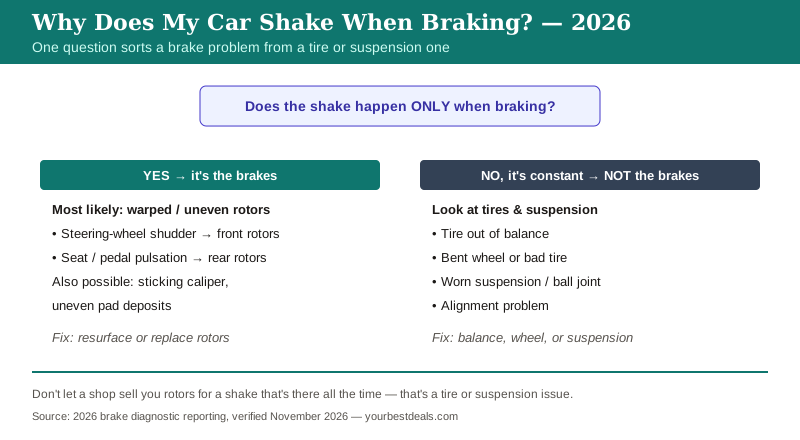
If your car shakes only when you brake, the cause is almost always warped or unevenly worn brake rotors. The uneven rotor surface makes the brake pads grab and release as the wheel spins, and you feel that as a shudder or pulsation – through the steering wheel if it’s the front rotors, through the seat or brake pedal if it’s the rear. The fix is resurfacing or replacing the rotors, typically a $300-to-$600 job per axle with pads.
But here’s the single most important thing on this page, and the mistake I saw people make constantly: a shake that happens all the time – at highway speed even when you’re not braking – is not your brakes. That’s a tire balance, a bent wheel, or a worn suspension part, and no amount of new rotors will fix it. One question sorts the whole thing out: does the shake happen only when braking, or is it always there?
Only when braking? It’s the rotors
When the shake appears only as you press the brake pedal and goes away when you release it, you’re looking at the brakes, and warped or unevenly worn rotors are the usual culprit. Rotors warp mostly from heat – hard braking, towing, riding the brakes down a long hill, or a stuck caliper cooking one rotor. The high and low spots on the warped surface push the pad in and out rapidly, which is the vibration you feel.
Where you feel it tells you which end. A shudder in the steering wheel points to the front rotors, which do most of the braking and warp more often. A pulsation felt through the seat or the brake pedal, without much in the wheel, points to the rear rotors. Less commonly, a sticking caliper that won’t release evenly or uneven pad material deposited on the rotor can cause the same braking shake, which a shop confirms by inspecting the rotors and caliper movement.
Constant shake? It’s not the brakes
If the vibration is there at speed regardless of braking – you feel it cruising at 60 and braking doesn’t change it much – the brakes are not your problem, and this is where people waste money on rotors they don’t need. A constant shake points to the tires and suspension: an out-of-balance tire, a bent wheel, a tire with a broken belt or a flat spot, a worn suspension component like a ball joint or wheel bearing, or an alignment problem. These get worse with speed, not with braking.
The tell is simple. Brake-related shake comes and goes with the brake pedal; tire and suspension shake is tied to road speed and is there whether you brake or not. Before you let anyone sell you rotors for a vibration, be sure it actually appears when you brake and eases when you stop braking. If it doesn’t, the money belongs at a tire balance or a suspension check, not the brakes.
Straight From the Invoice: shake diagnoses
These are jobs I either did myself or watched come through the bay – a warped-rotor shake, a constant shake that wasn’t brakes, and a sticking caliper.
Invoice #1 – 2015 Honda Accord, warped front rotors, independent, Ohio
Steering-wheel shudder that showed up only when braking from highway speed, worse after a mountain trip. Warped front rotors, replaced with pads for $440. Textbook. Lesson: a steering-wheel shudder that appears only under braking is warped front rotors, especially after hard or downhill braking.
Invoice #2 – 2013 Toyota Camry, constant shake that wasn’t brakes, Columbus
Owner was quoted rotors for a shake, but it was there at 65 mph without touching the brakes. A tire had thrown a balance weight and had a slight flat spot – a $60 balance and a tire, not rotors. Lesson: a shake that’s constant at speed is a tire problem; braking doesn’t cause it, so rotors won’t fix it.
Invoice #3 – 2016 Ford Escape, sticking caliper, Texas
Braking shake plus a pull and one hot front wheel. A sticking caliper had overheated and warped that one rotor. Fixing the caliper and the rotor solved both the shake and the pull. Lesson: a braking shake with a pull to one side and one hot wheel points to a sticking caliper cooking its rotor, not just plain warping.
How rotors get fixed
Resurface or replace
Depending on how warped they are and how much thickness is left, warped rotors can sometimes be resurfaced – machined smooth on a lathe – rather than replaced. But many modern rotors are made thin to save weight and don’t have enough material to safely machine, so replacement is often the only option and frequently costs about the same once you factor in the labor. A good shop measures the rotor thickness and tells you honestly whether yours can be turned or need replacing.
Do the pads too
When rotors are replaced for warping, the pads usually go with them, because the old pads have worn to match the warped surface and can transfer that unevenness to new rotors. Doing pads and rotors together is why this repair lands in the $300-to-$600-per-axle range rather than rotors alone. If a sticking caliper caused the warping, that gets fixed too, or the new rotor will just warp again. See our pads-and-rotors cost guide for the full breakdown.
Shop Talk
Do this test before you pay for anything: on a safe, open stretch of road, notice whether the shake is there when you’re just cruising and not braking. If it only shows up when you press the brake and fades when you let off, it’s the rotors. If it’s there at speed no matter what your foot’s doing, it’s a tire or suspension issue, and rotors won’t touch it. This one observation is the difference between a $450 rotor job that fixes your problem and a $450 rotor job that leaves the shake exactly where it was.
What gets misdiagnosed
The costly misdiagnosis here runs in one direction far more than the other: paying for rotors on a shake that was never the brakes. A constant vibration from a tire balance or a bent wheel gets blamed on rotors because “shaking” makes people think brakes, and a shop that doesn’t confirm the timing sells the rotors. The braking-only test above prevents this entirely, and it costs nothing to do yourself before you go in.
The rarer misses are on the brake side. A braking shake with a pull and one hot wheel is a sticking caliper, not just a warped rotor, and replacing the rotor without fixing the caliper means the new rotor warps again. And uneven pad deposits – pad material transferred onto the rotor from aggressive braking on a fresh pad job – can mimic warping and sometimes clean up rather than needing replacement. A shop that inspects the caliper and rotor surface, not just replaces parts, catches these.
The Real Number
A shake only when braking is warped rotors – a $300-to-$600-per-axle pads-and-rotors job, front rotors if you feel it in the wheel, rear if you feel it in the seat. But confirm the shake actually appears when you brake and eases when you let off, because a constant shake at speed is a tire balance, a bent wheel, or a suspension part, and rotors won’t fix it. If there’s also a pull and one hot wheel, it’s a sticking caliper that must be fixed too, or the new rotor warps again. One observation before you pay saves you from buying the wrong repair.
Frequently Asked Questions
Why does my steering wheel shake when I brake?
A steering-wheel shudder that appears only when braking is almost always warped or unevenly worn front rotors. The uneven surface pushes the brake pads in and out rapidly as the wheel turns, and because the front rotors do most of the braking and warp more often, you feel it in the steering wheel specifically. It usually worsens after hard braking, towing, or long downhill descents that overheat the rotors. The fix is resurfacing or replacing the front rotors, typically with pads, in the $300-to-$600 range for the axle.
How do I know if it’s my rotors or my tires?
By when the shake happens. A rotor problem causes a shake only when you brake – press the pedal and it appears, release it and it fades. A tire or suspension problem causes a shake that’s constant at road speed whether or not you’re braking, and it usually gets worse the faster you go. So take note on an open road: if cruising without braking is smooth and only braking brings the shake, it’s the rotors; if it shakes at speed regardless of the brakes, it’s tires, wheel balance, or suspension. That one test prevents buying the wrong repair.
Can warped rotors be fixed without replacing them?
Sometimes. Warped rotors can be resurfaced – machined smooth on a lathe – if they have enough thickness left to stay above the minimum after machining. But many modern rotors are made thin to save weight and don’t have the material to safely turn, so replacement is often the only safe option and frequently costs about the same once you include the machining labor. A good shop measures the rotor and tells you whether yours can be resurfaced or need replacing. Don’t resurface a rotor that’s already near minimum thickness.
Is it safe to drive with warped rotors?
You can drive short-term, but don’t ignore it. Warped rotors reduce braking effectiveness and stability under hard stops, and the underlying cause – like a sticking caliper – can worsen. The shake also tends to get worse over time as the warping increases. It’s not usually an immediate emergency like a grinding or a sinking pedal, but it is a brake-performance issue on the system that stops your car, so get it diagnosed and fixed reasonably soon rather than living with a growing shudder every time you brake.
What causes brake rotors to warp?
Heat is the main cause. Hard, repeated braking, towing heavy loads, and riding the brakes down long hills overheat the rotors, and if they cool unevenly – like driving through a puddle right after – the metal can distort. A sticking caliper that keeps a pad dragging on one rotor overheats just that rotor and warps it. Aggressive braking on brand-new pads before they’re bedded in can also deposit uneven pad material that mimics warping. Smooth braking and fixing a dragging caliper promptly are the best ways to avoid it.
Why does my car shake when braking at high speed but not low speed?
Because warped rotors produce more noticeable vibration the faster the wheel is spinning, so the pulsation from the uneven surface is amplified at highway speed and may be barely felt at low speed. This is a classic warped-rotor pattern. It still qualifies as a braking-only shake – it appears when you brake from higher speeds and eases off the pedal – which points to the front rotors. If instead the shake at high speed is there even without braking, that’s a tire-balance issue that also worsens with speed, so confirm whether braking is what triggers it.
How much does it cost to fix a car that shakes when braking?
If it’s warped rotors, expect $300 to $600 per axle for rotors and pads together at an independent shop, more at a dealer or on a luxury car. If a sticking caliper caused the warping, add the caliper repair. If the shake turns out to be a tire issue instead, it’s far cheaper – often just a $60-to-$100 balance, or the cost of a tire or wheel. That range is exactly why confirming the cause first matters: the fix could be a $60 balance or a $500 brake job, and only the correct diagnosis tells you which. See our pads-and-rotors cost guide.
Sources
Brake shake diagnostics verified against 2026 brake reporting on November 2, 2026. Costs vary by vehicle and region; confirm locally. Brakes are a safety system – have a persistent shake professionally diagnosed.
- Tires Plus – what causes a car to shake when braking
- 1A Auto – steering wheel shakes when braking, warped rotors
- ConsumerAffairs – brake pad and rotor cost, 2026
Related Guides
- Car brakes guide: symptoms, parts, and costs
- Brake pad and rotor replacement cost
- Ceramic vs organic brake pads
- Brake pad replacement cost

Eddie Brennan is an ASE Master Certified technician (including A5, Brakes) who spent 11 years at an independent shop in Columbus, OH, and talked plenty of drivers out of rotors for a shake that turned out to be a tire. He writes the repair and diagnostic guides on Your Best Deals and takes no referral fees. He drives a 250,000-mile 2015 Subaru Outback and a 2020 Ford F-150.