
Last updated: November 8, 2026 – By Eddie Brennan
November 2026 update: refreshed the brake-pad interval ranges and what drives faster or slower wear.
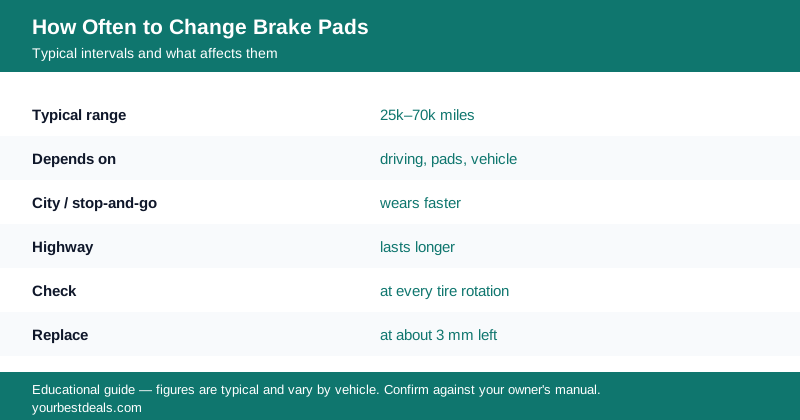
There’s no single number – brake pads typically last anywhere from about 25,000 to 70,000 miles, with some going well beyond, because wear depends heavily on your driving style, the pad material, and the vehicle. Stop-and-go city driving, hills, towing, and hard braking wear pads fast (lower end); steady highway driving is easy on them (higher end). Rather than chase a mileage number, the right approach is to have the pads checked at every tire rotation (roughly every 5,000 to 7,500 miles) and replace them when about 3 mm of material is left, or when the wear-indicator squeal starts. That way you replace on condition, not a guess – which is both safer and keeps it a routine pad-only job.
People always want a fixed interval for brakes, and I get it, but brakes aren’t like oil – they wear by use, not time. The honest answer is “it depends, so measure them,” and the free measurement at every rotation makes that easy.
What determines how fast pads wear
The same car can go through pads in 25,000 miles for one driver and 70,000 for another, based on:
Driving environment. City and stop-and-go driving means constant braking, wearing pads fast; highway driving involves far less braking, so pads last much longer. Hilly or mountainous driving (lots of downhill braking) and towing or hauling accelerate wear.
Driving style. Hard, late braking wears pads (and rotors) faster than smooth, early, gentle braking. Riding the brake pedal downhill is especially hard on them.
Pad material. Pad compounds differ – some prioritize long life, others performance or low noise – so the pad affects longevity. Front pads also wear faster than rear on most cars, since the front brakes do most of the work.
Because of all this, condition beats calendar; our brake pad replacement cost guide, worn pad symptoms guide, and front brake job guide cover the signs and costs.
Shop Talk
Here’s the practical system that beats guessing a mileage: get your pads measured at every tire rotation. The wheels are already off, so a tech can read pad thickness in millimeters in seconds, usually free, and tell you roughly how much life is left. Replace when you’re down to about 3 mm (new pads are ~10–12 mm), which gives you a comfortable window to schedule the job before the wear indicator squeals or the rotors get involved. This condition-based approach means a highway commuter isn’t replacing pads prematurely on a calendar, and a stop-and-go city driver isn’t caught off guard by fast wear. A few money tips: front and rear wear at different rates (fronts usually faster), so you’ll often do fronts and rears on separate visits – that’s normal, don’t let anyone talk you into replacing a rear set that’s barely worn. Always do pads in pairs across an axle. And smooth, early braking really extends pad life, so easing off the hard stops saves money. If you tow, drive hills, or do heavy city miles, check more often and expect the shorter end of the range. The goal is to replace pads at the right time on condition – not too early (wasting money) and not too late (taking the rotors with them). The rotation-time measurement is how you hit that window every time.
What Gets Misdiagnosed
The common error is trusting a fixed mileage “interval” for brakes the way you would for oil – replacing too early (wasting money) or assuming you’re fine at a number when aggressive driving has worn the pads out well before it. Brakes wear by use, not time, so a calendar figure misleads.
The other is replacing all four pads because the fronts are done, when the rears often have plenty of life left. The pattern: measure at each rotation, replace each axle on its own condition, and let the 3 mm mark (or the squeal) be the trigger, not a mileage guess.
The Real Number
Brake pads last roughly 25,000 to 70,000 miles, but the number varies so much with driving, pads, and vehicle that you should replace on condition, not calendar. Have pads measured at every tire rotation and replace at about 3 mm (or when the wear indicator squeals). Fronts usually wear faster than rears, so do each axle on its own condition, always in pairs, and smooth braking really stretches pad life.
Frequently Asked Questions
How many miles do brake pads usually last?
Brake pads typically last somewhere between 25,000 and 70,000 miles, and some last beyond that, but the range is wide because wear depends so heavily on how and where you drive. There’s no single mileage that applies to all cars and drivers: a person doing heavy stop-and-go city driving, lots of hills, or towing might wear out pads toward the 25,000-mile end, while someone doing mostly steady highway miles with smooth braking might get 70,000 or more from the same pads. The pad material and the specific vehicle also matter. Because of this, treating a mileage figure as a hard interval is misleading – it’s a rough expectation, not a service schedule. The reliable approach is to monitor pad condition rather than counting miles: have the pads measured at each tire rotation (every 5,000 to 7,500 miles or so), and replace them when they’re worn to about 3 mm or the wear indicator starts squealing. That way you replace based on how worn they actually are, which accounts for your particular driving. So if you want a number for planning, 25,000 to 70,000 miles is the realistic window, but let the measured thickness, not the odometer, make the final call. For what replacement costs when the time comes, see our brake pad replacement cost guide.
What makes brake pads wear out faster?
Brake pads wear faster with stop-and-go driving, aggressive braking, hilly terrain, towing or heavy loads, and certain pad materials – essentially anything that makes the brakes work harder or more often. City driving with constant stops wears pads much faster than highway driving, where you brake comparatively little, which is why two drivers with the same car can see very different pad life. Hard, late braking generates more heat and wear than smooth, early, gentle braking, so driving style matters a lot – easing off aggressive stops really extends pad life. Mountainous or hilly driving with lots of downhill braking is tough on pads, as is towing or carrying heavy loads, which increases the braking force needed. The pad compound plays a role too: some pads are formulated for longevity, others for performance or quietness, with trade-offs in wear. And front pads wear faster than rear on most vehicles because the front brakes handle the majority of stopping. So if you do heavy city miles, drive hills, tow, or brake hard, expect the shorter end of the wear range and check your pads more often. Conversely, smooth highway driving with gentle braking stretches pad life toward the longer end. Knowing your driving pattern helps you anticipate wear, but measuring the pads at each rotation is still the definitive way to know when they’re due.
Do front and rear brake pads wear at the same rate?
No – on most vehicles the front brake pads wear faster than the rear, because the front brakes do the majority of the braking work, so you’ll typically replace front pads more often than rear. When you brake, the car’s weight shifts forward, loading the front wheels, and most vehicles are designed with the front brakes handling roughly 60 to 70 percent of the stopping, which wears the front pads correspondingly faster. As a result, it’s common and normal to replace the front pads once or even twice before the rear pads are due. This is why brake service is quoted and done per axle, and why you shouldn’t automatically replace all four just because the fronts are worn – the rears may still have plenty of life, and replacing them early wastes money. A technician measuring the pads at a rotation will report front and rear thickness separately so you can see which axle is due. That said, rear pads do wear out eventually and shouldn’t be neglected, and on some vehicles (or with certain driving) the rears can wear faster than typical, so measure both. The practical takeaway is to treat the front and rear axles independently: replace whichever axle reaches about 3 mm, in pairs across that axle, when it’s actually due. So expect to do fronts more often, and don’t let a shop upsell you a full four-pad job when only the fronts need it.
Should I replace brake pads on a schedule or when they’re worn?
Replace brake pads based on their measured condition (worn to about 3 mm) rather than a fixed mileage schedule, because unlike oil, which degrades with time and use predictably, pads wear by how much braking you do, which varies too much for a calendar interval to be reliable. Using a set mileage risks two errors: replacing too early (your highway-driven pads still have plenty of life, wasting money) or too late (your city-driven pads wore out before the number you were counting on, risking rotor damage and safety). The condition-based approach avoids both: have the pads measured at every tire rotation – a quick, usually free check while the wheels are off – and replace them when they reach the roughly 3 mm guideline or when the wear-indicator squeal starts. This matches replacement to your actual driving and gives a comfortable window to schedule the job. It also lets you treat each axle independently, since fronts and rears wear at different rates. So the answer is condition, not schedule – but “condition” requires actually checking, which is why tying the pad inspection to your tire rotations is the smart habit. If you never have the pads looked at, you’re flying blind and relying on the squeal as a last warning. Build the measurement into your routine and you’ll always replace pads at the right time. For the signs that they’re due, see our worn brake pad symptoms guide.
How do I know when my brake pads need replacing?
You know it’s time when the pads are measured at about 3 mm of remaining material, when the wear-indicator squeal starts, or when you notice symptoms like longer stopping, a brake warning light, or (too late) grinding – with the measurement being the best early indicator. The ideal is proactive: have the pad thickness checked at each tire rotation, and when it’s down to roughly 3 mm (from about 10–12 mm new), schedule replacement. That’s before any noise or performance issue. The next indicator is the built-in wear indicator, a metal tab that squeals against the rotor when the pads get low – a signal to replace soon, while there’s still material and the rotors are fine. If you hear grinding (a metallic scrape), the pads are gone and you’re into rotor damage, so that’s the “already waited too long” stage to avoid. Other hints include a brake warning light on cars with pad sensors, longer stopping distances, or less confident braking. The smart play is to catch it at the measurement or the squeal, not the grind. So don’t wait for a problem to appear – build the pad check into your rotations so you replace at the 3 mm point on your schedule, keeping it a routine, affordable pad job. For the full list of signs and their urgency, see our worn brake pad symptoms guide.
Does smooth driving really make pads last longer?
Yes – driving smoothly, braking early and gently rather than hard and late, really extends brake pad life, sometimes significantly, because pad wear is directly related to how much friction and heat the braking generates. Hard, last-moment braking converts a lot of the car’s energy into heat and friction at the pads in a short time, wearing them (and the rotors) faster, while anticipating stops and braking gradually spreads that energy out and uses less pad material. Coasting toward a red light or stop sign instead of accelerating up to it and braking hard, maintaining a safe following distance so you can ease off rather than slam on the brakes, and avoiding riding the pedal downhill all reduce wear. The effect is real: two drivers with identical cars can see substantially different pad life based largely on braking habits, alongside their driving environment. This is one of the few maintenance costs you directly control through behavior. Smooth braking also improves fuel economy and reduces wear on other components, so it pays off beyond just the pads. It won’t change the fundamental fact that city driving wears pads faster than highway driving, but within your conditions, gentle braking stretches the interval. So if you want your pads (and rotors) to last and your brake costs to drop, ease off the aggressive stops – it’s free and effective, and it’s a habit that keeps brakes a less frequent expense.
Can I just replace pads, or do I need rotors too?
Often you can replace just the pads if you catch them at the right time and the rotors are still in good condition, but if the rotors are worn below spec, warped, or scored (which happens if pads wore out and went metal-on-metal), they need resurfacing or replacement too – which is exactly why replacing pads on time keeps it a pad-only job. When you replace pads before they’re fully worn, the rotors usually have enough material and a smooth surface to simply get fresh pads, measured and reused. A technician measures rotor thickness against the minimum spec and checks for warping or scoring; if the rotors are within spec and smooth, pads alone are fine. But if you waited until grinding, the metal backing has gouged the rotors, so you’ll need rotors as well, and a pulsating pedal indicates warped rotors that need addressing. Some shops have a policy of resurfacing or replacing rotors with every pad change for best performance, but it’s not always strictly necessary if the rotors measure good. The cost difference is significant: pads alone is the cheaper job, while pads plus rotors is more. So the way to keep it to pads only is to replace at the 3 mm/squeal stage before the rotors are damaged, and to have the rotors measured rather than assume. If you’ve let the brakes grind, budget for rotors too. For the cost of each scenario, see our front brake job guide and brake rotor guide.
Sources
Brake-pad interval guidance verified against standard brake-service practice in November 2026. Replace on measured condition; have pads inspected at each tire rotation.
- ASE – National Institute for Automotive Service Excellence
- NHTSA – vehicle safety
- RepairPal – brake pad replacement reference
Related Guides
- Worn Brake Pad Symptoms
- Brake Pad Replacement Cost
- Front Brake Job Cost
- Tire Rotation Cost
- Brake Guides

Eddie Brennan is an ASE Master Certified technician (A5 Brakes among his certs) who spent 11 years in an independent shop in Columbus, OH, before a back injury moved him into writing. He always told customers brakes wear by use, not time – so get them measured at every rotation and replace at 3 mm rather than chasing a mileage. He drives a 2015 Subaru Outback with over 250,000 miles and a 2020 Ford F-150, and takes no referral fees or advertising money from any shop or chain.