
Last updated: November 5, 2026 – By Diane Holcomb
November 2026 update: reconfirmed EV/hybrid maintenance savings, battery replacement costs, and warranty terms.
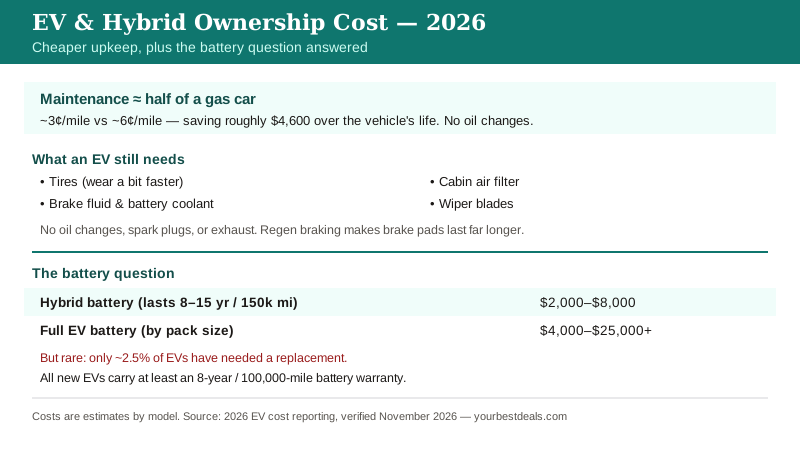
Owning an EV or hybrid costs meaningfully less to maintain than a gas car – about half as much, roughly 3 cents per mile versus 6 for gas, saving around $4,600 in maintenance over the vehicle’s life. That’s because EVs skip oil changes, spark plugs, and exhaust work entirely, and their regenerative braking makes brake pads last far longer. The thing people worry about is the battery, and the honest answer is reassuring: full EV battery replacements ($4,000 to $25,000 by pack size) are rare, with only about 2.5% of EVs ever needing one, and all new EVs carry at least an 8-year, 100,000-mile battery warranty. Hybrid batteries ($2,000 to $8,000) last 8 to 15 years. These are estimated ranges that vary by model.
I fielded a lot of EV and hybrid questions as these became common, and the same fear came up every time: “what happens when the battery dies and it costs me $20,000?” The reality is far less scary than the headline, and the day-to-day savings are real. Let me lay out what an EV or hybrid actually costs to own – the lower routine maintenance, what still needs service, and the truth about the battery.
Maintenance: about half a gas car’s
The biggest ownership advantage is lower maintenance. Studies put EV maintenance and repair at roughly half that of a comparable gas car over the vehicle’s life – about 3 cents per mile versus 6, saving an average of around $4,600. The reason is mechanical simplicity: an EV has no engine oil to change, no spark plugs, no timing belt, no exhaust or catalytic converter, and far fewer moving parts to wear out. Those recurring gas-car services simply don’t exist on an EV.
Brakes are a standout. EVs and hybrids use regenerative braking, which slows the car using the electric motor and recaptures energy, so the physical brake pads do much less work and last far longer – often well beyond what a gas car’s pads would. That alone removes a common recurring cost. Between no oil changes and long-lasting brakes, the routine-maintenance column shrinks dramatically compared with a gas vehicle. Our EV maintenance guide details exactly what changes.
What still needs service
An EV isn’t maintenance-free, so it’s worth knowing what remains. Tires still wear – and often a bit faster, because EVs are heavier from the battery and have instant torque, so plan for tire rotations and replacements on schedule. Brake fluid still needs periodic changes, and cabin air filters and wiper blades are the same as any car. Many EVs also use coolant for the battery thermal-management system, which needs occasional service. And the 12-volt accessory battery (separate from the main pack) still exists and eventually needs replacing like any car battery.
Hybrids sit in between: they have a gas engine, so they still need oil changes, but their engines often run less and their brakes last longer thanks to regen, so maintenance is lower than a pure gas car but not as low as a full EV. The point is that “lower maintenance” doesn’t mean “no maintenance” – tires, fluids, filters, and the 12-volt battery are ongoing. Budgeting for those keeps the ownership picture realistic. See our tire care guide and maintenance schedule for those shared items.
The battery question, honestly
This is the fear, so let’s be direct. A full EV battery pack replacement is expensive – $4,000 to $9,000 for a small pack, $7,000 to $14,000 for a mid-size one, $10,000 to $18,000 for a large one, and $15,000 to $25,000 or more for a flagship performance pack. Those are real numbers. But the crucial context is how rarely it happens: in large real-world datasets, only about 2.5% of EVs have ever needed a battery replacement, and every new EV carries at least an 8-year, 100,000-mile battery warranty (longer in some states), so a premature failure is covered.
Hybrid batteries are cheaper and better understood, running $2,000 to $8,000 to replace and typically lasting 8 to 15 years or up to 150,000 miles – many go the life of the car without replacement. Battery costs are also falling as technology improves, so replacement prices are trending down over time. The realistic takeaway: for most owners, the battery outlasts their ownership or is covered by warranty, and the rare replacement, while pricey, is offset over the years by the substantial fuel and maintenance savings. Don’t let the worst-case headline overshadow the everyday economics.
Shop Talk
Two things people don’t realize about EV and hybrid batteries. First, batteries degrade gradually, not suddenly – you lose a small percentage of range over years, not all of it at once, so “the battery died” is rarely a cliff. Most warranties guarantee the pack retains around 70% capacity through the warranty period. Second, a full pack replacement often isn’t the only option: on many hybrids and some EVs, a single failed module or cell can be replaced, or a remanufactured pack used, for far less than a brand-new pack. If you’re ever quoted a five-figure battery, ask about module-level repair and reman options before assuming you need the whole thing. And buy from a shop that specializes in hybrid/EV batteries – they know the cheaper routes.
Where Drivers Overpay
The first overpay is a decision cost: avoiding an EV or hybrid out of battery fear and missing years of lower fuel and maintenance bills. Given how rare battery replacement is and that warranties cover early failures, the everyday savings usually outweigh the small risk of a big battery bill – so the fear itself can be the expensive choice. Owning an EV can save $7,000 to $11,000 over its life versus a comparable gas car when you add up fuel and maintenance.
The second overpay is on the battery itself when replacement does come up: accepting a full-pack quote without asking about module-level repair or a remanufactured pack, which can cost far less on many vehicles. And the third is dealer service for routine EV maintenance that an independent (tires, cabin filter, brake fluid) does cheaper – the shared items don’t require the dealer. So the money-smart approach is to weigh the real (low) battery risk against the real (high) savings, and when battery work is needed, explore the cheaper repair routes before a full replacement. Our hybrid battery guide covers that in depth.
The Real Number
EVs and hybrids cost about half as much to maintain as a gas car – roughly 3 cents a mile versus 6 – with no oil changes and long-lasting regen brakes, saving around $4,600 over the vehicle’s life. They still need tires, brake fluid, cabin filters, and the 12-volt battery. The battery fear is overblown: full EV pack replacement ($4,000 to $25,000 by size) hits only about 2.5% of EVs and is covered by an 8-year, 100,000-mile warranty, while hybrid batteries ($2,000 to $8,000) last 8 to 15 years. If battery work does come up, ask about module repair or a reman pack before paying for a whole new one.
Frequently Asked Questions
Are EVs cheaper to maintain than gas cars?
Yes, meaningfully. Studies put EV maintenance and repair at roughly half that of a comparable gas car over the vehicle’s lifetime – about 3 cents per mile versus 6, saving an average of around $4,600. The savings come from mechanical simplicity: EVs have no oil changes, spark plugs, timing belts, exhaust systems, or catalytic converters, and their regenerative braking makes brake pads last far longer. They still need tires, brake fluid, cabin air filters, and the 12-volt battery, so they aren’t maintenance-free, but the recurring engine-related costs of a gas car simply don’t exist. Over the life of the vehicle, that lower maintenance is a real ownership advantage.
How much does it cost to replace an EV battery?
A full EV battery pack replacement runs from about $4,000 for a small pack to $25,000 or more for a large flagship pack, with mid-size packs typically $7,000 to $14,000. These are real, significant costs. However, replacement is rare – only about 2.5% of EVs have ever needed one – and all new EVs carry at least an 8-year, 100,000-mile battery warranty (longer in some states), so early failures are covered. Batteries also degrade gradually rather than failing suddenly, and module-level repair or remanufactured packs can cost far less than a new pack on many vehicles. For most owners the battery outlasts their ownership or is under warranty.
How long do EV and hybrid batteries last?
Hybrid batteries typically last 8 to 15 years or up to 150,000 miles, and many go the life of the car without replacement. EV batteries are generally designed to last even longer, with warranties guaranteeing around 70% capacity retention through at least 8 years or 100,000 miles, and real-world data showing most packs lasting well beyond that. Batteries degrade gradually – losing a small percentage of range over years – rather than dying all at once, so “the battery is done” is rarely a sudden event. Factors like climate, charging habits, and use affect longevity, but for most owners the battery is not the frequent replacement expense the headlines suggest.
Do EVs still need brakes and tires?
Yes to both, though differently. Tires still wear and often a bit faster than on a gas car, because EVs are heavier from the battery pack and deliver instant torque, so budget for rotations and replacements on schedule. Brakes still exist and need brake fluid changes, but the pads themselves last much longer thanks to regenerative braking, which slows the car with the electric motor and spares the physical brakes. So you’ll replace tires on a normal or slightly accelerated schedule, but brake pad replacements are far less frequent. Both are shared maintenance items with gas cars, and an independent shop can handle them at normal prices.
Is the EV battery warranty enough to protect me?
For most owners, largely yes. Every new EV sold in the US carries at least an 8-year, 100,000-mile battery warranty, and some states require longer, so a premature battery failure within that window is covered by the manufacturer. Since only about 2.5% of EVs ever need a replacement and batteries usually last well beyond the warranty, the odds of an out-of-warranty, out-of-pocket replacement are low. The warranty typically also guarantees the battery retains a minimum capacity (often around 70%) through the period. If you buy used, check the remaining battery warranty, since it transfers, and factor the battery’s age and health into the price.
Should battery fear stop me from buying an EV?
Based on the numbers, probably not. Battery replacement is rare (about 2.5% of EVs), covered by a long warranty when it happens early, and trending cheaper as technology improves. Meanwhile the everyday savings are substantial: about half the maintenance cost of a gas car plus fuel savings, adding up to an estimated $7,000 to $11,000 over the vehicle’s life. So avoiding an EV purely out of battery fear can be the more expensive choice, since you forgo years of real savings to avoid a low-probability cost. That said, weigh your specific situation – how long you’ll keep the car, your climate, and charging access – rather than deciding on the headline alone.
Do hybrids need oil changes and normal maintenance?
Yes. A hybrid has a gas engine alongside its electric motor, so it still needs oil changes and the usual engine maintenance, though often at normal or slightly extended intervals since the engine runs less. Hybrids do benefit from regenerative braking, so their brake pads last longer like an EV’s, and overall maintenance tends to be lower than a pure gas car but higher than a full EV. You also have the hybrid battery to consider, which lasts 8 to 15 years and costs $2,000 to $8,000 if it ever needs replacing. So a hybrid splits the difference: gas-car engine upkeep, EV-style brake savings, and a generally reliable battery.
Sources
EV and hybrid maintenance and battery cost figures verified against 2026 cost reporting on November 5, 2026. Figures are estimated ranges that vary by model; battery warranties vary by manufacturer and state.
- MotorWatt – EV battery replacement cost by brand, 2026
- Lemonade – hybrid battery replacement costs, 2026
- Great Plains Institute – Consumer Reports EV maintenance study
Related Guides
- How long do hybrid batteries last?
- How EV maintenance differs from gas cars
- Car maintenance schedule and cost
- Tire care guide: pressure, tread, and cost

Diane Holcomb spent seven years at Charlotte dealership service desks, where the same EV battery fear came up in every conversation – and where the day-to-day savings turned out to tell a very different story. She writes the cost guides on Your Best Deals and takes no referral fees. She drives a 2019 Honda CR-V and a 2007 Toyota Camry.