
Last updated: November 5, 2026 – By Diane Holcomb
November 2026 update: reconfirmed what EV maintenance drops, what remains, and the roughly-half cost figure.
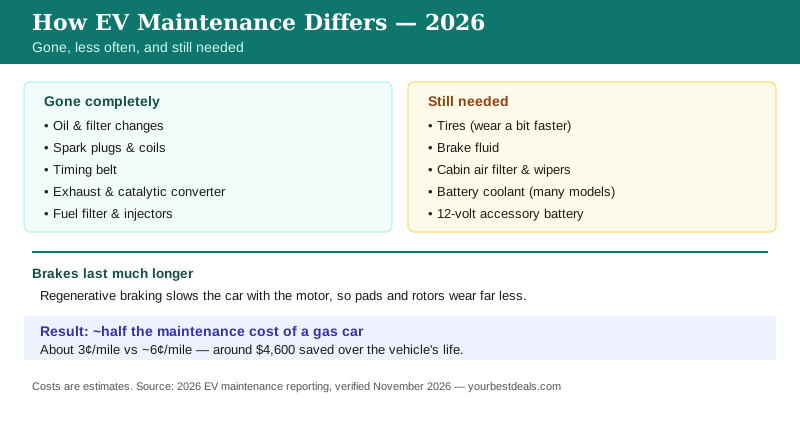
EV maintenance is dramatically lighter than a gas car’s – roughly half the cost, about 3 cents per mile versus 6, saving around $4,600 over the vehicle’s life. The reason is simple: an electric motor has far fewer moving parts than a gas engine, so entire categories of routine service disappear. No oil changes, no spark plugs, no timing belt, no exhaust or catalytic converter, no fuel filter or injectors. On top of that, regenerative braking makes the brake pads last much longer. What remains is a short list – tires, brake fluid, cabin filter, wipers, and the 12-volt battery. Here’s exactly what drops, what stays, and why the total is so much lower.
When people asked me what an EV would actually cost to keep up, the answer surprised them every time: the biggest recurring gas-car expenses simply aren’t there. Let me break it into three buckets – what’s gone completely, what happens much less often, and what still needs doing – so you know what owning an EV really involves.
Gone completely
An electric motor doesn’t burn fuel, so the entire maintenance chain around combustion vanishes. There are no oil and filter changes – the single most frequent gas-car service, gone. No spark plugs or ignition coils, because there’s no spark ignition. No timing belt to replace on an interval. No exhaust system or catalytic converter, so none of the emissions repairs that come with them, like oxygen sensors or a clogged converter. And no fuel filter or fuel injectors, since there’s no liquid fuel system.
That’s a huge chunk of a gas car’s recurring cost eliminated outright. Think of everything a gas car needs across 100,000 miles – a dozen-plus oil changes, spark plugs, maybe a timing belt, fuel system work, and the occasional emissions repair. On an EV, none of that exists. This is the core reason EV maintenance runs about half of a comparable gas vehicle’s, and it’s not a small difference – it’s whole line items removed from the ownership budget. Our EV ownership guide covers the full cost picture.
Much less often: brakes
Brakes deserve their own category because of regenerative braking. When you lift off the accelerator or brake in an EV, the electric motor runs in reverse as a generator, slowing the car and recapturing energy back into the battery. This means the physical friction brakes – pads and rotors – do far less work than in a gas car, where they handle all the slowing. As a result, EV brake pads commonly last much longer, sometimes well beyond what a gas car’s would.
You still have real brakes, and they still matter for hard stops and low-speed maneuvering, so they’re not eliminated – just used far less. This dramatically stretches the interval between brake jobs, removing another common recurring expense. It’s one of the quiet advantages of an EV that owners notice over time: the brake pad replacement that a gas car needs every so often comes around much more rarely. Combined with no oil changes, that’s two of the most frequent gas-car services either gone or greatly reduced.
Shop Talk
One counterintuitive EV brake note: because the friction brakes get used so little, they can actually seize or corrode from disuse, especially in wet or salty climates, since they don’t wear off rust the way frequently-used brakes do. So EV owners should have the brakes inspected and the calipers serviced periodically even though the pads aren’t worn – occasional use and a caliper cleaning keep them healthy. The other thing people miss: EVs still have a regular 12-volt battery (separate from the big drive battery) that runs the electronics, and it dies every few years like any car battery – a cheap replacement, but a common cause of an EV that “won’t turn on.” Don’t overlook the small battery while focusing on the big one.
Still needed
An EV isn’t maintenance-free, so here’s what remains on the list. Tires still wear, and often a bit faster than on a gas car, because EVs are heavier from the battery pack and their instant torque can scrub tires – so budget for rotations and replacements, maybe slightly more often. Brake fluid still needs periodic changing even though the pads last longer. Cabin air filters and wiper blades are identical to any car. Many EVs use coolant for the battery thermal-management system, which needs occasional service. And the 12-volt accessory battery still exists and eventually needs replacing.
These shared items are all things an independent shop can handle at normal prices – you don’t need the dealer for tires, a cabin filter, or brake fluid. So while the list is much shorter than a gas car’s, “lower maintenance” isn’t “no maintenance.” Budgeting for tires, fluids, filters, and the 12-volt battery keeps your ownership expectations realistic. See our tire care guide and maintenance schedule for these shared items, which apply to EVs just as they do to gas cars.
The Real Number
EV maintenance costs about half a gas car’s – roughly 3 cents a mile versus 6, saving around $4,600 over the vehicle’s life – because whole categories of service disappear: no oil changes, spark plugs, timing belt, exhaust, catalytic converter, or fuel system, and brake pads last much longer thanks to regen braking. What remains is tires (which wear a bit faster), brake fluid, cabin filter, wipers, battery coolant, and the 12-volt battery – all handleable at a normal independent shop. Just don’t forget the small 12-volt battery, and have the little-used brakes inspected occasionally so they don’t seize.
Frequently Asked Questions
What maintenance does an EV need?
An EV still needs tires (rotations and replacements, often slightly more often since EVs are heavier), brake fluid changes, cabin air filter replacement, wiper blades, and, on many models, battery-coolant service for the thermal-management system. It also has a 12-volt accessory battery that eventually needs replacing like any car battery. What it doesn’t need is the big list of combustion-related services: no oil changes, spark plugs, timing belt, exhaust or catalytic converter work, or fuel system service. So the EV maintenance list is much shorter and cheaper, but not empty. All the remaining items are shared with gas cars and can be handled at a normal independent shop.
Do electric cars need oil changes?
No. Electric cars have no combustion engine, so there’s no engine oil to change – one of the most frequent and recurring gas-car services simply doesn’t exist on an EV. This is a big part of why EV maintenance costs about half a gas car’s. Note that some EVs have a gear reduction unit or other components with lubricant that may need very occasional attention per the manufacturer, but that’s nothing like the regular oil changes a gas engine requires. Plug-in hybrids and regular hybrids do still have a gas engine and therefore do need oil changes. But a pure battery-electric vehicle has no oil changes at all.
Why do EV brakes last longer?
Because of regenerative braking. When you slow an EV, the electric motor runs in reverse as a generator, using the motor to decelerate the car and recapture energy back into the battery. This means the physical friction brakes – the pads and rotors – do far less work than in a gas car, where they handle all the slowing. As a result, EV brake pads commonly last much longer, stretching the interval between brake jobs well beyond a gas car’s. The brakes aren’t eliminated, since they’re still needed for hard stops, but they wear so slowly that brake replacement becomes a much rarer expense. It’s one of the quiet cost advantages of driving electric.
How much cheaper is EV maintenance than gas?
Roughly half. Studies put EV maintenance and repair at about 3 cents per mile versus about 6 cents for gas cars over the vehicle’s lifetime, saving an average of around $4,600 in maintenance alone. Adding fuel savings, total ownership savings can reach $7,000 to $11,000 over the life of the vehicle compared with a comparable gas car. The savings come from eliminating oil changes, spark plugs, timing belts, exhaust and emissions work, and fuel system service, plus far less frequent brake jobs. These are averages that vary by vehicle and driving, but the direction is consistent: EVs cost substantially less to maintain, which offsets their sometimes higher purchase price over time.
Do EVs still need brake fluid and tire service?
Yes. Even though EV brake pads last much longer, the brake system still uses hydraulic fluid that needs periodic changing, and the brakes should be inspected regularly – in fact, because EV brakes are used so little, they can seize or corrode from disuse in wet climates, so occasional caliper service matters. Tires absolutely still need service: EVs are heavier and have instant torque, so tires wear at a normal or slightly faster rate and need regular rotation and eventual replacement. Both brake fluid and tire service are shared with gas cars and don’t require a dealer. So the EV maintenance list is shorter, but tires and brake fluid remain on it.
Does an EV have a regular 12-volt battery?
Yes, and it’s easy to overlook. Separate from the large high-voltage drive battery that powers the motor, an EV has a conventional 12-volt battery that runs the electronics, lights, and systems – much like the battery in a gas car. It ages and dies every few years and needs replacing, and a dead 12-volt battery is a common reason an EV “won’t turn on” even when the main pack is fine. Replacing it is a cheap, routine job. So while the big battery gets all the attention, the small one is the one that actually needs periodic replacement, and forgetting it can leave you stranded despite a healthy drive battery.
Can any mechanic service an EV?
For the shared items – tires, brake fluid, cabin filter, wipers, 12-volt battery – yes, most independent shops can handle EV service just like a gas car, and often cheaper than a dealer. For high-voltage battery and drive-system work, you generally want a shop or dealer with EV-specific training and equipment, since those systems require special safety procedures. But since the routine maintenance list is dominated by the shared items, most of an EV’s upkeep doesn’t require a specialist. As EVs become more common, more independents are getting EV-trained. For everyday maintenance, you have options beyond the dealer; for major high-voltage work, use a qualified EV shop.
Sources
EV maintenance differences and cost figures verified against 2026 cost reporting on November 5, 2026. Figures are estimated averages that vary by vehicle and driving conditions.
- Great Plains Institute – Consumer Reports EV maintenance study
- Drive Electric Vermont – EV vs gas maintenance differences
- Recharged – EV maintenance costs vs gas cars, 2026
Related Guides
- EV and hybrid ownership cost
- How long do hybrid batteries last?
- Tire care guide: pressure, tread, and cost
- Car maintenance schedule and cost

Diane Holcomb spent seven years at Charlotte dealership service desks, where the shortest service list she ever wrote up was for an EV – no oil, no plugs, no exhaust, just tires and fluids. She writes the cost guides on Your Best Deals and takes no referral fees. She drives a 2019 Honda CR-V and a 2007 Toyota Camry.