
Last updated: November 6, 2026 – By Eddie Brennan
November 2026 update: refreshed guidance on overfill thresholds, symptoms, and the fix.
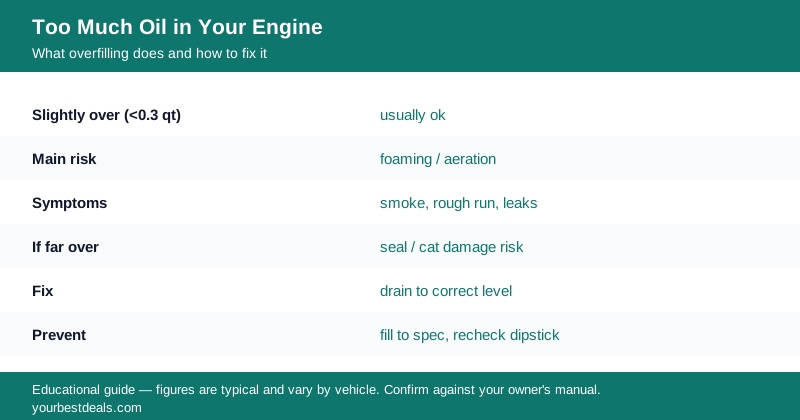
A small overfill – up to roughly a quarter to a third of a quart over the full mark – is usually harmless. The problem starts with significant overfilling: when the oil level rises high enough for the spinning crankshaft to dip into it, the crank whips the oil into foam (aeration), and foamy oil can’t be pumped or lubricate properly. That leads to symptoms like exhaust smoke, rough running, and oil leaks or seepage from seals, and in bad cases it can damage seals, force oil into places it shouldn’t go, or foul the catalytic converter. The fix is simple: drain the excess down to the correct level. So a touch over is fine; a lot over needs correcting.
I pulled plenty of cars into the bay for “smoking and running rough after an oil change,” and more than once the cause was simply too much oil. Easy to cause, easy to fix – but worth understanding so you don’t ignore it.
Why overfilling causes problems
The oil level is engineered so the crankshaft spins just above the oil in the pan. Overfill enough and the crank counterweights start hitting the oil surface, churning air into it like a whisk. Aerated, foamy oil has two problems: the oil pump can’t move foam the way it moves liquid, so lubrication and oil pressure suffer, and the frothy oil doesn’t protect bearings and surfaces properly.
The excess pressure and volume also push oil past seals and gaskets (causing leaks), can force oil up into the PCV system and intake (causing smoke and fouling), and over time can damage seals or send oil to the catalytic converter. How bad it gets depends on how far over you are – a hair over the line is negligible, a quart or more over is a real problem to correct promptly.
Prevention ties back to checking correctly; our how to check your oil guide, what oil and how much your car takes, and how to change your oil cover doing it right.
Shop Talk
How worried to be comes down to how far over you are. If the dipstick reads a hair above the full mark – think an eighth of an inch, under about a quarter-quart – it’s generally fine to drive and you can correct it at the next change. If you’re a half-quart to a quart or more over (oil well above MAX), don’t just shrug it off: that’s enough to aerate the oil and cause the smoke, rough running, and leaks, so drain the excess before driving much. The easiest fix at home is to crack the drain plug and let a little out into a pan, checking the dipstick until you’re back in range; a shop can do it quickly too, and some use a suction pump through the dipstick tube. The way to avoid the whole thing is to fill to spec, not to a round number: know your engine’s capacity, add a little under it, run the engine, let it settle, and top to the full mark in small increments while rechecking. Don’t trust that “5 quarts” is right for every car – capacities vary, and a quick-lube occasionally overfills, so check the stick yourself after any change. A slightly high reading isn’t an emergency; a badly overfilled engine churning foam is worth fixing right away.
What Gets Misdiagnosed
Post-oil-change smoke and rough running get blamed on a “bad oil change” or a failing part when the real cause is simply overfill – too much oil aerating and getting pushed into the intake. The dipstick tells the story in seconds, yet people chase sensors and plugs first.
The other misread is a sudden oil leak right after a change, assumed to be a bad seal, when an overfilled crankcase is forcing oil past seals that were fine. The pattern: after any change or top-off, check the level first – if it’s well over MAX, correct it before diagnosing anything else.
The Real Number
A little over the full mark (under about a quarter-quart) is harmless; a half-quart to a quart or more over aerates the oil and causes smoke, rough running, leaks, and potential seal or catalytic-converter damage. If you’re well over MAX, drain the excess down to the correct level before driving much – crack the drain plug and let a little out, or have a shop suction it. Prevent it by filling to your engine’s actual capacity and rechecking the dipstick, not by pouring in a round number.
Frequently Asked Questions
How much overfill is actually a problem?
A small amount over – roughly up to a quarter to a third of a quart above the full mark – is generally harmless and you can simply correct it at the next change, while a half-quart to a quart or more over is enough to cause real problems and should be drained down. The reason there’s a threshold is that the trouble starts when the oil level rises enough for the spinning crankshaft to contact and churn the oil into foam; a slight overfill doesn’t reach that point, but a significant one does. So if your dipstick reads just a touch above MAX, don’t panic – it’s within tolerance for most engines. If it reads well above MAX (clearly high, or you know you added too much), treat it as something to fix before driving much, because aerated oil loses pressure and lubricating ability. There’s no exact universal number since pan designs differ, but the practical rule is: a hair over is fine, a noticeable amount over needs correcting. When in doubt, drain down to the full mark – it’s easy and removes any risk. The dipstick is your guide: get the level back between the marks, ideally near but not over MAX, and the engine is happy.
What are the symptoms of too much oil?
The common symptoms of significant overfill are blue or white exhaust smoke, rough or unstable running, oil leaks or seepage, and sometimes a drop in oil pressure or related warning light – all stemming from aerated oil and excess pressure. The crankshaft whipping the oil into foam means the pump moves froth instead of solid oil, which can cause low oil pressure and poor lubrication. The excess can be pushed into the PCV system and intake, where it burns and makes smoke (often bluish) and can foul spark plugs, causing the rough running or misfire-like behavior. The raised level and pressure also force oil past seals and gaskets, showing as fresh leaks or seepage after a change. In severe or prolonged cases, it can damage crankshaft seals or send enough oil to the catalytic converter to harm it. If you notice these right after an oil change or top-off, check the dipstick first – an over-MAX reading explains it. Mild overfill may show no symptoms at all, which is why the dipstick, not just symptoms, is the real check. If you see smoke and rough running post-change and the level is high, drain the excess and the symptoms typically resolve.
How do I fix an overfilled engine?
Drain the excess oil down to the correct level – either remove a small amount via the drain plug or have a shop suction it out through the dipstick tube – until the dipstick reads back in the proper range. At home, the simple method is to position a drain pan, crack the drain plug just enough to let a little oil trickle out, then snug it and recheck the dipstick, repeating until you’re between the marks (ideally near but not over MAX). Work carefully with warm (not scalding) oil, and use a new crush washer if you fully remove the plug. Alternatively, a top-side extraction pump pulls oil out through the dipstick tube cleanly, which many shops and some DIYers use. A shop can correct an overfill in a few minutes. Once you’re back to the correct level, run the engine, recheck, and confirm the smoke and rough running clear up (give the aerated oil a little time to settle and any excess in the intake to burn off). The key is simply getting the level right; there’s rarely lasting harm from a promptly corrected overfill. So don’t drive long on a badly overfilled engine, but don’t over-worry either – drain to spec and you’re back to normal. Prevent a repeat by filling to your engine’s actual capacity next time and rechecking the dipstick.
Can too much oil damage my engine?
A small, briefly-corrected overfill rarely causes lasting damage, but a significant overfill left in place can, which is why it’s worth fixing rather than ignoring. The potential damage from running badly overfilled: aerated oil and reduced oil pressure can accelerate wear on bearings and other surfaces that depend on a solid oil film; excess oil pushed into the intake and combustion can foul spark plugs and, over time, send oil to and damage the catalytic converter (an expensive part); and the elevated pressure can blow out crankshaft or other seals, turning into leaks. None of this is instant with a modest overfill, but the longer you drive significantly overfilled, the greater the risk. The good news is that catching it early and draining to the correct level almost always prevents any permanent harm – most overfills are corrected before damage occurs. So the honest answer is: too much oil can damage an engine if it’s a lot and left for a while, but a promptly corrected overfill typically does not. That’s the case for checking the dipstick after any change and not driving long on an over-MAX reading. Treat a big overfill as a fix-now item and a slight one as a fix-at-next-change item, and you avoid the damage entirely.
Why did the shop overfill my oil?
Overfills at a shop or quick-lube usually come from using a generic fill quantity instead of your engine’s exact capacity, or from not rechecking the dipstick after filling – both avoidable, which is why checking the level yourself after any change is smart. A busy quick-lube might assume “5 quarts” for a car that actually takes 4.5, or add a full container without verifying, leaving you over MAX. It’s not common, but it happens, and it’s one reason I tell people to pull the dipstick in the parking lot before driving off after a change (or soon after). If you find it overfilled, go back and have them correct it – a reputable shop will drain the excess at no charge, since it was their error. The fix is quick. To protect yourself, know your engine’s capacity (it’s in the manual), and after any oil change – DIY or shop – let the car sit a minute and check the dipstick to confirm the level is between the marks, ideally near but not over full. If it’s well over, have it corrected. This simple post-change check catches both overfills and the rare underfill, so it’s worth the minute regardless of who did the work. A good shop won’t mind you verifying, and it keeps your engine at the right level.
Is it safe to drive with slightly too much oil?
If you’re only a little over the full mark (under roughly a quarter-quart), yes, it’s generally safe to drive and you can correct it at your next change; if you’re significantly over (a half-quart to a quart or more above MAX), you should drain the excess before driving much. The distinction matters because a slight overfill doesn’t reach the crankshaft to aerate the oil, so it causes no real harm, while a significant overfill does and brings the smoke, rough running, and leak risks. So judge it by the dipstick: a hair over is fine to drive on short-term, clearly over MAX is not. If you must drive a significantly overfilled car a short distance to get it corrected, do so gently and briefly, then drain to spec. There’s no benefit to extra oil – more is not better here – so there’s no reason to leave a significant overfill in place. When unsure how far over you are, err toward draining down to the full mark, which removes any doubt and any risk. The simplest guidance: get the level back between the marks and you can drive normally; until then, if it’s well over, treat it as a fix-first item. A properly filled engine is the goal, and correcting an overfill takes only a few minutes.
How do I avoid overfilling in the future?
Fill to your engine’s actual capacity and confirm with the dipstick, rather than pouring in a round number and assuming it’s right. Start by knowing your capacity (in the owner’s manual) – it varies by engine, so “5 quarts” isn’t universal. When changing oil, add a bit less than the stated capacity first (say, start with most of it), run the engine briefly to circulate and fill the filter, shut off, wait a minute for the oil to settle, then check the dipstick and top off in small increments to the full mark, rechecking as you go. This way you approach the correct level from below and never blow past it. When simply topping off a low engine, add half a quart at a time and recheck rather than dumping in a full quart. After any oil change, DIY or shop, verify the level on the stick before driving off. These habits make overfilling nearly impossible. The principle is that the dipstick, not the container count, is the final authority on level – the capacity figure gets you close, and the stick confirms you’re right. Build in that final check and you’ll fill to spec every time, avoiding both overfill and underfill. For the full change procedure, see our how to change your oil guide.
Sources
Overfill guidance verified against standard engine-lubrication and service practice in November 2026. Thresholds are general; confirm your engine’s capacity and correct level with your owner’s manual and dipstick.
- ASE – National Institute for Automotive Service Excellence
- API – engine oil basics
- SoFi – oil and maintenance (2026)
Related Guides
- How to Check Your Engine Oil
- What Oil Does My Car Take?
- How to Change Your Oil
- Oil Change Cost Guide
- Engine Oil & Lubrication Guides

Eddie Brennan is an ASE Master Certified technician who spent 11 years in an independent shop in Columbus, OH, on brakes, suspension, and electrical diagnostics before a back injury moved him into writing. He lost count of the “smoking and running rough after an oil change” cars that turned out to be simple overfills – fixed in minutes with the dipstick as the guide. He drives a 2015 Subaru Outback with over 250,000 miles and a 2020 Ford F-150, and takes no referral fees or advertising money from any shop or chain.