
Last updated: November 5, 2026 – By Eddie Brennan
November 2026 update: reconfirmed the symptom list, cleaning-vs-replacement costs, and the converter warning.
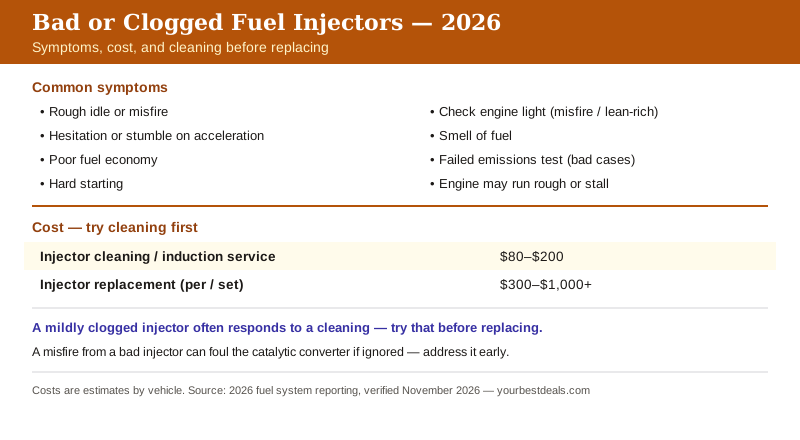
Bad or clogged fuel injectors usually show up as a rough idle or misfire, hesitation on acceleration, poor fuel economy, or hard starting – and the good news is the first fix is cheap. A fuel-injector cleaning or induction service, $80 to $200, often restores a mildly clogged injector, so it’s worth trying before spending $300 to $1,000 or more to replace injectors. The injectors spray a precise, atomized amount of fuel into each cylinder, so when one clogs or leaks, that cylinder runs poorly and the whole engine feels it. Below are the signs, the cleaning-versus-replacement math, and why a misfiring injector is worth addressing before it costs you a catalytic converter.
Injectors were a repair where I could often save people money, because a cleaning fixed a gummed-up injector more often than folks expected. Let me give you the symptoms, when a cleaning is worth trying, and when an injector really needs replacing.
The common symptoms
A bad or clogged injector disrupts the fuel delivery to one or more cylinders, and the symptoms follow from that. A rough idle or a misfire is the classic sign – the affected cylinder isn’t getting its correct fuel spray, so it stumbles. Hesitation or a stumble when you accelerate is common, as is poor fuel economy, because the engine compensates for the bad injector by running inefficiently. Hard starting can happen too, especially if an injector is leaking or not delivering at startup.
On the diagnostic side, a check engine light with a misfire code or a lean/rich fuel-mixture code often points at an injector, and the code frequently identifies the affected cylinder. In some cases you’ll smell fuel, from a leaking injector, and a badly running engine can fail an emissions test. Because these symptoms overlap heavily with spark plugs, coils, and other causes, reading the code and pinpointing the cylinder is what turns “maybe injectors” into a real diagnosis. See our engine and fuel system guide for the bigger picture.
Cleaning vs. replacing – the cost math
Here’s where you can save money. A fuel-injector cleaning or induction service runs $80 to $200 and uses a professional-grade cleaner run through the system to dissolve deposits. On a mildly clogged or gummed-up injector – the most common real-world cause of injector symptoms – this often restores proper spray and fixes the problem for a fraction of replacement. It’s the right first step when the injector is dirty rather than mechanically failed.
Replacement is the answer when an injector is actually failed – stuck open, stuck closed, leaking internally, or electrically dead – where cleaning won’t help. That runs $300 to $1,000 or more, depending on the vehicle, how many injectors are replaced, and how buried they are; high-pressure direct-injection systems and hard-to-reach injectors push toward the top. A proper diagnosis, sometimes including an injector flow or balance test, tells you whether you’re dealing with dirty injectors that clean up or failed ones that need replacing. Don’t skip straight to replacement on symptoms alone when a cleaning might solve it.
Shop Talk
A cheap bottle of fuel-injector cleaner in your tank is fine as preventive maintenance and can help keep injectors clean, but don’t expect a pour-in bottle to fix an injector that’s already causing a misfire – that usually needs the stronger professional induction service or, if the injector has actually failed, replacement. Also, before you or a shop condemns an injector for a misfire, make sure the spark plug and ignition coil for that cylinder have been ruled out, because a bad coil causes the same misfire code for a lot less money. A simple trick a tech uses: swap the suspected injector (or coil) to another cylinder and see if the misfire follows it. If it moves, you’ve found the culprit.
What Gets Misdiagnosed
The most common injector misdiagnosis is condemning an injector for a misfire that’s actually a spark plug or ignition coil. All three produce a cylinder misfire and can set the same code, but a plug or coil is cheaper than an injector. A good diagnosis rules out the ignition side first – often by swapping the coil to another cylinder to see if the misfire follows – before concluding it’s the injector. Buying injectors for what turned out to be a $50 coil is a classic overpay, so the ignition components should be checked first.
The second is jumping to replacement when a cleaning would have worked. Most injector complaints come from deposits and gumming, not mechanical failure, and an $80-to-$200 induction service frequently restores them – yet injectors get replaced at several times that cost without trying the cleaning. The flip side is real: a really failed injector (stuck or leaking) won’t respond to cleaning and does need replacement, which a flow or balance test confirms. So the right sequence is rule out ignition, try cleaning on a dirty injector, and replace only a confirmed-failed one. That order keeps a rough-idle complaint from becoming an unnecessary big bill.
The Real Number
Bad or clogged injectors show up as a rough idle or misfire, hesitation, poor fuel economy, and hard starting. Start cheap: an $80-to-$200 injector cleaning or induction service often fixes a gummed-up injector, so try it before replacing at $300 to $1,000-plus. First, rule out the spark plug and coil for that cylinder, since they cause the same misfire for less. Replace only an injector confirmed failed by a flow or balance test. And don’t ignore a misfire – it dumps raw fuel into the catalytic converter and can destroy it, turning a cheap fix into an expensive one.
Frequently Asked Questions
What are the symptoms of a bad fuel injector?
The common symptoms are a rough idle or misfire, hesitation or a stumble on acceleration, poor fuel economy, and hard starting. You may also get a check engine light with a misfire or a lean/rich fuel-mixture code, smell fuel from a leaking injector, or fail an emissions test in bad cases. These happen because the injector delivers a precise fuel spray to a cylinder, so a clogged or failed one makes that cylinder run poorly. Because plugs and coils cause the same misfire symptoms, the diagnostic code and pinpointing the affected cylinder are what confirm it’s the injector rather than a cheaper ignition part.
How much does it cost to fix fuel injectors?
It depends on whether they need cleaning or replacing. A fuel-injector cleaning or induction service runs $80 to $200 and often restores a mildly clogged injector, which is the most common real-world cause. Replacing a failed injector runs $300 to $1,000 or more, depending on the vehicle, how many injectors are done, and how hard they are to reach – high-pressure direct-injection systems cost more. These are estimated ranges that vary by vehicle. Because cleaning is so much cheaper and frequently works, it’s the right first step for dirty injectors; replacement is reserved for injectors confirmed mechanically failed by a flow or balance test.
Can fuel injector cleaning fix a misfire?
Often yes, if the misfire is caused by a clogged or gummed-up injector, which is common. A professional induction service ($80 to $200) runs a strong cleaner through the system to dissolve deposits and can restore proper spray, clearing the misfire for far less than replacement. However, if the injector has actually failed – stuck open or closed, leaking, or electrically dead – cleaning won’t help and it needs replacing. And if the misfire is really a spark plug or ignition coil, cleaning the injector won’t fix it. So cleaning is worth trying for a dirty injector, but the cause should be diagnosed first so you’re cleaning the right thing.
Is it safe to drive with a bad fuel injector?
You can often drive with a bad injector short-term, but it’s not ideal. A misfiring injector makes the engine run rough and wastes fuel, and – importantly – a persistent misfire dumps unburned fuel into the catalytic converter, which can overheat and destroy it, turning a modest repair into an expensive converter job. A leaking injector can also be a fire or fuel-dilution risk. So while a bad injector rarely strands you immediately, driving on it risks the far pricier catalytic converter and can worsen the problem. It’s best to diagnose and address it promptly rather than ignore the rough running.
How do I know if it’s the injector or the spark plug?
Since a bad injector, a worn spark plug, and a failing ignition coil all cause a cylinder misfire and can set the same code, you separate them by testing. A common technique is to swap the suspected coil or injector to a different cylinder and see whether the misfire follows the part – if it moves, that part is the culprit. Technicians also check the plug’s condition and use injector flow or balance tests. Because spark plugs and coils are cheaper than injectors, they’re usually ruled out first. Getting this right matters, because buying injectors for what was actually a cheap coil is a common and avoidable overpay.
What causes fuel injectors to go bad?
The most common cause is deposits – carbon and fuel varnish building up and clogging the tiny spray holes, which happens gradually with miles and lower-quality fuel. Injectors can also fail mechanically: sticking open or closed, leaking internally, or developing electrical faults in the solenoid. Contamination from a dirty fuel system or a neglected fuel filter accelerates clogging. Because deposits are the leading cause and respond to cleaning, many “bad injector” cases are really dirty injectors. Using quality fuel and occasional cleaner as maintenance helps prevent clogging. Genuine mechanical failure is less common and is what actually requires replacement rather than cleaning.
Does fuel injector cleaner in the tank actually work?
Pour-in fuel injector cleaner works as preventive maintenance – it can help keep reasonably clean injectors from building up deposits and maintain spray quality over time. What it generally won’t do is fix an injector that’s already clogged enough to cause a misfire; that usually needs the stronger professional induction service or, if the injector has failed, replacement. So a bottle in the tank now and then is fine as upkeep, but don’t rely on it to cure an active driveability problem. If you already have a rough idle or misfire, get the cause diagnosed rather than hoping a fuel additive resolves it.
Sources
Fuel injector symptoms and cleaning/replacement costs verified against 2026 fuel system reporting on November 5, 2026. Costs are estimated ranges that vary by vehicle; a flow or balance test confirms a failed injector.
- RepairPal – fuel injector replacement cost estimate, 2026
- ConsumerAffairs – fuel injector replacement cost, 2026
- CarParts.com – fuel injector replacement cost, 2026
Related Guides
- Engine and fuel system: parts and cost
- Fuel pump symptoms
- Spark plug replacement cost
- Signs of a bad catalytic converter

Eddie Brennan spent 11 years as an ASE Master Certified technician at an independent shop in Columbus, OH, where a $150 induction service fixed a gummed-up injector more often than customers expected. His A1 Engine Repair certification covers fuel-injection diagnostics. He takes no referral fees and drives a 250,000-mile 2015 Subaru Outback and a 2020 Ford F-150.