
Last updated: November 9, 2026 – By Eddie Brennan
November 2026 update: refreshed interval guidance and the interference-engine explanation.
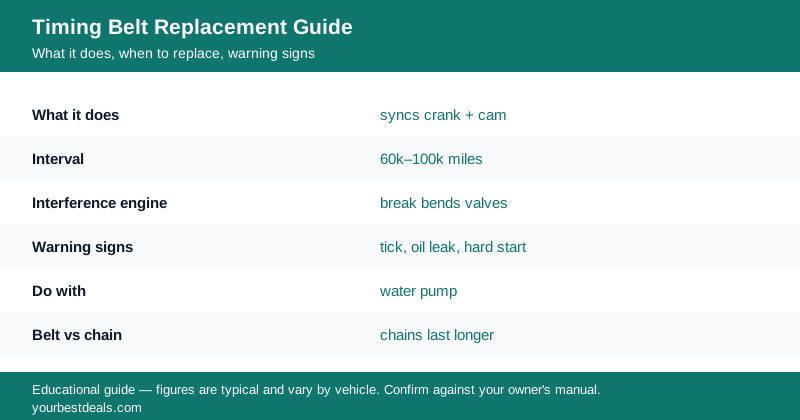
A timing belt keeps the engine’s top end (valves) and bottom end (pistons) in sync. It’s replaced on the maker’s schedule – commonly every 60,000 to 105,000 miles, or by age, roughly 7 to 10 years, whichever comes first – because a belt that snaps while driving stops the engine instantly, and on an interference engine the pistons then hit the open valves and bend them, turning a routine job into major engine damage. When the belt is replaced, the water pump, tensioner, and idler pulleys are normally done at the same time, because the labor to reach them is already paid for. One important check first: many modern engines use a timing chain, not a belt, and chains aren’t on a fixed replacement interval – so step one is knowing which your engine has.
The timing belt is the one maintenance item I never let people gamble on. A belt is a planned, known cost. A snapped belt on an interference engine is a bent-valve repair that can cost several times as much – I’ve seen that bill land on people who were “almost” going to get the belt done.
Belt vs chain: know which you have
The first thing to establish is whether your engine uses a timing belt or a timing chain. A rubber timing belt wears and must be replaced on a schedule. A metal timing chain is designed to last much longer – often the life of the engine – and is not on a fixed interval, though chains and their tensioners/guides can wear and need attention on some engines at high mileage. Check your owner’s manual or look up your specific engine: if it’s a chain, there’s no scheduled belt replacement to worry about; if it’s a belt, the interval matters a great deal. Don’t assume – engines of the same model year can differ by trim and engine option.
Interference vs non-interference: why the stakes differ
On an interference engine, the valves and pistons share the same space at different moments, kept apart only by correct timing. If the belt breaks, that timing is lost instantly and the pistons strike the open valves – bending valves and sometimes damaging pistons or the head, which is an expensive repair. On a non-interference engine, there’s enough clearance that a broken belt simply stops the engine without the valves and pistons colliding, so a snapped belt leaves you stranded but usually without internal damage. Most modern engines are interference designs, which is exactly why the replacement interval is treated as a hard deadline rather than a suggestion.
What gets replaced with the belt
A proper timing belt job is more than the belt. Because reaching the belt requires removing covers and components, the parts driven by or near it are replaced at the same time while everything’s apart: the water pump (on many engines it’s driven by the timing belt, and its labor is already covered), the tensioner that keeps the belt tight, and the idler pulleys the belt rides over. The belt’s drive seals (crankshaft/camshaft seals) are often inspected or replaced too if they’re weeping. Doing these together is the smart call – replacing just the belt and leaving an old water pump or worn tensioner risks a failure that forces the whole job to be redone. For the full cost picture, see our timing belt replacement cost guide.
Shop Talk
Always have the water pump, tensioner, and idlers done with the timing belt, even if they seem fine. Here’s the logic: the expensive part of a timing belt job is the labor to tear down to the belt, not the belt itself. The water pump, tensioner, and idler pulleys all live right there, and they wear on a similar timeline to the belt. If you replace only the belt to save a little on parts and the water pump fails six months later, you pay that entire teardown labor a second time – which wipes out any savings and then some. Replacing them together, as a kit, is how it’s properly done and why reputable shops quote it that way. The other thing people get wrong is going by mileage only and ignoring age: a belt in a low-mileage car that’s 10 years old has still aged and can crack even without the miles, so whichever comes first (the mileage or the years) is your trigger. And if you buy a used car and can’t confirm the belt was done, the safe assumption on an interference engine is to do it – the cost of assuming it’s fine and being wrong is a bent-valve repair. Treat the belt as a hard deadline, not a maybe.
What Gets Misdiagnosed
The biggest mistake isn’t a misdiagnosis so much as a miscalculation: treating the timing belt interval as optional or stretchable. People push past the interval to save money, not realizing that on an interference engine a snapped belt turns a planned cost into a major engine repair. The belt is one of the few maintenance items where skipping it risks catastrophic, expensive damage rather than gradual wear.
The other is confusing a belt with a chain (or vice versa) and either worrying about a non-existent belt interval on a chain engine or, worse, ignoring a real belt interval because someone assumed it was a chain. Confirm which your specific engine uses before deciding there’s nothing to do.
The Real Number
Confirm whether your engine has a belt or a chain. If it’s a belt, replace it on the maker’s schedule – commonly 60,000–105,000 miles or 7–10 years, whichever comes first – and do the water pump, tensioner, and idlers at the same time while it’s apart. On an interference engine (most modern ones), a snapped belt bends valves and turns a planned cost into a major repair, so treat the interval as a hard deadline. For the full cost, see our timing belt replacement cost guide.
Frequently Asked Questions
How often should a timing belt be replaced?
Most manufacturers specify timing belt replacement somewhere between 60,000 and 105,000 miles, or by age at roughly 7 to 10 years, whichever comes first – but the exact figure varies by engine, so your owner’s manual or a lookup of your specific engine is the authority. The mileage-or-age “whichever comes first” rule matters because the belt is rubber: it wears with miles but also degrades with age and heat cycles even if the car isn’t driven much, so a low-mileage car that’s 10 years old can still have a belt due for replacement. Some engines fall at the lower end of that range, others at the higher end, and manufacturers occasionally revise intervals, which is why you shouldn’t rely on a generic number. The key point is that the interval is a maximum, not a target to exceed – the risk of waiting past it (especially on an interference engine) is a snapped belt and possible engine damage. So find your engine’s specific interval, track both the mileage and the age, and schedule the replacement at whichever limit you reach first. If you’ve bought a used car and can’t verify when the belt was last done, the prudent move on an interference engine is to treat it as due. For the cost, see our timing belt replacement cost guide. Don’t stretch the interval to save money.
What happens if a timing belt breaks while driving?
If a timing belt breaks while driving, the engine stops running instantly because the camshaft(s) and crankshaft are no longer synchronized – and on an interference engine, the consequences are much worse: the pistons strike the now-mistimed open valves, bending valves and sometimes damaging pistons, the cylinder head, or more. On a non-interference engine, a broken belt simply stalls the engine with no internal collision, leaving you stranded but typically without major damage, so you’d need a tow and a new belt but not an engine rebuild. The problem is that most modern engines are interference designs, so for most drivers a snapped belt means potential bent valves and a repair costing several times what the belt replacement would have. The engine loses power immediately when the belt goes, so you’d coast to a stop. There’s rarely warning before a belt fails – belts don’t usually give a gradual symptom the way some parts do, which is exactly why they’re replaced on a preventive schedule rather than run to failure. So the answer to “what happens” depends entirely on interference vs non-interference, but because you can’t control which you have and most are interference, the safe course is to never find out – replace the belt on schedule. For the repair implications, see our timing belt replacement cost guide. A broken belt is the scenario the whole interval exists to prevent.
How do I know if my engine has a timing belt or a timing chain?
The most reliable way to know whether your engine has a timing belt or a timing chain is to check your owner’s manual or look up your specific engine (by year, make, model, and engine size) in a repair database or by asking a dealer or shop – because engines in the same model can differ by engine option. A timing belt is made of reinforced rubber and is replaced on a schedule; a timing chain is metal (like a bicycle chain) and is designed to last much longer, usually without a fixed replacement interval. Some practical clues: if your maintenance schedule lists a timing belt replacement at a specific mileage, you have a belt; if there’s no such item, you likely have a chain. Belt engines often have a plastic timing cover on the front/side of the engine, while chain engines have a metal cover, though this isn’t always easy to tell without knowing what you’re looking at. The reason this matters so much is that the consequences of getting it wrong cut both ways: ignoring a real belt interval because you assumed a chain risks a snapped belt and engine damage, while worrying about a belt interval on a chain engine wastes money on a service you don’t need. So don’t guess – confirm for your exact engine. If you have a chain, there’s generally no scheduled replacement (though chains can wear at high mileage on some engines). If you have a belt, note the interval and plan for it. Your manual is the quickest authoritative source.
Should the water pump be replaced with the timing belt?
On most engines where the water pump is driven by or located behind the timing belt, yes – the water pump should be replaced at the same time as the timing belt, because the expensive labor to access that area is already being done, and replacing an aging water pump then avoids paying that teardown labor a second time if the pump fails later. The water pump and the timing belt tend to wear on similar timelines, so a water pump that’s survived to the belt’s replacement interval is often partway through its own life; leaving it in place to save on the part is a gamble that, if it fails, forces the entire timing belt job to be repeated to reach the pump. That’s why reputable shops quote the timing belt service as a job that includes the water pump, tensioner, and idler pulleys together – it’s the cost-effective, properly-done approach. On the smaller number of engines where the water pump is driven separately (not by the timing belt) and easily accessible on its own, replacing it with the belt is less critical, but where it’s behind the timing cover, doing it together is strongly advised. So when you get a timing belt quote, expect and want it to include the water pump; a quote for the belt alone may look cheaper but can cost far more if the pump fails soon after. For the full job cost including these parts, see our timing belt replacement cost guide. Doing them together is the smart money.
What’s the difference between an interference and non-interference engine?
The difference is whether the valves and pistons can physically collide if the timing is lost: in an interference engine, the valves open into space that the pistons also travel through (at different moments, kept apart only by correct timing), so if the timing belt breaks, the pistons strike the open valves and cause damage; in a non-interference engine, there’s enough clearance that the pistons never reach the valves even if timing is lost, so a broken belt just stops the engine without internal collision. This single design difference is what determines how costly a broken timing belt is. On an interference engine, a snapped belt typically means bent valves and a repair costing several times the belt replacement – potentially a cylinder head rebuild. On a non-interference engine, a snapped belt means a stall and a tow, then a new belt, with the engine’s internals usually unharmed. Most modern engines are interference designs, chosen by manufacturers for efficiency and performance reasons, which is why timing belt intervals are treated so seriously today. To find out which you have, look up your specific engine – it’s a known characteristic of each engine design. The practical upshot is the same either way: replace the belt on schedule. But knowing you have an interference engine underlines why the interval is a hard deadline, not a loose guideline. When in doubt, assume interference and don’t stretch the interval. For cost context, see our timing belt replacement cost guide.
Are there warning signs a timing belt is about to fail?
Timing belts usually give little or no warning before they fail, which is the central reason they’re replaced on a preventive schedule rather than run until symptoms appear – unlike many parts that squeal, leak, or vibrate as they wear, a timing belt often snaps without a clear advance signal. That said, there are occasional clues in some cases: a high-pitched whirring or ticking from the timing cover area, a rough idle or difficulty starting (if the belt has slipped a tooth and the timing is slightly off), or visible cracking, glazing, or missing teeth if the belt can be inspected. An oil or coolant leak near the timing cover can also shorten a belt’s life by degrading the rubber. But relying on symptoms is dangerous because most belts simply break at the end of their life with no prior sign, and on an interference engine that first “symptom” is the engine damage itself. So the honest answer is: don’t count on warning signs. The belt’s whole maintenance philosophy is preventive replacement precisely because failure is often sudden and consequences can be severe. If you do notice whirring, rough running, or hard starting and your belt is anywhere near its interval, get it inspected promptly – but the real protection is replacing it on schedule before any of that happens. For the service cost, see our timing belt replacement cost guide. Preventive replacement beats waiting for a sign that may never come in time.
Can I replace a timing belt myself?
Replacing a timing belt is an advanced DIY job that’s within reach of an experienced home mechanic on some engines but really risky for a beginner, because getting the timing even one tooth off can cause poor running or, on an interference engine, serious damage – so honest self-assessment matters here more than on most jobs. The work involves removing covers and accessory components to reach the belt, precisely aligning the timing marks on the crankshaft and camshaft(s), replacing the belt along with the water pump, tensioner, and idlers, and getting everything back together with the timing exactly right. On some engines it’s well-documented and doable with the right tools (including the correct engine-specific timing tools in many cases) and patience; on others, tight packaging, hard-to-reach components, or the need for special tools make it impractical at home. The consequence of an error is what raises the stakes: on an interference engine, incorrect timing can bend valves just as a snapped belt would, so a mistake is expensive. If you have solid mechanical experience, the engine-specific service information, and the proper timing tools, it can be a satisfying DIY. If you’re newer to this or unsure, this is a job where the cost of a professional doing it correctly is cheap insurance against a timing error that damages the engine. Either way, use the engine-specific procedure, not a generic one. For professional cost, see our timing belt replacement cost guide.
Sources
Timing belt interval and procedure information verified against standard manufacturer-schedule guidance in November 2026. Always use your vehicle’s specific interval and engine-specific procedure.
- ASE – National Institute for Automotive Service Excellence
- Cars.com – maintenance and repair resources
- EPA – vehicle and engine information
Related Guides
- Timing Belt Replacement Cost
- Water Pump Replacement Cost
- What Is an Engine Misfire
- How to Change Your Oil
- Engine Guides

Eddie Brennan is an ASE Master Certified technician (A1 Engine Repair among his certs) who spent 11 years in an independent shop in Columbus, OH, before a back injury moved him into writing. The timing belt is the one maintenance item he never let customers gamble on – a planned cost beats a bent-valve repair every time. He drives a 2015 Subaru Outback with over 250,000 miles and a 2020 Ford F-150, and takes no referral fees or advertising money from any shop or chain.