
Last updated: November 10, 2026 – By Diane Holcomb
November 2026 update: reconfirmed the full-job cost, the debris/flush requirement, and the confirm-first caution.
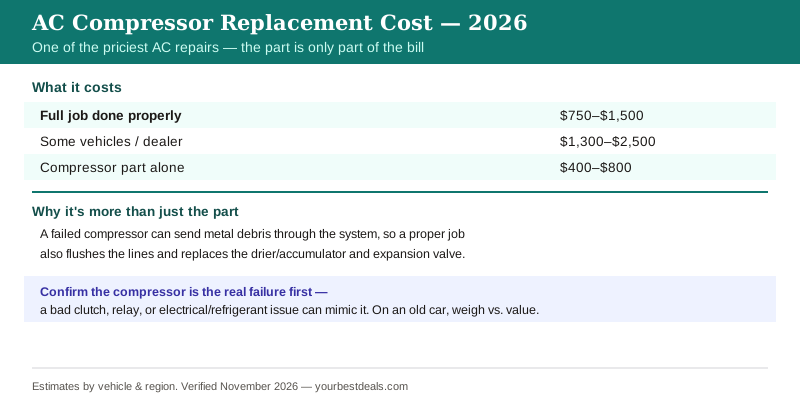
Replacing a car’s AC compressor properly typically costs about $750 to $1,500, and can reach $1,300 to $2,500 on some vehicles or at a dealer – making it one of the most expensive AC repairs. The compressor part itself runs about $400 to $800, and the rest is labor plus the essential extra steps: evacuating and recharging the system, and often flushing the AC system and replacing related parts. That flush-and-replace work is why the job costs far more than the part alone. Because it’s so expensive, two things matter: confirm the compressor is actually the failure before authorizing it, and on an older car, weigh the repair cost against the vehicle’s value.
The compressor is the big-ticket AC repair, and it’s where a wrong diagnosis or a corner-cut job gets expensive. Understanding why it costs what it does – and why the “extra” parts aren’t upsells – helps you judge the quote. Let me cover the cost, the debris issue, and how to confirm it before you spend four figures.
What you’ll actually pay
Here’s the price picture. These are estimated ranges that vary by vehicle and shop.
| Item | Cost | Notes |
|---|---|---|
| Full job done properly | $750–$1,500 | Compressor + flush + related parts + recharge |
| Some vehicles / dealer | $1,300–$2,500 | Complex or luxury cars |
| Compressor part alone | $400–$800 | Part only, not the job |
| Related parts (drier, valve) | included | Part of a proper job |
Here’s why a compressor job isn’t just “part plus install”: when a compressor fails internally, it can shed metal debris that circulates through the AC system. If a shop just bolts in a new compressor without cleaning that out, the debris can destroy the new compressor quickly. So a proper job includes flushing the AC lines and replacing the accumulator or receiver-drier and the expansion valve or orifice tube, plus evacuating and recharging the system. Those aren’t upsells – they protect your expensive new compressor. Our bad compressor signs guide covers the symptoms.
Shop Talk
Two things protect you on this expensive repair. First, make sure the compressor is really the failure before you authorize it, because cheaper problems mimic a dead AC: a bad compressor clutch (sometimes replaceable without the whole compressor), a failed relay or fuse, a wiring or pressure-switch fault, or simply a system so low on refrigerant that the compressor won’t engage (the system won’t let it run with no refrigerant, as a protection). A good shop confirms the compressor itself is bad – seized, noisy, or not pumping – not just that the AC is warm. Ask what test showed the compressor is the failure. Second, if it truly needs a compressor, don’t let a shop skip the flush and the drier/expansion valve. It’s tempting to save money with a “just the compressor” quote, but if the old one grenaded and sent metal through the system, a bare swap can kill the new compressor in short order, and now you’re paying twice. The full job costs more up front but is the one that lasts. And the honest conversation on an older car: a $1,000-to-$1,500 AC repair on a car worth $3,000 is a real decision – sometimes living without AC, or a cheaper partial fix, makes more sense than sinking compressor money into an old vehicle. Weigh the repair against what the car’s worth.
Where Drivers Overpay
The biggest overpay is replacing a compressor that wasn’t the actual problem. Because a dead AC can come from a bad clutch, relay, wiring, pressure switch, or just a low/leaking system that won’t let the compressor engage, jumping to a $750-to-$1,500 compressor without confirming it is a costly mistake. Insist the shop demonstrate the compressor itself has failed (seized, not pumping, or noisy) before authorizing it. Some failures, like a bad clutch, can sometimes be fixed for far less.
The opposite mistake is cheaping out on a real compressor job by skipping the flush and related parts. A bare compressor swap that ignores the metal debris from the old failure can destroy the new compressor quickly, meaning you pay for the job twice. So the full job – flush, drier, expansion valve, recharge – is the economical choice when a compressor truly failed, even though it costs more up front. And on an old, low-value car, the smartest money move is sometimes not doing the repair at all. Confirm the diagnosis, do the full job if it’s needed, and weigh it against the car’s worth.
The Real Number
A proper AC compressor job is $750 to $1,500 (up to $2,500 on some cars) – the part is only $400 to $800; the rest is labor, a system flush, related parts (drier, expansion valve), and a recharge. Those extras protect the new compressor from debris the old one shed, so don’t cut them. Confirm the compressor is truly the failure first – a clutch, relay, or low-refrigerant issue can mimic it – and on an old car, weigh a four-figure repair against the vehicle’s value.
Frequently Asked Questions
How much does it cost to replace a car AC compressor?
A proper full job typically costs $750 to $1,500, and up to $1,300 to $2,500 on some vehicles or at a dealer, making it one of the priciest AC repairs. The compressor part alone is $400 to $800, but the job also includes labor, evacuating and recharging the system, flushing the AC lines, and often replacing the drier and expansion valve. Those extra steps protect the new compressor and are why the job costs well more than the part. These are estimates that vary by vehicle. Confirm the compressor is actually the failure before authorizing this.
Why does a compressor job cost so much more than the part?
Because a compressor replacement done right involves more than bolting in the part. When a compressor fails internally, it can send metal debris throughout the AC system, so a proper job flushes the lines and replaces the accumulator or receiver-drier and the expansion valve or orifice tube to remove that debris and protect the new compressor, plus evacuating and recharging the system. Those steps add parts and labor beyond the compressor itself. Skipping them to save money risks the debris destroying the new compressor, so they’re protection, not upsells.
Do I really need to flush the system and replace the drier?
For a properly failed compressor, yes. When the old compressor breaks down internally, it can contaminate the system with metal particles and debris. If a shop installs a new compressor without flushing that out and replacing the drier (which traps moisture and debris) and the expansion valve, the contamination can circulate and quickly destroy the new compressor – meaning you pay for the job twice. So while a “just the compressor” quote looks cheaper, the full job is the economical choice that actually lasts. These related parts protect your expensive new compressor.
How do I know if my AC compressor is actually bad?
A truly bad compressor is typically seized (won’t turn), noisy (grinding or squealing when the AC engages), or not pumping (the AC is warm and the compressor isn’t building pressure). But a warm AC alone doesn’t confirm the compressor – a bad clutch, failed relay or fuse, wiring or pressure-switch fault, or a system so low on refrigerant that it won’t let the compressor engage can all mimic it. A good shop tests to confirm the compressor itself has failed before recommending replacement. Ask what test showed the compressor is the cause before authorizing this expensive repair.
Can just the AC compressor clutch be replaced instead of the whole compressor?
Sometimes, yes, and it can save a lot. On some vehicles, if the failure is specifically the compressor’s clutch (the part that engages the pulley) rather than the compressor pump itself, the clutch can be replaced separately for far less than a full compressor. This isn’t possible or advisable on every car or every failure, but it’s worth asking about if the diagnosis points to the clutch. It’s one reason confirming the exact failure matters – you might avoid a full compressor replacement if only the clutch is bad.
Is it worth replacing the AC compressor on an old car?
It’s a real judgment call. A $750-to-$1,500 (or higher) AC compressor repair on a car worth only a few thousand dollars is a significant fraction of the vehicle’s value, so it’s worth weighing. Consider how long you plan to keep the car, how much you value AC, and the car’s overall condition. Sometimes living without AC, or a cheaper partial repair, makes more sense than putting compressor money into an old vehicle. There’s no universal answer, but on a low-value car this repair deserves a cost-versus-worth conversation rather than an automatic yes.
Can I drive with a bad AC compressor?
Usually yes, though it depends on the failure. If the compressor simply isn’t cooling, the car drives fine without AC. But if the compressor has seized, it can affect the serpentine belt that also drives other accessories (like the alternator and water pump), which is a problem – a seized compressor pulley can stop the belt or cause it to throw. In that case it needs attention promptly, sometimes with a bypass pulley as a stopgap. So a compressor that’s just not cooling is drivable, but a seized one that affects the belt is more urgent. Have it checked to know which you have.
Sources
Price ranges verified against 2026 AC-repair pricing in November 2026. Dollar amounts are estimates that vary by vehicle and shop.
- RepairPal – AC compressor replacement cost
- AutoZone – AC compressor replacement cost
- ConsumerAffairs – cost of car AC repair
Related Guides
- 6 Signs of a Bad AC Compressor
- Car AC Recharge Cost
- Car AC Repair Cost by Problem
- Air Conditioning Guide
- Car Repair Cost Estimator

Diane Holcomb spent seven years as a service advisor at multi-brand dealerships in Charlotte, NC, where a compressor quote meant confirming the failure and having the honest cost-versus-value talk on older cars. She drives a 2019 Honda CR-V and a hand-me-down 2007 Toyota Camry, and takes no referral fees or advertising money from any shop or chain.