
Last updated: November 10, 2026 – By Diane Holcomb
November 2026 update: reconfirmed clutch kit and labor pricing and the full-kit point.
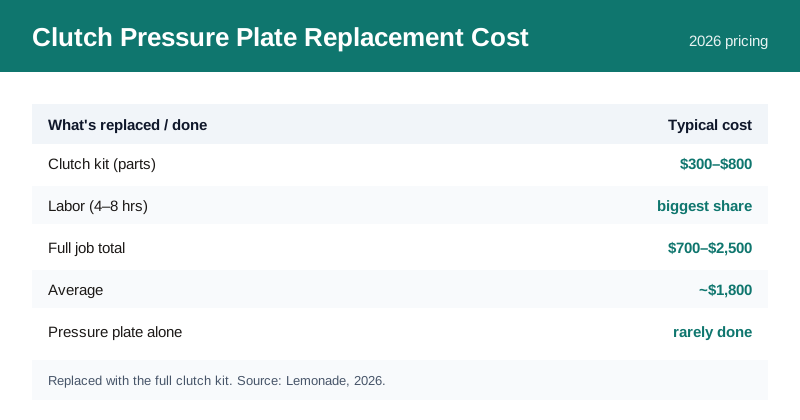
Replacing a clutch pressure plate, like the disc, means doing a full clutch job – about $700 to $2,500 total, averaging near $1,800. The pressure plate comes in the clutch kit (disc, pressure plate, and release bearing) at $300 to $800 for parts, and labor is the biggest share because the transmission must come out. The pressure plate is rarely replaced on its own – it’s part of the kit. It’s the spring-loaded unit bolted to the flywheel that clamps the clutch disc against the flywheel to transfer engine power, and releases that clamp when you press the clutch pedal. When the pressure plate wears or its diaphragm spring weakens, it can’t clamp firmly – so you get a slipping clutch, a chattering or shuddering takeoff, a stiff or inconsistent pedal, and trouble engaging smoothly. Because reaching it requires pulling the transmission, it’s always done together with the disc and bearing.
The pressure plate is the “clamp” half of the clutch, and it goes in with the whole kit. Let me break down the cost and the symptoms.
What you’ll actually pay
Here’s the picture. These are estimates that vary by vehicle and shop.
| Item | Cost | Notes |
|---|---|---|
| Clutch kit (parts) | $300–$800 | Disc + plate + bearing |
| Full job total | $700–$2,500 | Labor-heavy |
| Average | ~$1,800 | Typical |
| Pressure plate alone | rarely done | Kit is standard |
The pressure plate works with the rest of the clutch; our clutch replacement guide, clutch disc guide, and release bearing guide cover the related parts.
Shop Talk
The pressure plate is the clamping half of the clutch – a big spring-loaded plate bolted to the flywheel that squeezes the clutch disc against the flywheel to send power, and lets go when you push the pedal. Like the disc, it’s buried behind the transmission, so the cost is the same labor-heavy clutch job, and the pressure plate always goes in as part of the kit, never alone. If a shop ever offered to replace just the pressure plate and reuse the old disc and bearing, that’d be a mistake – same big labor, and the reused parts would be the next to fail. A worn pressure plate shows up a bit differently from a worn disc: a weak pressure plate causes slipping (can’t clamp hard enough) but also often a chatter or shudder when you let the clutch out from a stop (the plate grips unevenly), and sometimes a clutch pedal that feels stiff, notchy, or inconsistent. A disc that’s just worn tends to slip more smoothly. Either way, the fix is the same full clutch replacement, so the exact which-part diagnosis matters less than recognizing the clutch is going. One more: if you’re doing a clutch because of a pressure plate problem, make sure the shop inspects the flywheel – a chattering pressure plate sometimes comes with flywheel damage, and that should be addressed while everything’s apart.
Where Drivers Overpay
As with the disc, the overpay would be paying the transmission-out labor to replace only the pressure plate and reuse an old disc and release bearing. The parts cost difference is small; the labor is the whole bill. Doing the complete kit once is the save, and it’s why the pressure plate is never sold as a standalone clutch repair.
The related check is the flywheel: a chattering pressure plate can come with flywheel damage, so inspecting and addressing it while the transmission’s out avoids a repeat teardown. The pattern: replace the full kit, inspect the flywheel, and do it all in one job.
The Real Number
A clutch pressure plate job is a full clutch replacement: $700 to $2,500 (average ~$1,800), kit $300 to $800, labor the bulk. The pressure plate is never replaced alone – it goes in with the disc and release bearing. A chattering or shuddering takeoff and a slipping or stiff clutch are the signs. Inspect the flywheel while the transmission’s out, and replace the whole kit once rather than paying that labor twice.
Frequently Asked Questions
How much does it cost to replace a clutch pressure plate?
It’s the cost of a full clutch job – about $700 to $2,500 total, averaging near $1,800 – because the pressure plate is replaced as part of the clutch kit, not on its own. The kit (disc, pressure plate, release bearing) is $300 to $800 for parts, and labor is the biggest share since the transmission has to be removed to reach the clutch. A worn flywheel that needs attention adds cost. These are estimates that vary widely by vehicle and shop. The pressure plate is rarely, if ever, replaced alone, because the labor to pull the transmission far exceeds the parts-price difference between one component and the whole kit. So budgeting for a pressure plate means budgeting for a complete clutch replacement.
What does the clutch pressure plate do?
The pressure plate is the clamping component of the clutch. It’s a spring-loaded (diaphragm-spring) assembly bolted to the engine’s flywheel, with the clutch disc sandwiched between it and the flywheel. When your foot is off the clutch pedal, the pressure plate’s spring clamps the disc tightly against the flywheel, locking the engine to the transmission so power flows to the wheels. When you press the clutch pedal, the release bearing pushes on the pressure plate’s spring fingers, releasing the clamp and disengaging the disc so you can shift or stop. So the pressure plate provides the clamping force that makes the clutch “grab.” If its spring weakens or its surface wears, it can’t clamp properly, and the clutch slips or engages poorly.
What are the symptoms of a bad pressure plate?
A worn or weak pressure plate commonly causes a slipping clutch (it can’t clamp the disc hard enough, so engine RPMs rise without matching acceleration), and often a chatter or shudder when releasing the clutch from a stop (the plate grips unevenly or grabs). You may also notice a clutch pedal that feels stiff, notchy, or inconsistent, difficulty engaging smoothly, or trouble getting the car moving cleanly. These overlap with a worn disc, which is fine – because both are fixed by the same full clutch replacement, pinpointing the exact worn component is less critical than recognizing the clutch is failing. A shop confirms clutch wear and does the whole kit. The chatter/shudder on takeoff is a bit more characteristic of a pressure plate (or flywheel) issue than a simply worn disc.
Is the pressure plate ever replaced by itself?
In practice, no – it’s replaced as part of the clutch kit along with the disc and release bearing. The reason is purely economic: reaching the pressure plate requires removing the transmission (the expensive, labor-intensive part of the job), and once that’s done, the disc and release bearing are right there and the same age. Replacing only the pressure plate and reusing an old disc and bearing would save very little on parts while risking that one of the reused parts fails soon, forcing the whole big labor job again. So standard practice is to replace the complete kit in one go. If someone proposes replacing just the pressure plate on a car that’s apart anyway, it’s worth questioning – the small parts savings isn’t worth the risk of a repeat teardown. The kit approach is the sensible value.
What causes a clutch to chatter or shudder?
Clutch chatter – a shaking or shuddering when you release the clutch from a stop – can come from several clutch-related sources. A worn or warped pressure plate that grips unevenly is one. A contaminated clutch disc (oil on the friction surface, often from a leaking rear main or input shaft seal) is another common cause. A worn or scored flywheel, or a warped/damaged flywheel surface, also causes chatter. Worn engine or transmission mounts can contribute too. Because several of these are addressed during a clutch replacement, chatter often prompts the full job – and importantly, if oil contamination from a seal caused it, that seal should be fixed at the same time (it’s accessible with the transmission out) or the new clutch will be contaminated too. So chatter is a sign to inspect the whole clutch, flywheel, and nearby seals, not just one part.
Should the flywheel be checked when replacing the pressure plate?
Yes – it’s important, especially if the symptom was chatter or shudder. The pressure plate clamps the disc against the flywheel, so the flywheel’s surface condition matters: if it’s scored, warped, glazed, or heat-damaged, a new pressure plate and disc won’t grip properly and the problem (slipping or chatter) can persist. Since the transmission is already out for the clutch job, inspecting the flywheel is easy, and resurfacing or replacing it if needed is cost-effective at that point. Discovering a bad flywheel after reassembly means another expensive teardown. Some cars use a dual-mass flywheel that may need replacing rather than machining. So a proper clutch job – whether driven by the pressure plate, disc, or bearing – includes checking the flywheel and addressing it while everything’s accessible. Ask the shop to confirm the flywheel’s condition.
How long does a clutch pressure plate last?
The pressure plate generally lasts as long as the clutch disc, since they wear and age together and are replaced together – so there’s no separate interval, and it depends on driving style and conditions. A clutch (disc and pressure plate) can last from roughly 50,000 miles to well over 100,000, with gentle driving and highway use at the high end and lots of stop-and-go, clutch-riding, towing, or aggressive use at the low end. The pressure plate’s diaphragm spring can weaken over time and heat cycles, reducing its clamping force, which contributes to the clutch eventually slipping. Because it’s part of the clutch assembly, you don’t track it separately – when the clutch is worn enough to replace, the pressure plate goes in with the kit. So the same driving habits that extend disc life extend pressure plate life.
Sources
Price ranges verified against 2026 clutch pricing in November 2026. Dollar amounts are estimates that vary by vehicle and shop.
- Lemonade – clutch replacement cost
- RepairPal – repair cost estimator
- ASE – National Institute for Automotive Service Excellence
Related Guides
- Clutch Replacement Cost
- Clutch Disc Replacement Cost
- Clutch Release Bearing Replacement Cost
- Rear Main Seal Replacement Cost
- Car Repair Cost Estimator

Diane Holcomb spent seven years as a service advisor at multi-brand dealerships in Charlotte, NC, where a chattering clutch takeoff meant checking the pressure plate, flywheel, and nearby seals – all addressed in the one job while the transmission was out. She drives a 2019 Honda CR-V and a hand-me-down 2007 Toyota Camry, and takes no referral fees or advertising money from any shop or chain.