
Last updated: November 1, 2026 – By Diane Holcomb
November 2026 update: reconfirmed bearing part price and the do-it-with-the-clutch point.
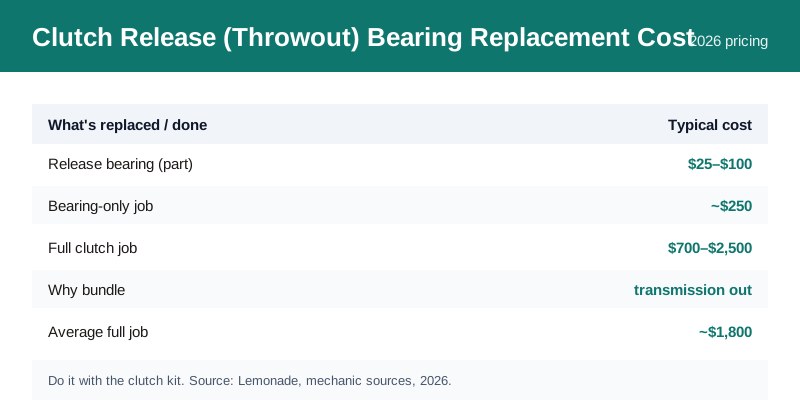
The clutch release bearing (also called the throwout bearing) is a cheap part – just $25 to $100 – but the catch is where it lives. Because the transmission has to come out to reach it, a bearing-only job runs about $250 at an independent shop if that’s truly all you do, and in practice it’s almost always replaced with the full clutch, which totals $700 to $2,500 (average near $1,800). The release bearing is the part that, when you press the clutch pedal, pushes on the pressure plate’s spring fingers to release the clamp and disengage the clutch so you can shift. When it wears out, you get a whirring, rumbling, or growling noise – the classic tell is that the noise changes (appears or disappears) when you press the clutch pedal. Since reaching it means pulling the transmission, it’s replaced as part of the clutch kit rather than on its own.
It’s a $30 part behind a $1,500 wall of labor, so the smart move is to do it with the clutch. Let me explain.
What you’ll actually pay
Here’s the picture. These are estimates that vary by vehicle and shop.
| Item | Cost | Notes |
|---|---|---|
| Release bearing (part) | $25–$100 | Cheap part |
| Bearing-only job | ~$250 | If truly alone |
| Full clutch job | $700–$2,500 | Transmission out |
| Average full job | ~$1,800 | Recommended |
The bearing is part of the clutch kit; our clutch replacement guide, clutch disc guide, and pressure plate guide cover the rest.
Shop Talk
The release bearing is the perfect example of why clutch parts get bundled: it’s a $25 to $100 part, but it sits inside the bellhousing, so to replace it the transmission has to come out – which is 4 to 8 hours of labor. That means replacing just the bearing costs nearly as much in labor as a full clutch job, so it makes almost no sense to pull the transmission for a cheap bearing and leave an aging disc and pressure plate in there. If the bearing’s noisy enough to warrant the job, do the whole clutch kit while you’re in – the bearing comes in the kit anyway. The classic symptom of a bad release bearing is a whirring, rumbling, or growling noise, and the giveaway is that it changes when you work the clutch pedal: on many setups the noise is there with the pedal up and quiets when you press it (or the reverse), because pressing the pedal loads the bearing differently. Don’t ignore that noise – a release bearing that seizes or comes apart can damage the pressure plate and make the clutch impossible to disengage, leaving you unable to shift. So a growing clutch-related noise is a reason to get the clutch inspected and plan the job, doing the full kit, before the bearing fails hard.
Where Drivers Overpay
The overpay is pulling the transmission for just the $30 bearing and leaving the aging disc and pressure plate behind – because if either fails soon, you pay that 4-to-8-hour labor again. When the bearing noise warrants the job, doing the whole kit is the clear save.
The other cost is ignoring the noise until the bearing seizes, which can damage the pressure plate and leave you unable to disengage the clutch and shift – a tow and a worse repair. The pattern: when a release-bearing noise appears, plan a full clutch kit, don’t do the bearing alone, and act before it fails hard.
The Real Number
The release (throwout) bearing is a $25 to $100 part, but it’s behind the transmission – so a bearing-only job is ~$250 and it’s almost always done with the full clutch ($700 to $2,500). A whirring or rumbling noise that changes when you press the clutch pedal is the sign. Don’t pull the transmission for just the bearing; do the whole kit. And don’t ignore the noise – a seized bearing can leave you unable to shift.
Frequently Asked Questions
How much does it cost to replace a clutch release bearing?
The release bearing itself is cheap, about $25 to $100. But because the transmission must be removed to reach it, the labor dominates: a bearing-only job runs roughly $250 at an independent shop if that’s truly all that’s done, and in practice it’s almost always replaced as part of a full clutch job, which totals $700 to $2,500 (averaging near $1,800). These are estimates that vary by vehicle and shop. Since the bearing comes in the clutch kit and the transmission is already out, it makes little sense to replace just the bearing and reuse the aging disc and pressure plate. So budgeting for a release bearing usually means budgeting for a complete clutch replacement, with the bearing being a small part of the parts cost.
What does the clutch release bearing do?
The clutch release bearing, also called the throwout bearing, is what actually disengages the clutch when you press the pedal. When you push the clutch pedal, the linkage (hydraulic or cable) pushes the release bearing forward against the pressure plate’s spring fingers (the diaphragm). That releases the pressure plate’s clamp on the clutch disc, disconnecting the engine from the transmission so you can shift gears or come to a stop. When you let the pedal out, the bearing retracts and the clutch re-engages. Because the bearing presses on the spinning pressure plate every time you use the clutch, it’s a wear part. It’s a small bearing but essential – if it fails, operating the clutch becomes noisy, difficult, or impossible, which is why it’s replaced along with the disc and pressure plate.
What are the symptoms of a bad release bearing?
The hallmark is a whirring, rumbling, or growling noise, and the key diagnostic clue is that the noise changes when you operate the clutch pedal. On many vehicles, the noise is present with the pedal up and quiets (or disappears) when you press the clutch, or vice versa – because pressing the pedal engages and loads the bearing differently. You might also feel a vibration through the clutch pedal, notice the clutch becoming harder to disengage, or hear grinding. As it worsens, the noise gets louder and more constant. Because the noise’s relationship to the clutch pedal is distinctive, it helps distinguish a release bearing from other noises. If you hear a clutch-related noise that changes with the pedal, it’s worth having the clutch inspected, since a failing release bearing warrants doing the clutch job before it seizes.
Why is the bearing replaced with the whole clutch?
Because the cost is the labor to reach it, not the part. The release bearing sits inside the bellhousing behind the transmission, so replacing it requires removing the transmission – the same 4-to-8-hour job as a full clutch replacement. Once the transmission is out, the clutch disc and pressure plate are right there and aging at the same rate. Replacing just the cheap bearing and reusing an old disc and pressure plate would mean risking that one of those fails soon and forces the entire expensive teardown again. Since the bearing is included in the clutch kit anyway, and the labor is already being spent, replacing the complete kit (disc, pressure plate, bearing) in one job is the sensible, cost-effective approach. That’s why you rarely replace a release bearing by itself – it goes in with the clutch.
Is it safe to drive with a noisy release bearing?
For a short time with a mild noise, maybe, but it’s deteriorating and shouldn’t be ignored. A failing release bearing gets worse, and if it seizes or comes apart, a few bad things can happen: it can damage the pressure plate’s fingers, make the clutch difficult or impossible to disengage (so you can’t press the pedal to shift or stop smoothly), and leave you stranded or struggling to drive. Because the consequences include being unable to shift, a growing release-bearing noise is a reason to get the clutch inspected and plan the repair soon rather than wait. A faint early noise gives you some time to arrange the job; a loud, worsening noise or any trouble disengaging the clutch means act promptly. It’s better to do the clutch on your schedule than after the bearing fails hard.
Can the noise be something other than the release bearing?
Yes – clutch-area noises have a few possible sources, which is why a proper diagnosis helps. Besides the release bearing, a worn pilot bearing/bushing (which supports the transmission input shaft in the end of the crankshaft) can make noise, often most noticeable with the clutch pedal pressed. Transmission bearings, a worn input shaft bearing, or even unrelated accessory noises can also be suspects. The release bearing’s distinctive trait is that its noise changes clearly with clutch pedal operation. A technician can often narrow it down by how the noise behaves with the pedal in and out and in neutral versus in gear. The good news is that most of these (release bearing, pilot bearing) are addressed during a clutch replacement, so if the clutch is being done, they’re handled. Confirming the source avoids pulling the transmission for the wrong reason, though.
What is the pilot bearing and is it replaced too?
The pilot bearing (or pilot bushing) is a small bearing in the center of the flywheel (or end of the crankshaft) that supports the tip of the transmission’s input shaft, keeping it centered and letting it spin freely relative to the crankshaft. Like the release bearing, it’s a small, inexpensive part that’s buried behind the transmission – so it’s commonly replaced during a clutch job while everything’s apart, since doing it later would mean another teardown. A worn pilot bearing can cause noise (often with the clutch pedal pressed and the transmission in gear) or make shifting difficult. A thorough clutch replacement typically includes a new pilot bearing along with the disc, pressure plate, and release bearing. So when you do a clutch, it’s worth confirming the pilot bearing is being replaced too – it’s cheap and the access is already paid for in labor.
Sources
Price ranges verified against 2026 clutch pricing in November 2026. Dollar amounts are estimates that vary by vehicle and shop.
- Lemonade – clutch replacement cost
- Mechanic Base – throwout bearing symptoms and cost
- ASE – National Institute for Automotive Service Excellence
Related Guides
- Clutch Replacement Cost
- Clutch Disc Replacement Cost
- Clutch Pressure Plate Replacement Cost
- Clutch Slave Cylinder Replacement Cost
- Car Repair Cost Estimator

Diane Holcomb spent seven years as a service advisor at multi-brand dealerships in Charlotte, NC, where a clutch noise that changed with the pedal meant the release bearing – and where she’d steer the customer to a full kit rather than pulling the transmission for a $30 part. She drives a 2019 Honda CR-V and a hand-me-down 2007 Toyota Camry, and takes no referral fees or advertising money from any shop or chain.