
Last updated: November 8, 2026 – By Diane Holcomb
November 2026 update: reconfirmed per-side pricing and the axle-vs-joint point.
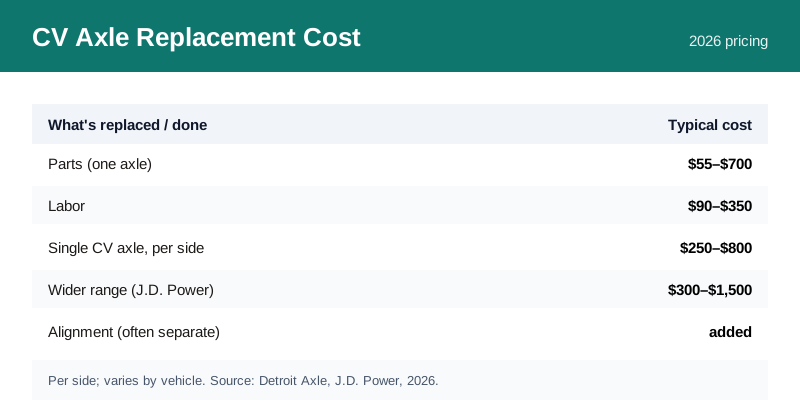
A CV axle replacement runs about $250 to $800 per side, parts and labor, with parts at roughly $55 to $700 and labor $90 to $350. J.D. Power gives a wider $300 to $1,500 range depending on the vehicle and labor hours. A wheel alignment is often a separate charge, since the suspension gets disturbed. A CV (constant velocity) axle is the shaft that sends power from the transaxle to a drive wheel while flexing for steering and suspension travel – most front-wheel-drive cars have one on each side. The classic symptom of a failing outer joint is a clicking or popping that gets louder in turns; a bad inner joint tends to clunk on acceleration. These days, replacing the complete axle shaft (a “remanufactured half-shaft”) is usually cheaper and more reliable than rebuilding a single joint.
The old fix was a new boot or a rebuilt joint; the modern fix is a whole axle, and it’s often the better buy. Let me break down the cost and the symptoms.
What you’ll actually pay
Here’s the per-side picture. These are estimates that vary by vehicle and shop.
| Item | Cost | Notes |
|---|---|---|
| Per side (parts + labor) | $250–$800 | Typical |
| Parts / labor | $55–$700 / $90–$350 | Reman axle |
| Wider range (J.D. Power) | $300–$1,500 | By vehicle |
| Alignment | often separate | Added |
A single worn joint is really a symptom of a worn axle; our CV joint guide covers the joint specifically, and the wheel bearing guide covers a noise that’s sometimes confused with it.
Shop Talk
Listen to how the noise behaves – it tells you which end is bad. A rhythmic clicking or popping that speeds up with the car and gets louder when you turn (especially a tight turn in a parking lot) is almost always a worn outer CV joint. A clunk when you get on and off the throttle points more to the inner joint. Either way, the modern repair is usually a complete remanufactured axle (half-shaft), not a single rebuilt joint – the whole axle often costs about the same as the labor to rebuild one joint, comes with fresh boots and grease on both ends, and takes less shop time. The real money-saver here is catching it early: the thing that kills a CV joint is a torn boot. The boot is a cheap rubber cover that holds grease in and dirt out; once it splits, grease flings out, grit gets in, and the joint is destroyed within weeks to months. If you spot a torn boot and dark grease sprayed around the inside of the wheel at an oil change, a reboot done right then is far cheaper than the full axle you’ll need if you wait. Also: don’t keep driving on a clicking axle – if it fails completely, the wheel loses drive and you’re stranded.
Where Drivers Overpay
The classic overpay is waiting past a torn boot. A split boot caught early can sometimes be rebooted cheaply; ignored, it lets the joint grind itself out and forces the full $250–$800 axle. The boot is the warning, and acting on it is the save.
The second is replacing both sides when only one clicks. CV axles don’t have to be done in pairs – if one side is noisy and the other’s boots are intact, doing just the bad side is fine. Some shops suggest both “while we’re in there”; that’s your call, not a requirement. The pattern: inspect boots at every oil change, reboot a fresh tear early, replace the complete axle (not a single joint) when it’s noisy, and only do the side that needs it.
The Real Number
A CV axle is $250 to $800 per side (J.D. Power’s wider range is $300 to $1,500), plus a possible alignment. Clicking in turns means a worn outer joint; a complete remanufactured axle is usually cheaper and better than rebuilding one joint. The real save is catching a torn boot early – reboot it before grit destroys the joint – and only doing the side that’s actually bad.
Frequently Asked Questions
How much does it cost to replace a CV axle?
About $250 to $800 per side, including parts and labor. Parts (a complete remanufactured half-shaft) run roughly $55 to $700, and labor $90 to $350, depending on the vehicle. J.D. Power gives a wider range of about $300 to $1,500 per axle for some vehicles with more labor hours. A wheel alignment is often a separate charge because replacing the axle disturbs the suspension. These are estimates that vary by vehicle and shop. CV axles are replaced per side, not necessarily in pairs, so if only one is bad you can do just that side. Because the complete axle often costs about the same as rebuilding a single joint, most shops replace the whole shaft.
What is a CV axle and what does it do?
A CV (constant velocity) axle, also called a half-shaft, is the shaft that transmits power from the transaxle or differential to a drive wheel. Its constant-velocity joints – one on each end – let the shaft deliver power smoothly while the wheel steers and the suspension moves up and down. Most front-wheel-drive cars have a CV axle on each front wheel; many all-wheel-drive vehicles have them front and rear. Each joint is packed with grease and sealed by a rubber boot. Because the axle has to flex constantly while spinning under power, the joints and their boots are wear items. When a joint wears out, you get the telltale clicking or clunking, and the axle needs replacement.
What are the symptoms of a bad CV axle?
The classic sign is a rhythmic clicking or popping that gets louder when you turn – especially a sharp, slow turn like in a parking lot – which indicates a worn outer CV joint. A clunk when you accelerate or shift between drive and reverse points more to a worn inner joint. You might also feel a vibration at speed. Often the first visible clue is a torn or leaking CV boot with dark grease flung around the inside of the wheel and nearby parts. Because a torn boot leads directly to joint failure, that’s the moment to act. If you hear clicking in turns, have it checked promptly, since a completely failed axle can leave the car unable to drive.
Should I replace the whole axle or just the CV joint?
These days, replacing the complete axle (a remanufactured half-shaft) is usually the better choice over rebuilding a single joint. The whole axle often costs about the same as the labor to rebuild one joint, it comes with fresh joints, grease, and boots on both ends, and it takes less shop time. Rebuilding or rebooting a single joint still makes sense in one case: catching a freshly torn boot early, before the joint is damaged, where a reboot can save the joint cheaply. But once a joint is worn and clicking, the full axle is the practical repair. See our CV joint guide for the joint-specific breakdown. Your shop can confirm which situation you’re in.
Do CV axles need to be replaced in pairs?
No. Unlike some brake or suspension parts, CV axles don’t have to be replaced in pairs. If one side is clicking and worn while the other side’s boots are intact and the joints are quiet, replacing just the bad side is a reasonable, money-saving choice. Some shops will suggest doing both “while we’re in there,” and on a very high-mileage car where the other side is also aging that can make sense – but it’s a judgment call, not a requirement. There’s no safety reason both must match. So if only one axle is bad, you’re within your rights to do only that one. Ask the shop to show you the condition of the other side’s boots if they recommend doing both.
What happens if a torn CV boot isn’t fixed?
A torn boot is the beginning of the end for the joint, which is why it matters so much. The boot is a cheap rubber cover that keeps grease packed in the joint and keeps dirt and water out. Once it splits, the grease flings out as the axle spins, and road grit and moisture get in. Without grease and with contamination, the joint wears rapidly – often within weeks to a few months – and goes from a cheap reboot to a full axle replacement. So catching a torn boot early, before the joint is damaged, can save you the bigger repair. Have your boots inspected during oil changes; it’s a quick look, and a fresh tear caught in time is the cheapest version of this repair.
Is it safe to drive with a clicking CV axle?
For a short time and gently, often yes – but it’s not something to ignore, and you shouldn’t drive on it indefinitely. A clicking outer joint is worn and deteriorating; as it gets worse the joint can eventually seize or come apart, and a completely failed CV axle means that wheel loses drive, which can leave you stranded or cause a loss of control if it happens at speed. So while a mild click isn’t an immediate emergency, it’s a clear signal to get the axle replaced soon rather than letting it fail. Driving many miles on a badly clicking axle risks a breakdown. Treat it as a “schedule the repair now” problem, not a “wait and see” one.
Sources
Price ranges verified against 2026 CV axle pricing in November 2026. Dollar amounts are estimates that vary by vehicle and shop.
- J.D. Power – CV axle replacement cost
- RepairPal – repair cost estimator
- ASE – National Institute for Automotive Service Excellence
Related Guides
- CV Joint Replacement Cost
- Wheel Bearing Replacement Cost
- Axle Shaft Replacement Cost
- Wheel Alignment Cost
- Car Repair Cost Estimator

Diane Holcomb spent seven years as a service advisor at multi-brand dealerships in Charlotte, NC, where a torn CV boot caught at an oil change was an easy save – and a car that clicked for months was a full axle. She drives a 2019 Honda CR-V and a hand-me-down 2007 Toyota Camry, and takes no referral fees or advertising money from any shop or chain.