
Last updated: November 10, 2026 – By Diane Holcomb
November 2026 update: reconfirmed two-wheel and four-wheel pricing, when an alignment is needed, and the alignment-vs-balancing distinction.
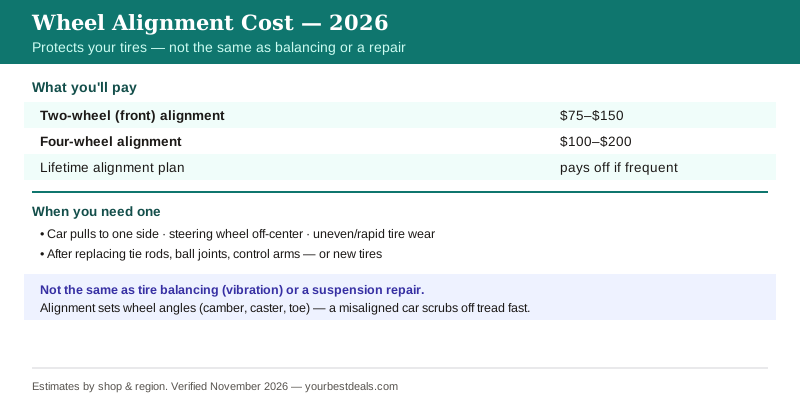
A wheel alignment costs about $75 to $150 for a two-wheel (front) alignment and $100 to $200 for a four-wheel alignment, with some shops a bit higher. Many shops also offer a lifetime alignment plan that can pay for itself if you align frequently. An alignment adjusts the angles – camber, caster, and toe – at which your tires meet the road, and it’s worth knowing it’s not the same as tire balancing (which fixes a vibration) or a suspension repair (which replaces worn parts). You need an alignment when the car pulls to one side, the steering wheel sits off-center, your tires wear unevenly or rapidly, or after you replace steering/suspension parts or put on new tires. The main reason to keep up with it: a misaligned car scrubs tread off your tires fast.
Alignment is cheap maintenance that protects an expensive thing – your tires – but it gets confused with balancing and sold as a lifetime plan, so it’s worth understanding. Let me cover the cost, when you actually need one, and how it differs from balancing.
What you’ll actually pay
Here’s the price picture. These are estimated ranges that vary by shop and region.
| Service | Cost | Notes |
|---|---|---|
| Two-wheel (front) alignment | $75–$150 | Many front-wheel-drive cars |
| Four-wheel alignment | $100–$200 | AWD and many modern cars |
| Lifetime alignment plan | varies | Worth it if you align often |
| Alignment after suspension work | included cost | Required after many repairs |
Whether you need a two-wheel or four-wheel alignment depends on your vehicle – many modern cars and all-wheel-drive vehicles call for a four-wheel alignment. A lifetime alignment plan (a one-time fee for unlimited alignments while you own the car) can be good value if you replace tires often, drive on rough roads, or do suspension work periodically. Note that an alignment is required after replacing steering or suspension parts (tie rods, ball joints, control arms) and is recommended with new tires. Our tires guide and tire balancing cost guide cover the related services.
Shop Talk
The best money move on alignments is tying them to tires. First, get an alignment when you put on a new set of tires – it’s cheap insurance that protects a $600-to-$1,200 tire investment from being scrubbed off by a misalignment you didn’t know you had. Second, if you buy tires from a shop that offers a lifetime alignment plan, do the math: if you keep cars a long time, drive on pothole-heavy roads, or replace tires every few years, a one-time lifetime-alignment fee can easily beat paying per-alignment over the years. Now the distinction that saves you from buying the wrong service: alignment, balancing, and a suspension repair are three different things people mix up. If your car pulls to one side or your tires are wearing unevenly, that’s alignment. If you feel a vibration at highway speed, that’s tire balancing. If you hear a clunk or the steering feels loose, that’s a worn suspension part (and you’ll need an alignment after fixing it). Buying an alignment to fix a vibration, or a balance to fix a pull, just wastes a visit. And one more: if a fresh alignment doesn’t hold – the car pulls again soon after – suspect worn suspension parts or bushings, because an alignment can’t stay put on worn components.
Where Drivers Overpay
The main way to waste money here is buying the wrong service because alignment, balancing, and suspension repairs get confused. Paying for an alignment to fix a highway-speed vibration (which is a balancing issue) or a balance to fix a pull (which is alignment) just burns a visit without fixing the problem. Match the symptom: a pull or uneven tire wear is alignment; a vibration is balancing; a clunk is a worn part.
The flip side – a real saving – is not skipping an alignment when it matters. Driving on a misalignment scrubs expensive tires bald in a few thousand miles, so a $100 alignment protects a much pricier tire set. And getting an alignment with new tires, or after suspension work, prevents premature tire wear. If alignments don’t hold, that points to worn suspension parts rather than a need to keep re-aligning. The pattern: align when you get tires or do suspension work, match the symptom to the right service, consider a lifetime plan if you align often, and investigate worn parts if an alignment won’t stay set.
The Real Number
A wheel alignment is $75 to $150 (two-wheel) or $100 to $200 (four-wheel). It’s cheap insurance for your tires – get one with new tires and after any steering/suspension repair. It’s not the same as balancing (vibration) or a suspension fix (clunk), so match the symptom: pull or uneven wear = alignment. A lifetime plan can pay off if you align often, and if a fresh alignment won’t hold, suspect worn suspension parts.
Frequently Asked Questions
How much does a wheel alignment cost?
About $75 to $150 for a two-wheel (front) alignment and $100 to $200 for a four-wheel alignment, with some shops higher. Which you need depends on your vehicle – many modern cars and all-wheel-drive vehicles require a four-wheel alignment. Some shops offer a lifetime alignment plan (a one-time fee for unlimited alignments), which can be good value if you align often. An alignment is also required after replacing steering or suspension parts and is recommended with new tires. These are estimates that vary by shop and region.
When do I need a wheel alignment?
Get an alignment when your car pulls to one side, the steering wheel sits off-center when driving straight, or your tires are wearing unevenly or rapidly (especially on one edge). You also need one after replacing steering or suspension parts like tie rods, ball joints, or control arms, since that work changes the alignment, and it’s recommended whenever you install new tires to protect them. Hitting a bad pothole or curb can knock the alignment off too. Regular alignment checks, roughly yearly or with tire service, catch problems before they ruin tires.
What’s the difference between an alignment and tire balancing?
They’re different services often confused. An alignment adjusts the angles (camber, caster, toe) at which the tires meet the road, and it fixes a car that pulls to one side or wears tires unevenly. Tire balancing corrects weight imbalance in the spinning wheel-and-tire assembly, and it fixes a vibration felt at highway speed. So a pull or uneven tire wear calls for an alignment, while a vibration calls for balancing. Buying one to fix the other’s symptom just wastes a visit. They’re sometimes done together but solve different problems.
Is a four-wheel alignment worth it over a two-wheel?
It’s not a matter of “worth it” so much as what your vehicle needs. All-wheel-drive vehicles and many modern cars with independent rear suspension require a four-wheel alignment to set all four corners correctly. Older cars with a solid rear axle may only need a front (two-wheel) alignment. A shop will align what your car calls for. Don’t pay for a four-wheel alignment on a car that only needs two-wheel, but do get the four-wheel if your vehicle requires it, since skipping the rear leaves part of the problem unaddressed.
Is a lifetime alignment plan worth it?
It can be, depending on how you drive and how long you keep cars. A lifetime alignment plan is a one-time fee for unlimited alignments while you own the vehicle, so it pays off if you align frequently – if you keep cars a long time, drive on rough or pothole-heavy roads, replace tires every few years, or do periodic suspension work. If you rarely need alignments and trade cars often, paying per-alignment may be cheaper. Do the math against the per-alignment price and your habits. For many high-mileage owners, the lifetime plan comes out ahead.
How often should I get a wheel alignment?
There’s no strict interval, but a common recommendation is to check it about once a year or whenever you install new tires, plus any time you notice symptoms (a pull, off-center steering, or uneven tire wear) or after hitting a serious pothole or curb. You also align after replacing steering or suspension parts. Rather than a fixed schedule, think of it as symptom- and event-driven: align with new tires, after suspension work, and when something feels or looks off. Regular checks protect your tires from the rapid wear a misalignment causes.
Why won’t my alignment stay fixed?
If your car pulls again or tires keep wearing unevenly shortly after an alignment, the likely cause is worn suspension or steering parts – a loose tie rod, worn ball joint, or failing bushings. Alignment settings depend on those parts holding the wheels in position, so if they’re worn, the alignment can’t stay put no matter how well it’s set. The fix is to repair the worn parts, then align. So an alignment that won’t hold is a sign to inspect the suspension, not to keep re-aligning. See our worn bushings guide.
Sources
Price ranges verified against 2026 alignment-service pricing in November 2026. Dollar amounts are estimates that vary by shop and region.
- Firestone Complete Auto Care – wheel alignment
- Kelley Blue Book – service & repair guide
- NHTSA – tires and alignment
Related Guides
- Tire Balancing & Rotation Cost
- New Tires Cost
- Ball Joint Replacement Cost
- Suspension & Steering Guide
- Car Repair Cost Estimator

Diane Holcomb spent seven years as a service advisor at multi-brand dealerships in Charlotte, NC, where she tied alignments to new-tire sales so customers protected the tires they’d just bought. She drives a 2019 Honda CR-V and a hand-me-down 2007 Toyota Camry, and takes no referral fees or advertising money from any shop or chain.