
Last updated: November 6, 2026 – By Diane Holcomb
November 2026 update: reconfirmed per-joint pricing, the required alignment, and the control-arm factor.
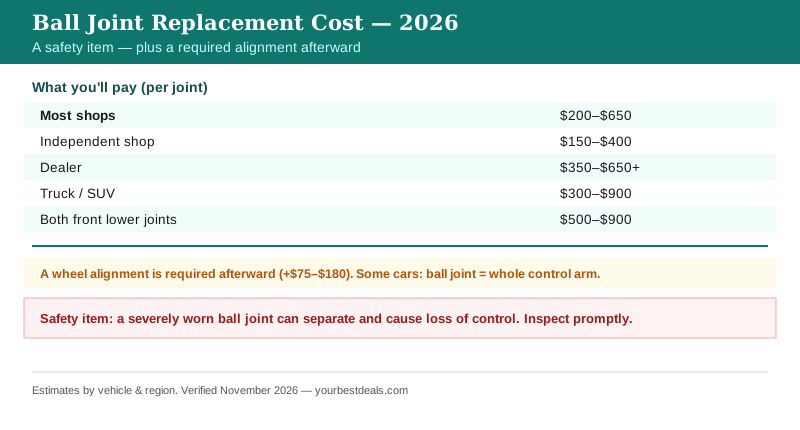
A ball joint replacement costs about $200 to $650 per joint including parts and labor – independent shops around $150 to $400, dealers $350 to $650 or more. Trucks and SUVs run higher at about $300 to $900 per joint, and both front lower joints together about $500 to $900. A wheel alignment is required afterward (add $75 to $180), because removing a ball joint changes the suspension geometry. One cost factor that varies a lot: on many cars the ball joint is built into the control arm, so you replace the whole control arm rather than just the joint, which changes the price. Importantly, a ball joint is a safety component – a severely worn one can separate and cause loss of control – so a clunking front end, uneven tire wear, or loose steering should be inspected promptly.
Ball joints are where a suspension repair becomes a safety priority, so the diagnosis and the “joint versus whole arm” question both matter for the price. Let me cover the cost, the alignment and control-arm factors, and the safety side.
What you’ll actually pay
Here’s the price picture. These are estimated ranges that vary by vehicle and shop.
| Situation | Cost | Notes |
|---|---|---|
| Per joint, most shops | $200–$650 | Parts and labor |
| Independent shop | $150–$400 | Often better value |
| Dealer | $350–$650+ | Higher labor |
| Truck / SUV (per joint) | $300–$900 | Heavier, more labor |
| Both front lower joints | $500–$900 | Common pairing |
| Alignment (required after) | $75–$180 | Added to the job |
The cost hinges on a few things: whether it’s a bolt-in or pressed-in joint (pressed-in takes more labor), whether it’s an upper or lower joint, and especially whether your car has the ball joint integrated into the control arm. On integrated designs, you replace the whole control arm (which comes with a new ball joint and bushings), which can actually be the more practical route. Always budget the required alignment. Our suspension guide and control arm cost guide cover the related parts.
Shop Talk
Take a worn ball joint seriously – this is a genuine safety part, not just a noise. The ball joint is what connects your control arm to the steering knuckle and lets the wheel pivot and move; if one wears badly and separates, the wheel can effectively fold under the car, causing a sudden loss of control. So a clunk over bumps, loose or wandering steering, or uneven tire wear on the front deserves a prompt inspection, not a wait-and-see. Now the cost angles that help you. First, ask whether your ball joint is a separate part or built into the control arm – on many modern cars it’s integrated, so the “ball joint” repair is really a control-arm replacement, and sometimes replacing the whole arm (with fresh joint and bushings) is the sensible, not-much-pricier option. Ask the shop to price it both ways where possible. Second, always factor in the alignment – it’s required after this work because pulling the joint changes the geometry, and a shop quote should include it; if it doesn’t, that’s $75 to $180 extra to budget. Third, if you’re doing one lower ball joint on a high-mileage car, ask about the other side and the tie rods and bushings while they’re in there, since front-end parts wear together and combining labor saves money. But confirm each part is actually worn – don’t let a single bad joint turn into a blanket front-end replacement without cause.
Where Drivers Overpay
The cost surprises on ball joints usually come from two places: the control-arm factor and the alignment. If your car has an integrated design, a “ball joint” job is really a control-arm replacement, which costs more than a standalone joint – so ask which your car has and have it priced both ways where there’s a choice. And always confirm the alignment is included or budgeted, since it’s required and adds $75 to $180; a quote that omits it understates the real total.
The overpay to avoid is letting one worn joint become a blanket front-end replacement without cause. It’s reasonable to combine the other side’s joint, tie rods, or bushings if they’re actually worn (saving overlapping labor), but each part should be confirmed bad, not replaced just in case. The flip side – don’t skip a really worn ball joint to save money, because it’s a safety item that can fail dangerously. The pattern: confirm which parts are truly worn, ask joint-versus-arm, include the alignment, and combine only really needed front-end parts.
The Real Number
A ball joint runs $200 to $650 per joint ($300 to $900 on trucks/SUVs, $500 to $900 for both front lowers), plus a required alignment ($75 to $180). On many cars the joint is built into the control arm, so you replace the whole arm – ask which yours is. It’s a safety part: a severely worn joint can separate and cause loss of control, so don’t ignore a front-end clunk, loose steering, or uneven tire wear. Confirm which parts are truly worn before a blanket front-end replacement.
Frequently Asked Questions
How much does it cost to replace a ball joint?
About $200 to $650 per joint including parts and labor at most shops – independent shops around $150 to $400, dealers $350 to $650 or more. Trucks and SUVs run higher at $300 to $900 per joint, and both front lower joints together about $500 to $900. A wheel alignment is required afterward, adding $75 to $180. On many cars the ball joint is integrated into the control arm, so you replace the whole arm, which changes the price. These are estimates that vary by vehicle and shop. Always budget the alignment into the total.
Why do I need an alignment after replacing a ball joint?
Because replacing a ball joint disturbs the front suspension geometry – the joint is part of what positions the wheel, so removing and replacing it changes the alignment settings. Without a follow-up alignment, the car can pull, the steering may be off-center, and your tires will wear unevenly and quickly. So an alignment ($75 to $180) is a required part of the job, not optional. Make sure your quote includes it or budget it separately. Skipping it to save money leads to ruined tires that cost far more than the alignment.
Is it safe to drive with a bad ball joint?
You should treat a bad ball joint cautiously, because it’s a genuine safety component. The ball joint connects the control arm to the steering knuckle and lets the wheel pivot; if a severely worn one separates, the wheel can fold under the car, causing a sudden and dangerous loss of control. A joint just starting to wear gives you warning signs – a clunk over bumps, loose steering, uneven tire wear – and some time to fix it, but you can’t easily tell how far gone it is. So a clunking or loose front end should be inspected promptly rather than driven on indefinitely. This isn’t a wait-and-see repair.
What are the symptoms of a bad ball joint?
The common signs are a clunking or knocking noise from the front suspension, especially over bumps or when turning; loose, vague, or wandering steering; uneven or accelerated tire wear; and sometimes a vibration or a feeling that the front end isn’t tight. These come from play developing in the worn joint. Because other suspension parts (tie rods, sway bar links, bushings) cause similar symptoms, a shop confirms a bad ball joint by checking for play with the wheel raised. Any of these front-end symptoms warrants prompt inspection given the safety role of the ball joint.
Why is a ball joint sometimes part of the control arm?
On many modern vehicles, the ball joint is manufactured as an integral part of the control arm rather than a separate replaceable piece. When that’s the case, you can’t just swap the joint – you replace the whole control arm (which comes with a new ball joint and bushings). This raises the part cost but sometimes makes sense anyway, since you get fresh bushings and joint together. On vehicles with a separate, bolt-in or pressed-in ball joint, you can replace just the joint. Ask your shop which design your car uses, and have it priced accordingly.
Should I replace both ball joints at once?
Not automatically, but often reasonable to consider. Ball joints don’t always wear at the same rate, so if only one is bad, you can replace just that one. However, on a high-mileage car where both are worn, doing them together saves overlapping labor and the second alignment. The key is confirming the second joint is actually worn – have the shop check it for play rather than replacing it just in case. The same logic applies to tie rods and bushings in the same corner: combine them only if they’re really worn, to save labor without paying for good parts.
How long do ball joints last?
There’s no fixed interval – ball joints are a wear item whose life depends on driving conditions, road quality, and climate. Many last well over 100,000 miles, while rough roads, potholes, heavy loads, and corrosion shorten that. They’re not a scheduled maintenance part; you replace them when they develop play and cause symptoms. Because they’re a safety component, having the front end (including ball joints) checked during routine service or whenever you notice a clunk, loose steering, or uneven tire wear is the sensible approach rather than waiting for a failure.
Sources
Price ranges verified against 2026 repair pricing in November 2026. Dollar amounts are estimates that vary by vehicle and shop, and include a required alignment.
- RepairPal – ball joint replacement cost
- ASE – National Institute for Automotive Service Excellence
- NHTSA – vehicle safety
Related Guides
- Control Arm Replacement Cost
- Wheel Alignment Cost
- Bad Tie Rod Symptoms
- Suspension & Steering Guide
- Car Repair Cost Estimator

Diane Holcomb spent seven years as a service advisor at multi-brand dealerships in Charlotte, NC, where a ball-joint quote meant explaining the required alignment and whether the joint was a separate part or the whole control arm. She drives a 2019 Honda CR-V and a hand-me-down 2007 Toyota Camry, and takes no referral fees or advertising money from any shop or chain.