
Last updated: November 7, 2026 – By Diane Holcomb
November 2026 update: reconfirmed per-side pricing, the required alignment, and the arm-includes-ball-joint-and-bushings point.
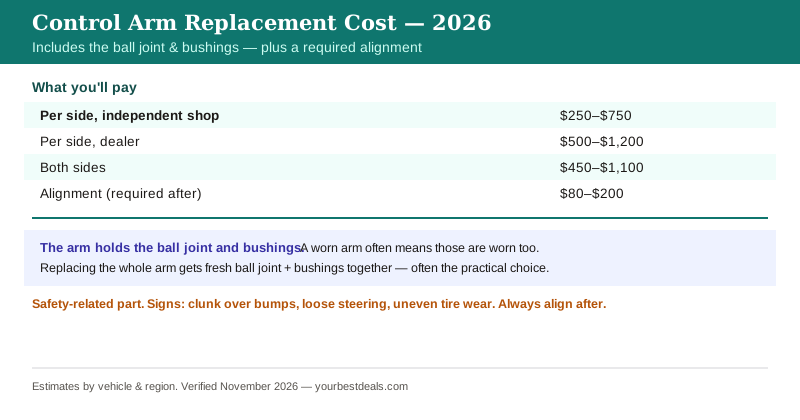
A control arm replacement costs about $250 to $750 per side at an independent shop and $500 to $1,200 at a dealer, with both sides running roughly $450 to $1,100. A wheel alignment is required afterward, adding $80 to $200. Trucks, luxury vehicles, and adaptive-suspension cars that use forged aluminum arms with electronic bushings cost more – sometimes $400 to $800 just for the part. The useful thing to understand: the control arm connects the wheel hub to the frame and holds the ball joint and bushings, so a worn control arm often means the ball joint or bushings are worn too – and replacing the whole arm gets you a fresh ball joint and bushings together, which is frequently the practical choice. It’s a safety-related suspension part, so get a clunking or loose front end inspected, and always include the alignment.
The control arm is a case where replacing the whole part can actually be the smart, economical move, because it bundles several wear items. Let me cover the cost, why the whole arm often makes sense, and the required alignment.
What you’ll actually pay
Here’s the price picture. These are estimated ranges that vary by vehicle and shop.
| Situation | Cost | Notes |
|---|---|---|
| Per side, independent shop | $250–$750 | Most cars and crossovers |
| Per side, dealer | $500–$1,200 | Higher labor and OEM parts |
| Both sides | $450–$1,100 | Often done together |
| Alignment (required after) | $80–$200 | Geometry changes |
| Truck / luxury / adaptive part | $400–$800 part | Forged aluminum, electronic bushings |
A control arm is a structural suspension link with a ball joint at one end and bushings where it mounts to the frame. Because those wear items come as part of the arm on many designs, a full control-arm replacement renews the ball joint and bushings in one job. Replacing it changes the suspension geometry, so an alignment is required afterward. Our suspension guide, ball joint cost, and alignment cost guides cover the related pieces.
Shop Talk
Here’s why replacing the whole control arm is often the economical choice even though it sounds like more: the control arm carries both a ball joint and the bushings, and on many modern cars those are built into the arm rather than sold separately. So when a ball joint or a bushing wears out, you can either try to press in a new individual part (labor-intensive, and not possible if it’s integrated) or replace the complete arm, which comes with a new ball joint and new bushings already installed. Because most of the cost is the labor to remove and reinstall the arm, getting all those fresh wear items in one job frequently beats paying to replace them one at a time later. Ask your shop to price the complete arm versus individual parts – on a lot of cars the complete arm wins. Two more notes: always include the alignment (it’s required because replacing the arm changes the geometry, and skipping it wears your tires), and treat a control-arm issue as safety-related – it holds the wheel to the car, so a clunking, loose, or wandering front end deserves prompt inspection. And if one side’s arm is worn on a high-mileage car, ask about the other side, since they wear together and doing both saves overlapping labor – but only if the second is actually worn.
Where Drivers Overpay
The main cost lever is the whole-arm-versus-individual-parts choice. On many cars, pressing in a single new bushing or ball joint is labor-intensive (or impossible if integrated), so replacing the complete arm – which arrives with a fresh ball joint and bushings – is often cheaper overall than doing those parts separately, since the labor to remove the arm dominates. Ask the shop to price it both ways. And always budget the required alignment; a quote that omits it understates the total.
The overpay to avoid is a blanket both-sides replacement when only one arm is worn – do the second side only if it’s really worn too (though if it is, combining saves labor). The flip side is going too cheap on a safety part: a control arm holds the wheel to the car, so skipping a really worn one isn’t wise. The pattern: price complete arm versus individual parts, include the alignment, confirm each side is actually worn before doing both, and don’t neglect a worn arm given its safety role.
The Real Number
A control arm runs $250 to $750 per side (dealer $500 to $1,200, both sides $450 to $1,100), plus a required alignment ($80 to $200). Because the arm includes the ball joint and bushings, replacing the whole arm renews several wear items in one job and is often cheaper than doing them separately – ask the shop to price it both ways. Always include the alignment, confirm both sides are worn before doing both, and treat it as the safety part it is.
Frequently Asked Questions
How much does it cost to replace a control arm?
About $250 to $750 per side at an independent shop and $500 to $1,200 at a dealer, with both sides running roughly $450 to $1,100. A wheel alignment is required afterward, adding $80 to $200. Trucks, luxury, and adaptive-suspension vehicles cost more – their forged aluminum arms with electronic bushings can be $400 to $800 just for the part. These are estimates that vary by vehicle and shop. Because the arm includes the ball joint and bushings, replacing the whole arm is often the economical choice over doing those parts individually.
Why does replacing the whole control arm make sense?
Because the control arm carries both a ball joint and the mounting bushings, and on many modern cars those are built into the arm rather than sold separately. So when a ball joint or bushing wears out, replacing the complete arm renews all those wear items at once, with a fresh ball joint and bushings already installed. Since most of the cost is the labor to remove and reinstall the arm, getting everything fresh in one job often beats pressing in individual parts or doing them separately later. Ask the shop to price the complete arm versus individual parts for your car.
Do I need an alignment after replacing a control arm?
Yes, always. The control arm is part of the suspension geometry, so replacing it changes the alignment settings (camber and toe). Without a follow-up alignment, the car can pull, steer off-center, and wear tires unevenly and quickly. So an alignment ($80 to $200) is a required part of the job, not optional. Make sure your quote includes it or budget it separately – a control-arm price that omits the alignment understates the real total, and skipping the alignment to save money leads to ruined tires that cost far more.
Is it safe to drive with a bad control arm?
You should treat it cautiously, because the control arm is a structural part that holds the wheel to the car and carries the ball joint. A worn bushing causes clunks and loose handling that’s not an instant emergency, but a failing ball joint within the arm can, in the worst case, separate and cause loss of control. Because you can’t easily tell how far gone it is from the driver’s seat, a clunking, loose, or wandering front end should be inspected promptly rather than driven on indefinitely. So a minor bushing clunk gives you some time, but don’t ignore control-arm symptoms given the safety role.
What are the symptoms of a bad control arm?
Common signs are clunking or knocking over bumps, loose or wandering steering, uneven or accelerated tire wear, vibration, and a feeling that the front end isn’t tight. These come from worn bushings (which allow movement) or a worn ball joint in the arm. Because other suspension parts cause similar symptoms, a shop confirms it by checking the arm’s bushings and ball joint for play with the wheel raised. An alignment that won’t stay set is another clue, since worn arm bushings can’t hold the geometry. Any of these front-end symptoms warrants a prompt inspection.
Should I replace both control arms at once?
Only if both are actually worn, though on a high-mileage car that’s often the case. If only one arm is worn, you can replace just that side. But since arms wear under similar conditions, if the second is also worn, doing both together saves overlapping labor and the second alignment. The key is confirming the second arm is really worn – have the shop check it for play rather than replacing it just in case. So it’s a judgment call based on the actual condition of each side, balancing labor savings against not replacing a good part.
Can I replace a control arm myself?
It’s doable for an experienced DIYer with the right tools, but with cautions: it involves suspension disassembly (sometimes a ball-joint separator and dealing with torque specs), and you’ll still need a wheel alignment afterward, which requires shop equipment. Using a complete arm (with ball joint and bushings pre-installed) makes the DIY job much easier than pressing bushings. If you’re comfortable with suspension work and can get the car aligned afterward, it’s a reasonable DIY; if not, the shop cost is reasonable given the alignment requirement. Either way, the alignment is non-negotiable.
Sources
Price ranges verified against 2026 suspension-repair pricing in November 2026. Dollar amounts are estimates that vary by vehicle and shop, and include a required alignment.
- RepairPal – control arm replacement estimates
- ASE – National Institute for Automotive Service Excellence
- NHTSA – vehicle safety
Related Guides
- Ball Joint Replacement Cost
- Wheel Alignment Cost
- What Worn Suspension Bushings Cause
- Suspension & Steering Guide
- Car Repair Cost Estimator

Diane Holcomb spent seven years as a service advisor at multi-brand dealerships in Charlotte, NC, where she’d price a complete control arm against individual parts so customers got fresh ball joint and bushings for the same labor. She drives a 2019 Honda CR-V and a hand-me-down 2007 Toyota Camry, and takes no referral fees or advertising money from any shop or chain.