
Last updated: November 8, 2026 – By Eddie Brennan
November 2026 update: reconfirmed the symptom list, cost with required alignment, and the safety urgency.
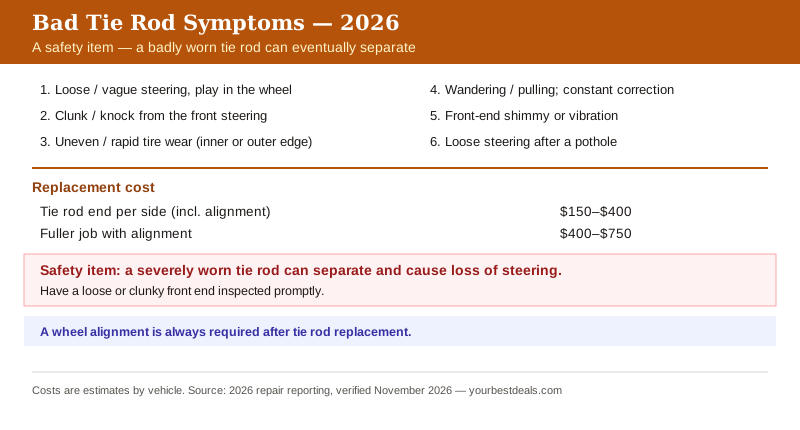
A bad tie rod shows up as loose or vague steering with play in the wheel, a clunk or knock from the front when steering or going over bumps, uneven or rapid tire wear (often on the inner or outer edge), the car wandering or pulling and needing constant steering correction, a front-end shimmy, and steering that feels loose after hitting a pothole. This one matters more than most suspension wear items because it’s a safety component: the tie rods connect your steering to the wheels, and a severely worn tie rod can eventually separate, causing a sudden loss of steering. Replacing a tie rod end runs about $150 to $400 per side including the required wheel alignment, and a fuller job with alignment can reach $400 to $750. A loose or clunky front end should be inspected promptly.
Tie rods are where a suspension complaint stops being just an annoyance and becomes a safety issue, so I always treated a loose-steering or front-clunk complaint as something to check thoroughly, not brush off. Let me cover the symptoms, why it’s urgent, and the cost – including the alignment you’ll always need with it.
The symptoms
They come from the ball joint inside the tie rod end wearing and developing play. Loose or vague steering – the wheel feels less precise, with a bit of play before the car responds, because the worn joint isn’t transmitting steering input tightly. A clunk or knock from the front when steering or over bumps. Uneven or rapid tire wear, especially on the inner or outer edge, because a worn tie rod throws off the toe alignment. Wandering or pulling – the car drifts and needs constant correction to keep straight. A front-end shimmy or vibration. Loose steering after a pothole, which can suddenly worsen play. Our suspension guide covers steering components, and uneven tire wear is detailed in our tires guide.
What it costs
Here’s the price picture. These are estimated ranges that vary by vehicle.
| Item | Cost | Notes |
|---|---|---|
| Tie rod end (per side, incl. alignment) | $150–$400 | Inner or outer |
| Fuller job with alignment | $400–$750 | Both/inner+outer, some cars |
| Wheel alignment (always required) | $80–$100 | Included in the above |
A key point on cost: replacing a tie rod always requires a wheel alignment afterward, because disturbing the tie rod changes the toe setting – so budget the alignment into the job (it’s typically included in the figures above). Outer tie rod ends are usually cheaper to replace than inner ones. See our dedicated tie rod replacement cost guide for the full breakdown.
Shop Talk
Take a tie rod seriously in a way you don’t have to with a sway bar link, because this one can actually leave you unable to steer. The way a tech checks it: with the car safely raised and the wheels hanging, they grab the tire at 3 and 9 o’clock and rock it in and out – play there points at a tie rod (or wheel bearing), and they’ll watch the tie rod ends for movement while a helper wiggles the wheel to see which joint is loose. A telltale you can catch yourself is the tire wear: a worn tie rod knocks the toe out of alignment, which scrubs one edge of the tire (feathered or one-side wear), so if you’re seeing odd inner or outer tire wear along with loose steering, tie rods are a prime suspect. Two practical notes. First, always get the alignment done with the repair – not optional, because the new tie rod resets the toe and skipping alignment will chew up your fresh (or existing) tires. Second, don’t sit on it. A tie rod that’s just starting to wear gives you loose steering and time to fix it, but a badly worn one can separate, and losing steering at speed is exactly as bad as it sounds. A loose or clunky front end is a get-it-inspected-now situation, not a wait-and-see one.
What Gets Misdiagnosed
The most important thing here isn’t a subtle misdiagnosis – tie rods are fairly easy to confirm by feeling for play – but making sure a loose-steering or uneven-tire-wear complaint actually gets the front end inspected rather than dismissed. Loose steering and clunks can come from tie rods, ball joints, wheel bearings, or bushings, and several of those (tie rods, ball joints) are safety items, so the whole front end should be checked together. Uneven tire wear in particular should trigger an alignment-and-suspension inspection, since it often signals a worn steering or suspension part throwing off the toe.
The other issue is skipping the required alignment to save money, which backfires. A tie rod replacement changes the toe setting, so an alignment isn’t optional – skip it and your tires wear rapidly and unevenly, costing far more than the alignment saved, plus the car may pull or wander. So the pattern is: get a loose or clunky front end inspected promptly (it’s a safety component), confirm which joint is worn, replace it, and always align afterward. Don’t let anyone talk you out of the alignment on this repair.
The Real Number
A bad tie rod causes loose steering, a front-end clunk, uneven tire wear, and wandering – and it’s a safety item, because a severely worn one can separate and cause loss of steering. Replacement runs $150 to $400 per side including the required alignment (up to $400 to $750 for a fuller job). Always do the alignment, or your tires wear fast. Treat a loose or clunky front end as a get-it-inspected-promptly situation, not a wait-and-see one.
Frequently Asked Questions
What are the symptoms of a bad tie rod?
The main signs are loose or vague steering with play in the wheel, a clunk or knock from the front when steering or over bumps, uneven or rapid tire wear (especially on the inner or outer edge), the car wandering or pulling and needing constant correction, a front-end shimmy, and steering that feels loose after hitting a pothole. They stem from the ball joint in the tie rod end wearing and developing play, which loosens the steering and throws off the toe alignment. Because a tie rod is a safety component, these symptoms warrant prompt inspection.
How much does it cost to replace a tie rod?
About $150 to $400 per side including the required wheel alignment, and a fuller job (inner and outer, or both sides) with alignment can reach $400 to $750. The alignment is always needed because replacing the tie rod changes the toe setting, so it’s built into these figures. Outer tie rod ends are usually cheaper to replace than inner ones. These are estimates that vary by vehicle. See our tie rod replacement cost guide for the full breakdown, and always include the alignment in the job.
Is it safe to drive with a bad tie rod?
It depends on how worn it is, and you should treat it cautiously because a tie rod is a steering safety component. A tie rod just beginning to wear gives you loose steering and some time to get it fixed, but a badly worn one can eventually separate, which causes a sudden loss of steering control – potentially at speed. Because you can’t easily tell from the driver’s seat how far gone it is, a loose or clunky front end should be inspected promptly rather than driven on indefinitely. This isn’t a wait-and-see repair like some noises.
Why does a bad tie rod cause uneven tire wear?
Because a worn tie rod throws off the toe alignment – the angle at which the tires point relative to straight ahead. When the ball joint in the tie rod develops play, the wheel can’t hold its precise toe setting, so the tire scrubs as it rolls, wearing one edge (inner or outer) faster than the rest, often with a feathered pattern. That’s why odd inner or outer tire wear combined with loose steering is a classic tie rod sign. It’s also why an alignment is mandatory after replacement, to reset the toe and stop the uneven wear.
Do I need an alignment after replacing a tie rod?
Yes, always. Replacing a tie rod disturbs the toe setting (the tie rod is literally what sets toe), so a wheel alignment afterward isn’t optional – it’s required to bring the steering geometry back to spec. Skipping it means your tires will wear rapidly and unevenly and the car may pull or wander, costing far more in ruined tires than the alignment would have. The alignment is typically included in the tie rod replacement quote for this reason. Never let anyone talk you out of the alignment on a tie rod job.
What’s the difference between an inner and outer tie rod?
The tie rod assembly has two parts: the inner tie rod, which connects to the steering rack, and the outer tie rod end, which connects to the steering knuckle at the wheel. Either can wear and develop play. Outer tie rod ends are more commonly replaced and usually cheaper and easier to access, while inner tie rods are a bit more involved. A tech will identify which joint is loose during inspection. Both require an alignment afterward. If both are worn, they may be replaced together, which raises the cost toward the higher end.
How long do tie rods last?
There’s no set interval – tie rods are a wear item that can last well over 100,000 miles or fail sooner depending on driving conditions, road quality, potholes, and corrosion. Rough roads and impacts accelerate wear. They’re not a scheduled maintenance part; you replace them when they develop play and cause the symptoms. Because they’re a safety component, having the front end (including tie rods and ball joints) checked during routine service or whenever you notice loose steering or uneven tire wear is the sensible approach rather than waiting for a failure.
Sources
Symptom list reflects standard steering diagnostics; cost ranges verified against 2026 repair pricing in November 2026. Dollar amounts are estimates that vary by vehicle and include a required alignment.
- RepairPal – tie rod replacement cost
- ASE – National Institute for Automotive Service Excellence
- NHTSA – steering and vehicle safety
Related Guides
- Tie Rod Replacement Cost
- Bad Sway Bar Link Symptoms
- What Worn Suspension Bushings Cause
- Suspension & Steering Guide
- Tires Guide

Eddie Brennan is an ASE Master Certified technician (A4 Suspension & Steering among his certs) who spent 11 years diagnosing steering play and front-end wear at an independent shop in Columbus, OH before a back injury moved him into writing full-time. He drives a 2015 Subaru Outback with over 250,000 miles and a 2020 Ford F-150, and takes no referral fees or advertising money from any shop or chain.