
Last updated: November 10, 2026 – By Eddie Brennan
November 2026 update: reconfirmed the symptom list, per-side cost, and the other-causes caution for a front-end clunk.
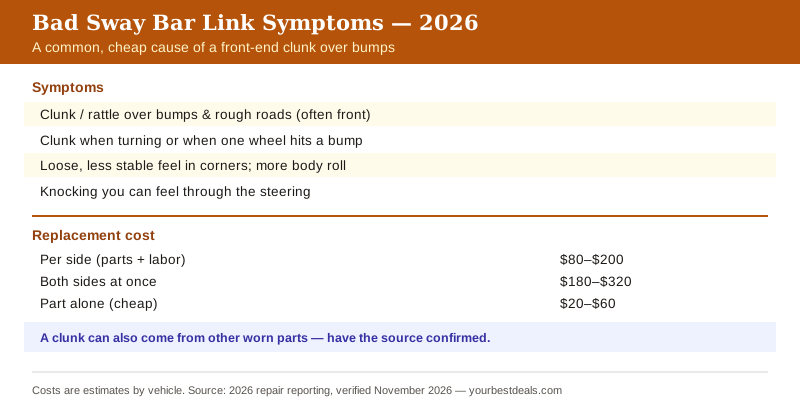
A bad sway bar link most often announces itself as a clunk or rattle over bumps and rough roads, usually from the front. Other signs: a clunk when turning or when one wheel hits a bump, a looser or less stable feeling in corners with more body roll, and a knocking you can sometimes feel through the steering. Replacing a link runs about $80 to $200 per side (the part is cheap at $20 to $60 – most of it is labor), or roughly $180 to $320 for both sides. Sway bar links connect the anti-roll (stabilizer) bar to the suspension to reduce body lean in corners, and when the little ball joints or bushings inside them wear out, they knock over bumps. It’s a common and relatively cheap suspension fix – but a front-end clunk has several possible causes, so it’s worth confirming the source before assuming the link.
The sway bar link clunk is one of the most common front-end noise complaints I heard, and often the cheapest to fix – but “cheapest likely cause” isn’t the same as “only cause,” so the trick is confirming it. Let me cover the symptoms, the cost, and how a tech pins the clunk on the link versus something else.
The symptoms
Most trace back to worn joints in the link letting it rattle against the suspension. The clunk over bumps is the signature – a knocking or rattling from the front (usually) as you go over bumps, potholes, or rough pavement, because the worn link slaps around instead of holding tight. A clunk when turning or when one wheel drops into a bump, as the sway bar loads and unloads. Looser cornering – with a worn or broken link, the sway bar can’t do its job as well, so you may feel more body roll or a less planted feel in corners. Knocking through the steering in some cases. Our clunking-over-bumps guide covers the broader noise question.
What it costs
Here’s the price picture. These are estimated ranges that vary by vehicle.
| Item | Cost | Notes |
|---|---|---|
| One link (parts + labor) | $80–$200 | Per side |
| Both sides | $180–$320 | Common to do together |
| Link part alone | $20–$60 | Cheap; labor is most of it |
| Luxury / European | $200–$500 | Pricier parts, more labor |
The link itself is inexpensive, so the cost is mostly the labor to access and replace it. Many people do both sides at once since they wear similarly and it saves a second visit, though if only one is bad you can do one. This is one of the more affordable suspension repairs, which is part of why it’s worth confirming a clunk is actually the link and not a pricier component. Our suspension guide covers related parts.
Shop Talk
Here’s how a tech confirms it’s the link and not something more expensive, because a front-end clunk can come from sway bar links, control-arm bushings, ball joints, strut mounts, worn shocks/struts, or loose components – and those range from cheap to pricey. With the car safely raised and the wheels hanging, they grab and shake each sway bar link and feel for play or a knock, and check the ball joints and bushings the same way; a bad link has obvious slop. Another good tell you can note yourself: a sway bar link clunk is usually most noticeable over small, sharp bumps and rough roads at lower speeds, and it’s a distinct metallic knock rather than a groan or squeak. Because the link is the cheapest common cause, a good shop rules it in or out first – but don’t let a shop replace links and call it done if the clunk continues, because then it was one of the other parts. The reassuring news: if the link is confirmed bad, it’s an affordable fix and not urgent the way a failing ball joint or tie rod is. Still, get the whole front end inspected while it’s up, since worn links often keep company with other aging suspension parts.
What Gets Misdiagnosed
The main issue isn’t misdiagnosing the link itself (it’s easy to feel play in a bad one) but assuming the link is the cause of any front-end clunk when it might be a pricier part. Ball joints, control-arm bushings, strut mounts, and worn struts all clunk too, so a good inspection checks each with the wheels hanging rather than defaulting to the cheapest guess. If links are replaced and the clunk persists, the real culprit was one of those others.
The opposite mistake is ignoring a clunk as “just a noise.” While a bad sway bar link itself isn’t an immediate safety emergency (the car still steers and stops), a persistent front-end clunk deserves inspection because it could be the link or it could be a ball joint or tie rod, which are safety items. So don’t panic at a clunk, but don’t dismiss it either – get the front end inspected so you know whether it’s the cheap link or something that needs prompt attention. See our tie rod symptoms guide for the safety-critical case.
The Real Number
A bad sway bar link clunks over bumps and makes cornering feel looser, and it’s a cheap fix at $80 to $200 per side ($180 to $320 for both). The part is only $20 to $60; labor is most of the cost. It’s one of the most common – and most affordable – causes of a front-end clunk, but ball joints, bushings, and strut mounts clunk too, so have the source confirmed with the wheels hanging before replacing, and get the whole front end looked at while it’s up.
Frequently Asked Questions
What are the symptoms of a bad sway bar link?
The main signs are a clunk or rattle over bumps and rough roads (usually from the front), a clunk when turning or when one wheel hits a bump, a looser or less stable feeling in corners with more body roll, and sometimes a knocking felt through the steering. They come from worn ball joints or bushings in the link letting it rattle against the suspension. The clunk is typically most noticeable over small, sharp bumps at lower speeds. Because other worn parts also clunk, have the link confirmed with the wheels hanging before assuming it’s the cause.
How much does it cost to replace a sway bar link?
About $80 to $200 per side, or roughly $180 to $320 for both sides done together. The link part itself is cheap at $20 to $60, so most of the cost is labor. Luxury and European vehicles can run higher, $200 to $500, due to pricier parts and more labor. These are estimates that vary by vehicle. Many people replace both sides at once since they wear similarly, but if only one is bad you can do just that one. It’s one of the more affordable suspension repairs.
Is it safe to drive with a bad sway bar link?
A worn sway bar link itself isn’t an immediate safety emergency – the car still steers, brakes, and drives, though cornering feels a bit looser with more body roll. So you can usually drive short-term, but it should be fixed reasonably soon, both to stop the annoying clunk and to restore proper handling stability. The bigger reason not to ignore the clunk is that the same noise can come from a ball joint or tie rod, which are safety-critical, so getting it inspected tells you whether it’s the harmless link or something that needs prompt attention.
What does a sway bar link do?
Sway bar links connect the sway bar (also called the anti-roll or stabilizer bar) to the suspension components at each wheel. The sway bar’s job is to reduce body lean when you corner by tying the left and right sides of the suspension together, and the links are what transfer that force. When the small ball joints or bushings in a link wear out, the connection gets sloppy, which causes the clunk over bumps and lets the car roll more in corners because the sway bar isn’t as effective. They’re small, inexpensive parts doing an important handling job.
Can a bad sway bar link cause a clunking noise?
Yes – a clunk or rattle over bumps is the single most common symptom of a worn sway bar link, and links are one of the most frequent causes of a front-end clunk overall. The worn joint lets the link knock against the suspension as the wheels move over bumps. That said, ball joints, control-arm bushings, strut mounts, and worn struts also clunk, so the noise alone doesn’t confirm the link. A tech shakes each link with the wheels hanging to feel for play and confirm it before replacing.
Should I replace both sway bar links at once?
It’s common and often sensible, since both links wear under similar conditions and doing them together saves a second labor visit – and if one has failed, the other may not be far behind. But it’s not mandatory; if only one is confirmed bad and the other checks out tight, you can replace just the one. Because the parts are cheap and the labor overlaps, many people opt to do both for the small extra part cost. Ask the shop to check both and decide based on the actual condition of each.
How long do sway bar links last?
There’s no fixed interval – they’re a wear item whose life depends on driving conditions, road quality, and climate. Rough roads, potholes, salt, and corrosion wear them faster, so some fail well before 100,000 miles while others last longer. They’re not a scheduled maintenance part; you replace them when they wear out and start clunking. Because they’re cheap and their failure is a common front-end noise, having them checked during any suspension inspection or when you hear a clunk is the practical approach rather than replacing them preventively.
Sources
Symptom list reflects standard suspension diagnostics; cost ranges verified against 2026 repair pricing in November 2026. Dollar amounts are estimates that vary by vehicle.
- RepairPal – stabilizer bar link replacement cost
- ASE – National Institute for Automotive Service Excellence
- NHTSA – vehicle safety
Related Guides
- What Causes a Clunking Noise Over Bumps?
- Bad Tie Rod Symptoms
- What Worn Suspension Bushings Cause
- Suspension & Steering Guide
- Tie Rod Replacement Cost

Eddie Brennan is an ASE Master Certified technician (A4 Suspension & Steering among them) who spent 11 years chasing front-end clunks at an independent shop in Columbus, OH before a back injury moved him into writing full-time. He drives a 2015 Subaru Outback with over 250,000 miles and a 2020 Ford F-150, and takes no referral fees or advertising money from any shop or chain.