
Last updated: November 5, 2026 – By Eddie Brennan
November 2026 update: reconfirmed the likely-cause list, cost ranges, and the steering-safety triage.
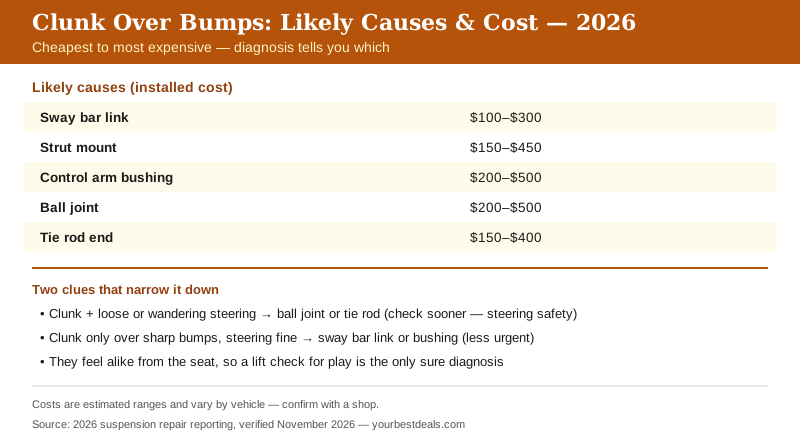
A clunk or knock when you go over bumps is almost always a worn suspension joint with play in it – most commonly a sway bar link, but it can also be a ball joint, a control arm bushing, a strut mount, or a tie rod end. The tricky part is that these all sound similar from the driver’s seat while ranging from about $100 for a sway bar link to $500 for a ball joint, so the noise alone won’t tell you the bill. The good news: a couple of clues narrow it down, and a shop confirms it in minutes by checking each joint for movement on a lift.
I chased a lot of these in eleven years under cars, and I’ll be honest – even a certified tech can get fooled by a clunk, because the sound travels through the frame and doesn’t come from where your ears say it does. That’s exactly why guessing at the cheapest part first is a bad bet. Let me walk through what’s usually behind it, how to tell the urgent version from the annoying-but-wait version, and what each fix costs.
The usual suspects, cheapest to most expensive
Most bump clunks come from one of five parts. A sway bar link is the most common and the cheapest – it connects the anti-roll bar to the suspension, and when its little joints wear, they rattle and clunk over bumps; figure $100 to $300 installed. A strut mount, the rubber-and-bearing piece at the top of a strut, clunks when it wears, often around $150 to $450. A control arm bushing, which cushions where the control arm meets the frame, knocks when it cracks or loosens, roughly $200 to $500.
Then come the two that also affect steering. A ball joint, the pivot that lets the wheel steer and move, clunks when worn and runs $200 to $500 – and a badly worn one is a safety concern because it’s holding the wheel to the car. A tie rod end, part of the steering linkage, can clunk and also make the steering feel loose, at $150 to $400. All these are estimated ranges that vary by vehicle, so treat them as ballparks and see the suspension guide for the full cost picture. The point is the spread: same noise, very different repair.
Two clues that narrow it down
You can’t diagnose it for certain from the seat, but two things help triage. First, pay attention to your steering. If the clunk comes with loose, wandering, or vague steering, suspect a ball joint or tie rod end – the parts that also hold or aim the wheel – and get it checked sooner, because those affect steering safety. If the steering feels totally normal and you only hear the clunk over sharp bumps and dips, it’s more likely a sway bar link or a bushing, which is less urgent though still worth fixing.
Second, notice when it happens. A clunk only over bumps, at low speed, points more at links, bushings, and mounts. A clunk plus a shudder through the wheel when braking can be a worn strut mount or ball joint. None of this replaces a proper inspection, but it tells you how fast to act. When in doubt, treat any suspension clunk paired with steering changes as the urgent kind and don’t drive on it longer than you have to.
What Gets Misdiagnosed
The classic error here is buying the cheapest part first because it’s the most common. Sway bar links are so often the cause that people just replace them, the clunk stays, and now they’ve spent money and still have the noise. Meanwhile the real culprit – a ball joint or a strut mount – sat there the whole time. The sound really travels, so even a good tech puts the car on a lift and physically checks each joint for play rather than trusting the ear. Pay for the ten-minute inspection and you buy the right part once.
The other misread is dismissing a clunk as “just the roads.” Worn suspension does clunk more on rough pavement, but the noise itself means a joint has developed play, and play only grows. On a ball joint especially, ignoring it risks the joint failing completely, which can let the wheel collapse outward – a genuine safety failure, not just a noise. So a clunk isn’t cosmetic. Get it identified, fix the part that’s actually worn, and don’t let a $200 joint become a tow and a bigger repair.
Shop Talk
Before you spend a dime, try this in a parking lot: with the car parked, grab the top of each front tire and rock it, then push down hard on each corner and listen. Real play or a clunk you can reproduce by hand helps a tech zero in fast, and it tells you the noise is a worn joint rather than something loose in the trunk. When you take it in, ask them to “check it on the lift for play” specifically – that inspection is usually cheap or free with the repair, and it’s what keeps you from paying for a sway bar link that was never the problem.
What the fixes cost
Here’s the rough installed cost for each likely cause, cheapest to most expensive. These are estimated ranges that vary by vehicle – a compact car’s parts cost far less than a truck’s.
| Part | Typical installed cost | Affects steering? |
|---|---|---|
| Sway bar link | $100–$300 | No – less urgent |
| Strut mount | $150–$450 | Indirectly |
| Tie rod end | $150–$400 | Yes – check sooner |
| Control arm bushing | $200–$500 | Somewhat |
| Ball joint | $200–$500 | Yes – safety concern |
For detailed estimates, see our cost pages for the sway bar link, tie rod, and ball joint.
The Real Number
A clunk over bumps is a worn suspension joint – usually a sway bar link ($100–$300), but possibly a strut mount, control arm bushing, tie rod end, or ball joint, up to about $500 installed, all estimated ranges. Don’t buy the cheapest part on a hunch; the sound travels, so pay for a lift inspection that checks each joint for play and buy the right part once. If the clunk comes with loose or wandering steering, treat it as urgent – that points at a ball joint or tie rod, which are steering-safety parts. A clunk only over sharp bumps with normal steering is less urgent but still worth fixing before the play grows.
Frequently Asked Questions
What is the most common cause of a clunking noise over bumps?
A worn sway bar link is the single most common cause, because its small joints take constant motion and wear out relatively early, then rattle and clunk over bumps. It’s also one of the cheaper fixes at roughly $100 to $300 installed. That said, “most common” doesn’t mean “always,” and a ball joint, control arm bushing, strut mount, or tie rod end can make an almost identical noise while costing more. Because the sound travels through the frame, a lift inspection is what confirms which part is actually worn rather than assuming it’s the link.
How do I know if it’s a ball joint or a sway bar link?
The biggest tell is your steering. A worn ball joint often comes with loose, vague, or wandering steering and can cause uneven tire wear, because it’s a pivot that helps aim and hold the wheel. A sway bar link usually clunks over bumps but leaves the steering feeling normal. A shop confirms it on a lift by grabbing the wheel and checking each joint for play, since the two can sound alike. Because a badly worn ball joint is a safety concern and a sway bar link isn’t, it’s worth getting the right answer rather than guessing – the ball joint also costs more.
Is it safe to drive with a clunking suspension?
It depends on the cause, which is why diagnosis matters. A clunk from a sway bar link is annoying but not an immediate danger, so you have time to schedule the fix. A clunk from a worn ball joint or tie rod end is different: those parts hold and steer the wheel, and a severe failure can let the wheel collapse or the steering go, which is a genuine safety failure. Since the noise alone won’t tell you which you have, treat any clunk paired with loose steering as urgent and get it inspected soon rather than driving on it.
How much does it cost to fix a clunking suspension?
It ranges from about $100 to $500 installed depending on the part, all estimated ranges that vary by vehicle. A sway bar link is roughly $100 to $300, a strut mount $150 to $450, a tie rod end $150 to $400, and a control arm bushing or ball joint $200 to $500. Because these overlap, the diagnosis is what sets your actual bill – replacing the wrong part means paying twice. A lift inspection to find the worn joint is usually cheap or included with the repair, and it’s the step that keeps the total honest. See our suspension cost guide for detail.
Can worn struts cause a clunking noise?
Yes, though it’s usually the strut mount at the top rather than the strut body itself. The mount is a rubber-and-bearing assembly that isolates the strut from the body, and when it wears it can knock over bumps and sometimes creak when you turn. That runs about $150 to $450 installed. A worn strut also rides bouncy and can shudder, so if you have a clunk plus a floaty ride, the strut assembly is worth checking. Since strut work needs an alignment afterward, factor a $70-to-$200 alignment into that repair. Our strut cost page covers it.
Why does the clunk only happen over bumps and not on smooth roads?
Because a worn joint with play only makes noise when it’s forced to move suddenly. On smooth pavement the suspension travels gently and the loose part stays quiet, but a bump or pothole jolts it, and the play lets the part knock against its mount or socket. That’s actually a useful diagnostic clue – a noise tied specifically to bumps points at a worn suspension joint rather than, say, an engine or exhaust issue. It doesn’t tell you which joint, but it confirms the family of problem. As the play grows, you’ll often start hearing it on rougher smooth roads too.
Should I replace sway bar links in pairs?
It’s usually a good idea, though not as critical as with struts. The left and right links wear at a similar rate, so if one has failed the other often isn’t far behind, and since much of the cost is the labor to get to them, doing both at once can save a second trip. Links are among the cheaper suspension parts, so the added cost of the pair is modest. If money is tight and only one is clearly worn, replacing the one is acceptable – just don’t be surprised if the other side clunks within a year and you’re back for it.
Sources
Clunk cause list and repair cost ranges verified against 2026 suspension repair reporting on November 5, 2026. Costs are estimated ranges that vary by vehicle; a shop diagnosis sets the actual figure.
- RepairPal – suspension component cost estimates, 2026
- CarParts.com – suspension parts and cost, 2026
- Car Treatments – suspension repair cost, 2026
Related Guides
- Car suspension: parts, wear signs, and cost
- How long should shock absorbers last?
- Ball joint replacement cost
- Tie rod replacement cost
- Sway bar replacement cost

Eddie Brennan spent 11 years as an ASE Master Certified technician at an independent shop in Columbus, OH, chasing more bump-clunks than he can count – his A4 Suspension & Steering certification covers exactly this diagnosis. He takes no referral fees and drives a 250,000-mile 2015 Subaru Outback and a 2020 Ford F-150.