
Last updated: November 8, 2026 – By Eddie Brennan
November 2026 update: reconfirmed the 50,000-to-100,000-mile lifespan, wear signs, and pair-replacement cost.
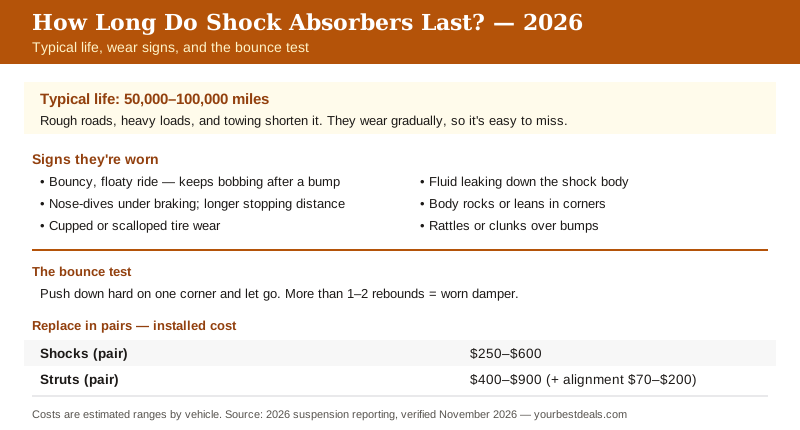
Most shock absorbers and struts last between 50,000 and 100,000 miles, with a common rule of thumb landing around 50,000 miles before they start to noticeably fade. There’s no hard expiration date, though – rough roads, potholes, heavy loads, and towing wear them faster, while gentle highway miles let them go longer. The catch is that shocks wear gradually, so the ride just slowly gets bouncier and you adapt without noticing. That’s why the mileage is a guideline, and the real answer comes from how the car actually rides and a quick hands-on check.
In the shop I saw plenty of cars at 80,000-plus miles on the original shocks whose owners swore the ride was “fine” – until they drove the car right after we replaced them and realized how floaty it had gotten. Because the decline is so slow, most people underestimate how worn their dampers are. Here’s how long to expect them to last, the signs they’re done, and the simple test you can do in your driveway.
What affects how long they last
The 50,000-to-100,000-mile range is wide because how and where you drive matters as much as the miles. Rough, potholed, or unpaved roads pound the dampers and shorten their life toward the low end. So does hauling heavy loads or towing regularly, which keeps the shocks working harder and hotter. Aggressive driving – hard cornering and braking – adds wear too. A car that lives on smooth highways with a light load can push toward the top of the range or beyond.
Quality of the part plays in as well. Premium shocks often outlast budget ones, and some heavy-duty or performance dampers are built for harder use. But no shock lasts forever, because inside is a piston moving through oil, and that oil and the seals degrade with every mile. Once the damping fluid breaks down or a seal starts leaking, the shock can’t control the spring properly anymore. So think of the mileage as a window to start paying attention, not a number that guarantees they’re fine until you hit it.
Signs your shocks are worn
The clearest sign is a bouncy, floaty ride – the car keeps bobbing after a bump or dip instead of settling in one clean motion. You’ll also feel it under braking, where the nose dives more than it used to, and under acceleration, where the rear squats. Worn shocks lengthen your stopping distance and let the body rock and lean in corners, which is a handling and safety issue, not just comfort. Some worn shocks or their mounts also rattle or clunk over bumps.
Two more give it away. Look at your tires: cupped or scalloped wear – patchy, wavy bald spots around the tread – is a classic sign the shock isn’t keeping the tire planted, so it bounces and scrubs. And look at the shocks themselves if you can see them; a shock that’s wet with oil, with fluid streaked down its body, has a leaking seal and is done. Any one of these is reason to have them checked. Together with the mileage, they tell you whether it’s time. For the fuller picture, see the suspension guide.
Shop Talk
Do the bounce test yourself before you pay anyone: push down hard on one corner of the car with your full weight, then let go. A healthy shock brings the corner back up and settles in one motion; a worn one keeps bobbing two or three times. Do all four corners and you’ll often feel one end worse than the other. It’s not a lab test, but it catches obviously tired shocks and gives you a real reason to ask for a replacement quote – or to push back if a shop says they’re shot and the car settles cleanly. Also, glance at the shock body for oil streaks; a leaking shock is a definite replace.
Why you replace them in pairs
Shocks and struts are replaced in pairs – both fronts or both rears – for the same reason tires are matched: the two sides wear at nearly the same rate, so a fresh damper on one side and a worn one on the other makes the car handle unevenly and can pull or wander under braking. A shop quoting the pair isn’t padding the bill; it’s keeping the car balanced. The exception is a single shock damaged by an impact while the other side is actually young and fine.
This is also why the mileage matters for planning. If your fronts are worn at 70,000 miles, the rears usually aren’t far behind, so some people do all four while the car’s apart to save on repeated labor. That’s a judgment call based on how worn the second pair is – no need to replace good parts, but if all four fail the bounce test, doing them together is efficient. Struts add one more wrinkle: because replacing them changes the wheel alignment, budget a $70-to-$200 alignment on top of strut work.
What Gets Misdiagnosed
The most common mistake isn’t a misdiagnosis so much as a non-diagnosis: people run worn shocks for years because nothing “breaks.” The ride degrades so slowly that it feels normal, and since a bad shock won’t strand you, it drops to the bottom of the priority list. Meanwhile the worn dampers are quietly cupping the tires and stretching the stopping distance. The fix is to actually check them at the mileage window rather than waiting for a failure that a shock doesn’t really produce.
The flip side is being told all four shocks are shot when they aren’t. Because “worn shocks” is a common upsell on a high-mileage car, it’s worth doing the bounce test and asking to see any oil leaks before agreeing to replace all four. If the car settles cleanly in one motion and the shocks are dry, they may have life left. Shocks are a judgment call on a gradient, not a pass-fail part, so a little skepticism and a hands-on check protect you from replacing parts that were still doing their job.
The Real Number
Expect shocks and struts to last 50,000 to 100,000 miles, sooner if you drive rough roads or tow. Because they fade gradually, use the signs – bouncy ride, nose-dive braking, cupped tires, oil-streaked shock bodies – and the bounce test rather than trusting the odometer alone. Replace them in pairs to keep handling even: figure roughly $250 to $600 for a pair of shocks and $400 to $900 for a pair of struts installed, plus a $70-to-$200 alignment after strut work, all estimated ranges by vehicle. Don’t run them worn for years – they don’t strand you, but they cup your tires and lengthen your stopping distance the whole time.
Frequently Asked Questions
How many miles do shock absorbers last?
Most shocks and struts last between 50,000 and 100,000 miles, with a common rule of thumb around 50,000 miles before they start to noticeably fade. The range is wide because driving conditions matter: rough roads, potholes, heavy loads, and towing shorten their life, while smooth highway miles extend it. There’s no hard expiration, since they wear gradually as the internal oil and seals degrade. Because of that slow decline, the mileage is a window to start checking rather than a guarantee. Use the ride quality and a bounce test to judge the actual condition.
What are the signs that shocks need to be replaced?
The main signs are a bouncy or floaty ride that keeps bobbing after bumps, nose-diving under braking, a longer stopping distance, and the body rocking or leaning in corners. Two visual signs seal it: cupped or scalloped tire wear, and oil streaked down the shock body from a leaking seal. Worn shocks can also rattle or clunk over bumps. Any one of these is reason to have them checked, and a leaking shock is a definite replacement. Because the decline is gradual, these signs are more reliable than the odometer for deciding it’s time.
How do I test if my shocks are worn?
The simplest check is the bounce test: push down hard on one corner of the car with your full weight, then let go and watch. A healthy shock brings the corner up and settles in a single motion; a worn one keeps bobbing two or three times before settling. Do all four corners, and you’ll often notice one end is worse. It’s not a precise measurement, but it reliably catches obviously worn shocks. Combine it with a look for oil leaks on the shock body and a check of your tires for cupped wear, and you’ll have a good read before paying for a diagnosis.
How much does it cost to replace shocks or struts?
As estimated installed ranges, a pair of shocks runs about $250 to $600 and a pair of struts about $400 to $900, with all four corners reaching $800 to $2,500 or more on some vehicles. Struts cost more because they’re a structural part and combine the damper with the spring support, and they require a $70-to-$200 alignment afterward. Parts vary a lot by vehicle, so a truck or luxury SUV sits well above a compact car. See our shock replacement cost and strut replacement cost pages for detail on your situation.
Do all four shocks need to be replaced at once?
Not necessarily, but they’re replaced in pairs – both fronts or both rears – because the two sides wear together and mismatched dampers make the car handle unevenly. Whether to do all four depends on how worn the second pair is: if your fronts fail at 70,000 miles, the rears are often close behind, so some people do all four to save on repeated labor, but there’s no need to replace good parts. The bounce test tells you which corners are worn. A shop should show you why any pair needs doing rather than simply replacing all four by default.
Is it dangerous to drive with worn shocks?
It won’t strand you, but worn shocks are a real safety compromise. They lengthen your stopping distance, let the car rock and lean in corners, reduce grip on rough roads and in emergency maneuvers, and can cause the tires to bounce and lose contact with the road. They also cup your tires, so waiting can add a tire bill to the shock job. Because the decline is gradual you may not notice how much control you’ve lost until the new shocks reveal it. If the ride is clearly bouncy or the car dives hard when braking, don’t put it off.
Do struts last as long as shocks?
Roughly, yes – struts fall in the same 50,000-to-100,000-mile window, since a strut is a shock absorber combined with a structural support and the damping element inside wears similarly. The difference is at replacement, not lifespan: struts cost more because they’re structural and hold part of the suspension geometry, and replacing them changes the wheel alignment, so you add a $70-to-$200 alignment. Many cars use struts in front and shocks in the rear, so you may deal with both. The wear signs and the bounce test apply to struts the same way they do to shocks.
Sources
Shock and strut lifespan and cost ranges verified against 2026 suspension reporting on November 8, 2026. Costs are estimated ranges that vary by vehicle; lifespan depends heavily on driving conditions.
- RepairPal – shock and strut replacement cost estimate, 2026
- CarParts.com – shocks and struts lifespan and cost, 2026
- SoFi – cost to replace shocks and struts, 2026
Related Guides
- Car suspension: parts, wear signs, and cost
- What causes a clunking noise over bumps?
- Shock replacement cost
- Strut replacement cost
- Tire rotation (worn shocks cup tires)

Eddie Brennan spent 11 years as an ASE Master Certified technician at an independent shop in Columbus, OH, where his A4 Suspension & Steering certification covered shocks, struts, and the tired dampers owners never noticed until they were replaced. He takes no referral fees and drives a 250,000-mile 2015 Subaru Outback and a 2020 Ford F-150.