
Last updated: November 10, 2026 – By Diane Holcomb
November 2026 update: reconfirmed per-pair shock pricing and the shock-vs-strut distinction.
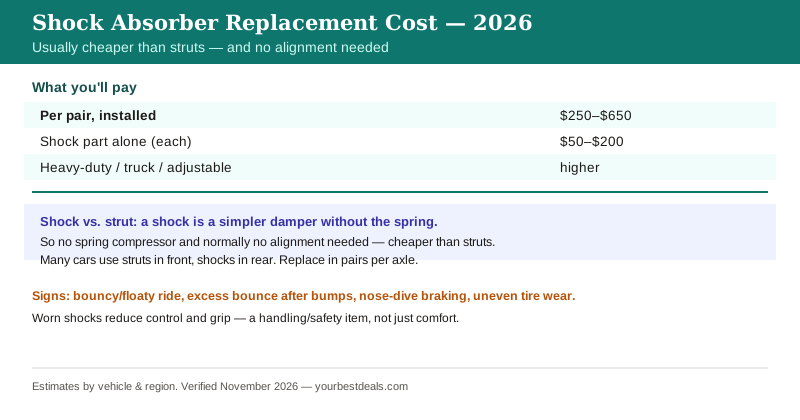
Shock absorbers cost about $250 to $650 per pair installed on most vehicles, with the shock part itself around $50 to $200 each and the rest labor. Shocks are usually cheaper than struts for a good reason: a shock is a simpler standalone damper that doesn’t carry the suspension spring, so unlike a strut, a shock replacement normally doesn’t require a spring compressor or a wheel alignment. Shocks are replaced in pairs per axle for even handling – most often the rears, since many modern cars use struts up front and shocks in back. Heavy-duty, truck, or adjustable shocks cost more. Worn shocks aren’t just a comfort issue: they reduce control and tire grip, making them a handling and safety item.
Shocks are the simpler, cheaper cousin of struts, and knowing the difference keeps you from overpaying or confusing the two jobs. Let me cover the cost, the shock-versus-strut distinction, and the signs you need them.
What you’ll actually pay
Here’s the price picture. These are estimated ranges that vary by vehicle and shop.
| Item | Cost | Notes |
|---|---|---|
| Per pair, installed | $250–$650 | Both on one axle |
| Shock part alone (each) | $50–$200 | Standard dampers |
| Heavy-duty / truck / adjustable | higher | Towing, off-road, performance |
| Alignment | not normally needed | Unlike struts |
Because a shock is just a damper (no spring, not a structural suspension member), replacing one is simpler and cheaper than a strut – no spring compressor and normally no alignment. Shocks are most often found on the rear of cars that use front struts, and on many trucks and SUVs all four corners may use shocks. Replace them in pairs per axle so both sides damp equally. Our strut cost guide covers the front/strut side, and the suspension guide the rest.
Shop Talk
Know whether your car uses shocks or struts at each corner, because it decides the cost and the job. A shock is a simple damper that bolts in at both ends; a strut is a bigger assembly that also holds the spring and is a structural part of the suspension. Many modern cars use struts in front and shocks in the rear, so a “my ride is bouncy” problem might be a cheap rear-shock job or a pricier front-strut job depending on which end is worn. The practical upshots: shocks don’t need a spring compressor (so no spring-transfer danger or labor) and normally don’t need an alignment, which is why a pair of shocks is usually a few hundred dollars versus a strut pair that can run four figures plus alignment. Replace shocks in pairs per axle so both sides damp evenly – a new shock paired with a tired one makes the car handle lopsided. And don’t dismiss worn shocks as just a comfort thing: shocks keep the tires planted on the road, so worn ones lengthen your braking distance and reduce grip in corners and over bumps, which is a genuine safety matter. The classic DIY check still works – push down hard on a corner of the car and let go; if it bounces more than once or twice before settling, that damper is worn.
Where Drivers Overpay
The main confusion that costs money is mixing up shocks and struts. They’re different parts at different prices, so paying strut prices (with alignment) for what’s actually a simple rear-shock job, or vice versa, means a wrong quote. Know which your car uses at the corner that’s worn: a rear-shock pair is usually a few hundred dollars with no alignment, while a front-strut pair is pricier and needs alignment. Ask the shop to confirm which part your vehicle has.
The flip side is ignoring worn shocks as “just comfort.” Because shocks keep the tires on the road, worn ones lengthen braking distance and reduce grip – a real safety issue – plus they cause cupped tire wear that shortens tire life. So they’re worth replacing when worn. Do them in pairs per axle (not one side), skip unnecessary premium/adjustable shocks for a normal commuter, and match the job to the right part. The pattern: identify shock vs. strut, replace in pairs, don’t overpay for performance shocks you don’t need, and don’t neglect really worn ones.
The Real Number
Shocks run $250 to $650 per pair installed – cheaper than struts, with no spring compressor and normally no alignment, because a shock doesn’t carry the spring. Replace them in pairs per axle (often the rears). Know whether your worn corner uses a shock or a strut, since that decides the cost. And treat worn shocks as a safety item, not just comfort – they keep the tires planted, so worn ones lengthen braking and cup your tires.
Frequently Asked Questions
How much does it cost to replace shocks?
About $250 to $650 per pair installed on most vehicles, with the shock part itself $50 to $200 each and the rest labor. Shocks are usually cheaper than struts because a shock is a simpler damper that doesn’t carry the spring, so there’s no spring compressor and normally no alignment needed. Heavy-duty, truck, or adjustable shocks cost more. Shocks are replaced in pairs per axle. These are estimates that vary by vehicle and shop. Confirm whether your car uses shocks or struts at the worn corner, since that changes the cost significantly.
Are shocks cheaper than struts?
Yes, usually noticeably cheaper. A shock is a simple standalone damper that doesn’t carry the suspension spring and isn’t a structural member, so replacing it is simpler – no spring compressor and normally no wheel alignment. A strut combines the damper with the spring and a load-bearing role, so it costs more (and requires an alignment). A shock pair is typically a few hundred dollars, while a strut pair can run four figures plus alignment. That’s why knowing which your car uses at the worn corner matters for the cost.
Do I need an alignment after replacing shocks?
Normally no. Because a shock is just a damper that bolts in at both ends and isn’t part of the alignment geometry (it doesn’t carry the spring or set wheel angles), replacing shocks doesn’t normally require a wheel alignment – unlike struts, which do. This is one reason shocks are cheaper to replace. There can be exceptions on some suspension designs, but for a typical shock replacement, an alignment isn’t part of the job. If a shop insists on charging for an alignment on a pure shock replacement, ask why your specific vehicle needs it.
Do shocks have to be replaced in pairs?
Yes, replace shocks in pairs on the same axle (both rears, or both fronts if your car uses front shocks). A new shock paired with a worn one on the other side makes the car damp and handle unevenly side-to-side, which affects stability and tire wear. Shocks on an axle also wear at a similar rate, so they’re usually due together. You don’t have to replace all four at once if only one axle is worn – front and rear wear differently – but within an axle, always do the pair for even, predictable handling.
What are the signs of worn shocks?
Common signs are a bouncy, floaty ride, excessive bouncing after hitting a bump (the car keeps oscillating instead of settling), nose-diving when braking or squatting when accelerating, reduced stability and more body roll in corners, clunks, and uneven or cupped tire wear. A simple check: push down hard on a corner of the car and release – if it bounces more than once or twice before settling, that shock is worn. Because worn shocks reduce tire grip and lengthen braking, they’re a safety issue worth addressing, not just a comfort complaint.
What’s the difference between a shock and a strut?
A shock absorber is a simple damper that controls bounce and bolts in at both ends, while a strut is a larger assembly that also holds the coil spring and serves as a structural part of the suspension. That difference drives the cost and the job: struts need a spring compressor (for bare cartridges) and a wheel alignment, making them pricier, while shocks need neither and are cheaper. Many cars use struts in front and shocks in the rear. Which your car has at each corner determines what the repair involves and costs, so confirm it before getting a quote.
How long do shocks last?
There’s no fixed interval, but shocks commonly last around 50,000 to 100,000 miles depending on road conditions, load, and driving style – rough roads, potholes, and heavy hauling wear them faster. They degrade gradually, so the ride and handling decline slowly enough that many drivers don’t notice until it’s significant. Having them inspected around 50,000 miles and beyond, or whenever you notice bouncing, nose-dive, or cupped tires, is the sensible approach. They’re replaced when worn or leaking, in pairs per axle, rather than on a strict schedule.
Sources
Price ranges verified against 2026 suspension-repair pricing in November 2026. Dollar amounts are estimates that vary by vehicle and shop.
- RepairPal – shock replacement estimates
- ASE – National Institute for Automotive Service Excellence
- NHTSA – vehicle safety
Related Guides
- Strut Replacement Cost
- How Long Should Shocks Last?
- What Causes a Clunking Noise Over Bumps?
- Suspension & Steering Guide
- Car Repair Cost Estimator

Diane Holcomb spent seven years as a service advisor at multi-brand dealerships in Charlotte, NC, where part of the job was explaining whether a bouncy ride meant cheap rear shocks or pricier front struts. She drives a 2019 Honda CR-V and a hand-me-down 2007 Toyota Camry, and takes no referral fees or advertising money from any shop or chain.